If you pulled the Five of Swords, you pulled the card of winning the wrong way. Fives are the suit's crisis point, and Swords are the suit of conflict and mind — so the Five of Swords is conflict at its most pointed: arguments, defeat, tension, and the particular bitterness of a victory that doesn't feel like one.
But the card's real meaning isn't in the winning. It's in the cost. The figure in the image has the swords — they "won" — and yet the scene is anything but triumphant. What the Five of Swords actually puts in front of you is a question, and it's an uncomfortable one: is this battle worth winning at all? Sometimes the strongest move the card points to isn't victory. It's walking away.
What the picture is showing
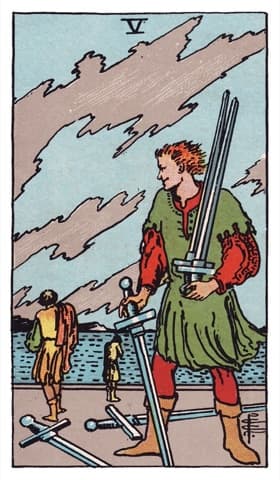
The Five of Swords shows a figure in the foreground gathering up swords, wearing a slight, self-satisfied smirk. Two other figures walk away in the background, shoulders slumped, heads down — defeated, retreating. The sky is jagged with windswept clouds. Five swords in all: three held or claimed by the victor, two abandoned on the ground.
Look at the mood, because it's doing the work. The "winner" has taken the field — and yet the whole image feels sour. The defeated walk off in dejection, the sky is troubled, and the victor's smile reads as smug rather than happy. This is a win that has cost something: relationships, goodwill, the moral high ground. The card deliberately stages victory and emptiness in the same frame.
That's the whole card. The Five of Swords is conflict and hollow victory — winning the fight in a way that loses something more important, and the question of whether the battle was worth it.
What the Five of Swords actually means
When this card appears, it's usually pointing at one of three things. All of them circle the gap between winning and being better off.
Conflict and tension
The most direct Five of Swords reading. An argument, a clash, a hostile or competitive situation, a falling-out. The card names open conflict — the kind with winners and losers — and the tension that comes with it. Wherever it lands, there's a fight in the picture.
Hollow victory — winning at a cost
This is the card's signature. The Five of Swords is the victory that doesn't satisfy: you won the argument but damaged the relationship, proved your point but pushed someone away, got your way but lost something quieter and more valuable. The win is real; so is the cost, and the cost is usually the larger of the two.
Defeat, resentment, and walking away
The card has two other figures, and sometimes you're one of them — on the losing side of a conflict, carrying defeat or resentment. Read from there, the Five of Swords can mark the sting of losing, the grudge that lingers, or the hard wisdom of retreating from a fight you can't win cleanly. Sometimes walking away is the move the card points to.
How to read the Five of Swords in love
In a love reading, the Five of Swords is a warning about how you fight. It points to conflict, arguments, and especially the kind of winning that costs the relationship — insisting on being right at the expense of being close, scoring points, or leaving a fight with your pride intact and your partner pushed further away. It can also mark lingering resentment, a grudge neither person will release, or a hollow "win" that left you both worse off.
It isn't, by itself, a card of the relationship ending — it's a card about the manner of the conflict. Its question is the medicine: is being right here worth what it's costing you? Often the Five of Swords is asking you to choose connection over victory — to put the sword down even though you could win. Reversed, it usually means exactly that turn: reconciliation, making amends, and the relief of choosing repair over being right.
How to read the Five of Swords in career
At work, the Five of Swords often points to conflict, office politics, or competition with a sharp edge — a clash with a colleague, a hostile environment, or a victory won through tactics that cost you allies and goodwill. It can mark winning a battle but losing standing, being on the receiving end of someone else's win-at-all-costs behavior, or a workplace where being right has become more important than getting along. Its counsel is to weigh the real cost of the fight: some professional battles are worth winning, but many aren't, and the Five of Swords is usually asking whether this is one you should walk away from rather than win ugly.
Reading this for a card you pulled?
Pull three cards free →The Five of Swords in combination
Five of Swords + Three of Swords
Conflict and the heartbreak it causes. The Five of Swords is the fight and its hollow victory; the Three of Swords is the sharp pain that follows. Together they describe a conflict that genuinely wounds — words said in a fight that can't be unsaid, a "win" that breaks a heart. A strong caution that the cost of this battle is real hurt, not just lost ground.
Five of Swords + Justice
Hollow victory meeting the question of what's fair. The Five of Swords is winning at a cost; Justice is truth, fairness, and consequence. Together they often press the moral question the Five raises: did you win fairly, or at the expense of what's right? Justice can mark a reckoning for a victory that wasn't clean — or the call to make the conflict fair before it goes further.
Five of Swords + Ten of Swords
Conflict escalating to its bitter end. The Five of Swords is the costly fight; the Ten of Swords is the painful conclusion. Together they can warn that a conflict pushed too far ends in real collapse — the hollow victory turning into a wound nobody recovers from cleanly. But the Ten's dawn applies: even here, the bottom of a conflict is where it can finally end.
Five of Swords + Nine of Swords
The fight and the sleepless aftermath. The Five of Swords is open conflict; the Nine of Swords is the anxiety and regret that keep you up afterward. Together they often describe winning (or losing) a battle and then lying awake over it — the guilt of a hollow victory, or the torment of a conflict unresolved. A pairing that asks whether the fight was worth the nights it's costing you.
How to read the Five of Swords by position
| Position | What the Five of Swords usually means |
|---|---|
| Past | A conflict or hollow victory that shaped you — a fight you won at a cost, or a defeat you carried, that taught you something about which battles are worth having. |
| Present | You may be in a conflict right now. The card asks the key question: is winning this worth what it's costing? Sometimes it points to victory; often it points to walking away. |
| Future | A conflict or competitive situation may be ahead. Forewarned, you can choose how to fight it — or whether to fight it at all — rather than stumble into a costly win. |
| Hopes / Fears | You may hope to win a conflict or fear being defeated in one — or, read deeper, fear becoming the smirking figure who wins and loses something more important in the process. |
When the Five of Swords is genuinely hard
A few honest notes, because this card lives in real conflict:
- When you're the one who got hurt. The Five of Swords isn't always you holding the swords. Sometimes you're the figure walking away defeated, and the card is naming a real loss — being beaten, treated unfairly, or pushed out of a fight you couldn't win. The card's comfort here is permission: walking away from an unwinnable or unfair fight isn't weakness, it's wisdom.
- When winning still feels necessary. Sometimes a battle genuinely needs to be fought — a boundary defended, an injustice resisted. The Five of Swords doesn't say "never fight." It says "count the cost first." If the fight is worth its price, the card isn't forbidding it; it's making sure you've looked at what you'll pay.
- When the resentment won't let go. The hardest version of this card is the grudge that outlives the fight — the win or loss you keep relitigating in your head. The Five of Swords reversed lives here, and its medicine is release: the conflict is over; the only thing still costing you is your grip on it.
The bigger reframe
The Five of Swords looks like a card about winning — someone has the swords, someone took the field. But the artist made the victory feel hollow on purpose: the sour smile, the dejected figures leaving, the troubled sky. The card isn't celebrating the win. It's holding up the cost of it and asking whether the trade was worth making.
That's the teaching, and it's more useful than it first appears: not every fight is worth winning, and some victories cost more than the loss would have. The Five of Swords puts a sword in your hand and a smirk on your face and then shows you the people walking away — so you can ask, before you swing, whether being right is worth being alone, whether this hill is worth the climb, and whether the strongest move on the board might actually be to set the sword down and walk off the field with your relationships intact.
If you've pulled the Five of Swords and there's a conflict in front of you, the free three-card draw on this site is built for exactly that. Pull two more cards around your Five of Swords: what the fight is really about, what winning it would cost, and whether it's a battle worth having at all.
Five swords, a hollow smile, two figures walking away. The card is just asking whether this is a fight worth winning — and reminding you that sometimes it isn't.
Pull three cards on the conflict you're facing → What the fight is really about. What winning would cost. Whether it's worth it.