If you pulled Justice and looked it up, you probably found a lot about fairness, legal matters, and "karma." Some of that holds. But the popular reading — be good and good things will come — is a comforting distortion of what this card actually does.
Justice isn't a reward system. It's a mirror. It's the card of cause and effect, of consequences arriving in exact proportion to what set them in motion — and of the honesty required to look at your part in that without flinching.
What the picture is showing
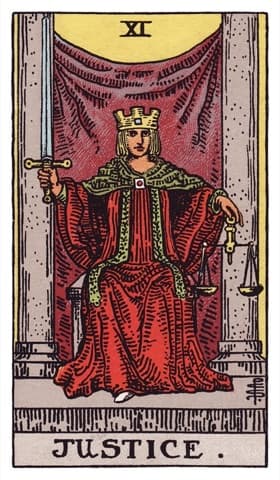
Justice shows a robed figure seated between two pillars, holding an upraised sword in one hand and a balanced scale in the other. The sword is double-edged and pointing up. The scales are even.
Every element is deliberate. The scales weigh — they measure what is, not what you wish were true. The sword is double-edged because truth cuts both ways: it judges others and you, with the same blade. It points up because clarity, not mercy, is what this card is made of. And the figure sits between pillars — at a threshold, a point of decision where one thing becomes the next.
That's the whole card. Justice is the moment where what you've done meets what happens next — measured exactly, with no thumb on the scale.
What Justice actually means
When this card appears, it's usually pointing at one of three things. Notice none of them are "you'll get what you deserve" in the wishful sense.
Consequences arriving
The most direct reading. Something set in motion — a choice, a pattern, a decision — is now producing its result. Justice draws when the effect of a cause is landing. Sometimes that's a reward you earned. Sometimes it's a bill coming due. The card doesn't take sides; it just balances the books.
A decision that must be made honestly
Justice often marks a genuine fork where the right choice requires you to be honest about facts you'd rather blur. The card asks you to weigh things as they actually are — not as you've been telling yourself they are. The sword cuts through the story.
Accountability — including your own
This is the uncomfortable edge. Justice frequently shows up to point at your part in a situation. Not to shame you, but to make you see it clearly. The card has no interest in who you'd like to blame. It only cares about what's actually true, and it includes you in the weighing.
How to read Justice in love
In a relationship reading, Justice usually means a moment of truth — fairness, honesty, and accountability between two people. Sometimes it's about balance being restored: a relationship finding equity after a period of imbalance. Sometimes it's a reckoning: the consequences of how someone has been treated finally being weighed. Often it's a call to be honest about your own contribution to where things stand.
Poorly aspected, Justice in love can point at imbalance unaddressed — one person carrying more than their share, or a truth being avoided to keep the peace. The card's medicine is the same either way: weigh it honestly, then act on what the scale actually shows.
How to read Justice in career
At work, Justice often relates to fair outcomes, decisions, contracts, or accountability. A situation where merit is finally being measured accurately. A negotiation that needs to be even. A choice that has to be made on the facts, not on politics or wishful thinking. If you've acted with integrity, Justice tends to confirm it lands. If corners were cut, the same card names the reckoning. And yes — it's also a literal card for legal and contractual matters, where the advice is always: get the details right.
Reading this for a card you pulled?
Pull three cards free →Justice in combination
Justice + The Chariot
Drive meeting consequence. The Chariot pushes forward forcefully; Justice weighs the result. Together they often mean a forceful decision is about to meet its outcome — and the reading asks whether you've steered fairly, not just successfully. A win taken dishonestly weighs differently on this scale.
Justice + Strength
Fairness meeting compassion. Strength steadies; Justice measures. Together they often describe handling a hard truth with both honesty and gentleness — being fair without being cold, accountable without being cruel. One of the more humane pairings for a difficult reckoning.
Justice + The Devil
A sharp pairing. The Devil is the trap you tell yourself you can't leave; Justice is the honest weighing of what staying actually costs. Together they often mean the moment of truth about a pattern — the scale showing you, plainly, the real price of the chain. The card's question becomes unavoidable here.
Justice + Death
Death is an ending; Justice is the accounting that comes with it. Together they often describe a chapter closing with consequences fully weighed — a fair, final reckoning. Not punitive, but complete. The books are balanced before the page turns.
How to read Justice by position
| Position | What Justice usually means |
|---|---|
| Past | A decision or action whose consequences shaped your current situation — a cause whose effect you're now living inside. |
| Present | A reckoning or choice is happening now. The card asks for honesty about the facts, including your own part. The scale is being read. |
| Future | Consequences are coming, in proportion to what's been set in motion. The card promises balance — which is good news or hard news depending on the cause. |
| Hopes / Fears | You hope for fairness, vindication, or balance restored, OR you fear being held accountable for something you haven't fully faced. |
When Justice is genuinely hard
A few honest cases where this card asks more than the tidy "fairness" reading suggests:
- When the world hasn't been fair to you. Justice as a card describes cause and effect, but real life is full of undeserved outcomes. Drawn after genuine injustice, the card isn't saying "you must have earned this." It's pointing at the next decision — what you do now, with clear eyes, given what's actually true.
- When the accountability is yours and you don't want it. The hardest Justice readings are the ones where the scale is weighing you. The card won't soften it. But it also isn't shaming you — it's offering the one thing that actually changes a pattern: seeing your part clearly enough to choose differently.
- When you want the card to take your side. Justice never does. It has no loyalty to your version of events. People who want vindication often get something more useful and less comfortable: an accurate measurement, which sometimes confirms them and sometimes doesn't.
The bigger reframe
Most people want Justice to mean "the good guys win and the bad guys get what's coming." But the card is colder and fairer than that. It doesn't reward virtue or punish vice on principle. It simply weighs — accurately, without mercy and without malice — and lets the result be what it is.
That's harder than the karma fantasy, and far more useful. Because the only part of the scale you control is what you put on it. Justice isn't promising the universe will be fair to you. It's reminding you that what you set in motion is being measured exactly — so set things in motion you'd be willing to see weighed.
If you've pulled Justice and there's a reckoning or a decision in front of you, the free three-card draw on this site is built for exactly that. Pull two more cards around your Justice card: what's being weighed, what your honest part in it is, and what the balanced choice actually looks like.
The scales don't lie, and the sword cuts both ways. The card just asks you to look at what's actually on the balance — including your own hand.
Pull three cards on what's being weighed → What set this in motion. Your honest part in it. The choice that balances the scale.