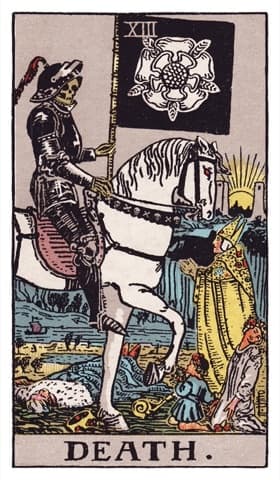
If you pulled the Death card and your stomach dropped, I want to slow that reaction down. The Death card is the most misread card in the entire tarot, and the misreading is so universal that it almost qualifies as the card's curse.
Death is not predicting your death. It's not predicting anyone's death. In thirty years of professional tarot reading I know of, no serious reader treats Death as a literal-death card — and the few amateur readers who do are wrong in a way that even the deck's original 1909 design rejects.
What Death actually says is more interesting than what people fear it says.
What the image is showing
Start with what's on the card. A skeletal figure in black armor rides a white horse across a battlefield. Beneath the horse's hooves: a fallen king, his crown rolling away. Standing before the rider: a bishop in robes, a young woman, a child. The bishop has his hands clasped in prayer. The woman has turned her face away. The child is reaching out with a flower.
In the background, two towers frame a rising sun. There's a ship sailing on a river behind them.
Notice what's not in the image: graves, hellfire, an executioner's blade aimed at the viewer. The card is not depicting death-as-event. It's depicting a procession — Death walking through, taking the king first (the highest status falls hardest), met with prayer, refusal, and a child's openness, with a sunrise behind it.
That sunrise is the whole interpretive key. Death isn't the end of the image. It's the moment between night and day.
What the Death card actually means
Death is the card of endings that make space for what comes next. Not "things changing" generically — the Eight of Cups handles that. Not "ego dissolution" abstractly — that's the Hanged Man. Death is specifically about a specific phase of your life finishing in a way that cannot be reversed.
What kinds of endings? Almost always one of these three:
1. A version of yourself that no longer fits
You've outgrown a job, a friend group, a belief, a way of moving through the world. The Death card draws when the version of you that fit that thing is the version that's actually dying. Nothing literal ends — you end, and a new you replaces you.
This is the most common Death reading and the most powerful. The card draws when you're already in the middle of becoming someone else and haven't fully admitted it.
2. A relationship in its current form
Not necessarily a breakup. Sometimes Death means the friendship-as-it-was is over, and what replaces it is either no relationship or a fundamentally different one. The same applies to marriages, business partnerships, mentor relationships, parent-child dynamics as you both age.
The relationship doesn't end. The version of it you've been operating inside of does.
3. A chapter you've been refusing to close
This is when Death feels harshest. You've known something needed to end for months or years. You've negotiated with yourself, made excuses, given it one more chance. Death drawn here is the card saying: the chapter is over whether you close it or not. Closing it consciously is just kinder to yourself than letting it close around you.
When this is the reading, Death is almost always a relief once you stop fighting it.
What Death does NOT mean
A few interpretations I want to push back on hard:
- "Someone is going to die." No. Tarot is not a forecast tool (more on this here), and even among predictive readers, this is considered a beginner mistake. The Death card has never been the literal-death card.
- "You're about to lose something." Sometimes, but the framing is wrong. Death isn't loss — it's a transition. Loss is what happens when an ending is forced on you. Death is what happens when an ending is the next chapter. Those feel different.
- "It's a warning." No. Death is descriptive, not prescriptive. It's naming the shape of where you already are, not warning you about a hypothetical future.
- "Reversed Death means you're avoiding change." This one is closer to true, but oversimplified. Reversed Death usually means an ending is being delayed or partially happened. Both true and useful, but not the same as "you're stuck."
How to read Death in different positions
The Death card means different things depending on where it sits in a spread.
| Position | What Death usually means |
|---|---|
| Past | An ending that already happened, that you may or may not have fully processed. Often shows up when grief work is still unfinished. |
| Present | You're inside an ending right now. The card is naming the moment, not predicting it. The work is to let the ending land. |
| Future | An ending is coming whether you want it or not — usually one you've been delaying. The card is asking whether you want to choose it or have it chosen for you. |
| Crossed by (in Celtic Cross) | A specific ending is the obstacle. You can't move forward without closing this chapter first. |
In a three-card past-present-future spread, Death in the present position is the most common — it tends to show up when you're in the middle of a transition that you came to the deck looking for clarity about.
Reading this for a card you pulled?
Pull three cards free →Death paired with other cards
A few common pairings worth knowing:
Death + The Tower
Two endings. The Tower is the sudden one (collapse you didn't see coming); Death is the slow one (transition you've been moving toward). Together: the sudden ending forces the slow transition to complete faster. Often shows up in readings about layoffs, breakups, or losses that catalyze a bigger life shift.
Death + The Sun
One of the most reassuring sequences in the deck. Death first, then Sun: the ending you're in is leading somewhere genuinely better, not just "different." If The Sun is in the future position after Death in the present, the spread is essentially saying: this is hard right now and the next chapter is worth it.
Death + Three of Swords
Different from Death alone. The ending here carries specific grief, often heartbreak-related. The combination is naming both the ending and the wound the ending caused. (More on the Three of Swords here.) The work is to grieve the wound, not just process the ending.
Death + Ten of Pentacles
Reads as "the end of a family chapter" or "the end of a financial era." Could be inheritance, retirement, the end of a long career, a family moving out of a home that defined a generation. Heavy but usually not tragic — more like the natural close of a long arc.
What to do when Death shows up
The actual work, by flavor:
| If Death is naming... | What helps |
|---|---|
| A version of yourself that no longer fits | Stop trying to revive the old version. The work isn't to be who you used to be; it's to recognize you've already changed. |
| A relationship in its current form | Have the conversation you've been avoiding. The relationship is already changing — you're just deciding whether to participate in how. |
| A chapter you've been refusing to close | Close it. Out loud, to one trusted person. The relief is usually immediate. The grief is usually shorter than you feared. |
Notice what's not on this list: "panic," "prepare for the worst," "wait it out." Death isn't a card to brace against. It's a card to cooperate with.
When Death is genuinely difficult
I don't want to oversell the "Death is freeing" reframe. Sometimes Death is genuinely hard, even when you understand it. A few honest cases:
- When the ending is involuntary. Job losses, breakups initiated by someone else, deaths of people you loved. Death drawn here isn't asking you to "embrace" anything — it's naming a fact you're going to have to live through. The work is mourning, not reframing.
- When you don't know what comes next. The Sun isn't always the next card. Sometimes Death is followed by the Hermit (long period of reflection) or even another major arcana that asks more of you. Endings don't always come with neat starts. The card doesn't promise the sunrise comes fast.
- When the ending shapes you in ways you didn't choose. Some Deaths leave you changed in directions you wouldn't have picked. The card doesn't pretend otherwise. The reframe isn't "it's all for the best" — it's "this is the shape your life is now taking, with or without your permission."
The Death card doesn't make endings painless. It makes them coherent. There's a difference, and the difference is most of why people who learn to read this card stop fearing it.
The bigger reframe
Almost every culture that uses tarot has the same observation: people fear the Death card more than the cards that name actual ongoing suffering. The Five of Pentacles is poverty. The Nine of Swords is anxiety. The Ten of Swords is being absolutely betrayed. Those are worse cards to pull, by most metrics. But people don't react to them the way they react to Death.
Why? Because Death is vivid. It looks scary. The image does work the words don't. And the word "death" itself activates a literal fear that the card was never about.
If you can sit with the Death card long enough to stop reading the cover and start reading the contents, you'll find one of the most generous cards in the deck. It marks the moments when life is asking you to finish something so the next thing can begin. That's not a curse. That's a gift most other cards can't give you.
If you've been sitting with a recent Death draw and want to see what comes next in your spread — what the ending is making space for — the free three-card reading on this site is built for exactly that. Pull two more cards around your Death card and read them as the arc you're inside. The skeleton on the horse isn't the destination. He's the doorway.
Pull three cards on your Death moment → What's ending. What's growing in the gap. What wants to take its place.