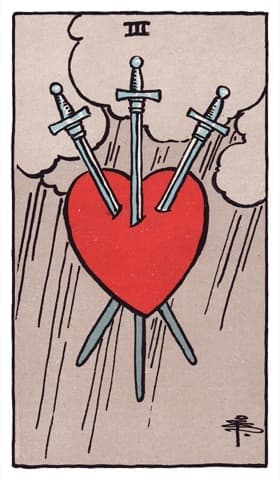
If you pulled the Three of Swords and the only thing you remember from the guidebook is "heartbreak," I want to slow that down. The Three of Swords is not just the heartbreak card. It's a much more specific image than that, and getting the specificity right changes what the card is actually telling you.
The image: a red heart with three swords driven straight through it, suspended in a grey sky, rain falling. No human figure. No setting. Just the heart, the swords, the weather.
That last part — no human figure — is the detail most readings skip, and it's the one that matters most.
What the picture is actually showing
Most Minor Arcana cards put a person in the scene doing something. The Three of Swords doesn't. You don't see who got hurt. You don't see who did the hurting. You don't see the relationship, the conversation, the betrayal. You just see the result: a heart, pierced cleanly, hanging in weather.
That's the whole interpretive key for this card.
The Three of Swords is not the card of what happened. It's the card of what's happening inside you right now because something happened. The swords are already in the heart. The damage is done. The question the card is asking is not "who did this?" or "why?" — it's "what is it like to be inside this pain right now?"
Three swords specifically, not one, not five. Three because heartbreak is rarely a single wound — there's the original loss, plus the way you found out, plus what it means about who you thought you were. Three layers. Three things to grieve. One pierced heart holding all of them at once.
When you read it that way, the card stops being a forecast ("heartbreak is coming") and starts being a mirror ("here is the shape of what you are carrying").
The three flavors of Three of Swords
In actual readings, the Three of Swords shows up in three pretty distinct contexts. The card looks the same; the meaning shifts based on which one you're in.
Flavor 1: Fresh wound
The most obvious one. Something just happened — a breakup, a betrayal, a friend who said the thing, a parent who didn't show up again, a coworker who took credit. The blood is wet. The swords are still being driven in. The card is naming what you already know: you are in acute pain right now and it is real.
In this flavor, the card is not asking anything of you. It's witnessing. The work is to let it witness — to not skip past the pain into productivity, fixes, or "everything happens for a reason." The Three of Swords drawn into a fresh wound is a card that says: yes, this is as bad as it feels. you're allowed to be in it.
Flavor 2: Old wound, still open
The more interesting flavor. Nothing new happened. The wound is months or years old. But the swords are still in there because you never actually pulled them out — you just got skilled at functioning around them.
This is the Three of Swords that shows up in readings about why you keep picking the same kind of partner, why you flinch when someone is kind to you, why you can't trust a particular friendship, why a sentence from ten years ago can still drop you. The pain is not present-tense in your life. It's permanent-tense in your nervous system.
In this flavor, the card is asking you to notice the swords are still there. Not necessarily to pull them out — that's a longer project, often with help — but to stop pretending they aren't.
Flavor 3: Anticipated wound
The third flavor is the trickiest, and the one most likely to be misread. The Three of Swords sometimes shows up when there is no actual heartbreak yet — just the bracing for one.
You haven't been hurt. You're rehearsing being hurt. You're keeping someone at arm's length because you've decided that if you let them close, the heartbreak will hurt more later. You're staying in the job another month because leaving means admitting you wasted three years on it. You're delaying the conversation because once you have it, the answer becomes real.
In this flavor, the swords aren't in the heart yet — but you've already accepted them as inevitable. The card is asking: are you sure? or are you flinching at a future that hasn't happened?
How to tell which flavor you pulled
A few diagnostic questions:
| Question | If yes → |
|---|---|
| Did something specific happen in the last few weeks that you're still raw about? | Flavor 1 (fresh wound) |
| Does the card feel like it's pointing at something old you'd rather not look at? | Flavor 2 (old wound) |
| Is there nothing you can name — but the card still feels accurate? | Flavor 3 (anticipated wound) |
If you got more than one yes, the card is doing what tarot cards often do — pointing at a layered situation. Fresh wounds often reopen old ones. Old wounds often shape the anticipations we carry forward. The Three of Swords sitting in a past-present-future spread is often the card showing you the through-line — the same shape of pain echoing across different decades of your life.
Reading this for a card you pulled?
Pull three cards free →What the card does NOT mean
A few interpretations I want to actively push back on:
- "Three of Swords means a love triangle." It doesn't. Some guidebooks list this as a meaning because of the number three. Three swords is not three people. It's three layers of one wound. Reading it as a triangle almost always sends the question in the wrong direction.
- "Three of Swords reversed means the heartbreak is over." This is the same mistake people make with reversed Tower — wishful thinking dressed up as interpretation. Reversed Three of Swords more often means the pain is being avoided, internalized, or delayed (similar to the patterns covered in the Tower reversed reading). It's rarely the pain being canceled.
- "Three of Swords is a warning to protect yourself." This is the Flavor 3 misread. The card is more often describing pain you're already in than predicting pain that's coming. Treating it as a forecast turns it into self-fulfilling caution.
The Three of Swords is descriptive, not predictive. It tells you the weather inside your chest. It does not tell you what to do about it.
What to do with a Three of Swords reading
Once you've identified the flavor, the useful next moves are pretty different:
| Flavor | What helps |
|---|---|
| Fresh wound | Permission to actually feel it. Cancel one thing this week. Don't talk yourself out of being sad. Don't perform recovery. |
| Old wound | Name the original event. Out loud or in writing. Not to fix it — just to stop pretending the swords aren't there. Talk therapy if you have access. |
| Anticipated wound | Ask: what am I assuming about how this ends? Is the assumption based on this person/situation, or on the last one? Often the answer is unflattering. |
What does not help, across all three flavors: trying to think your way out of it, rushing to lessons-learned, treating the pain as evidence that you're broken, or pulling more cards in hopes that the next one will be more comforting. The Three of Swords doesn't get reframed by a Three of Cups appearing two cards later. It gets witnessed.
When the Three of Swords is good news
Yes, sometimes it is. Not often, but sometimes.
When the Three of Swords appears in a reading about whether to leave a situation that's been quietly hurting you for years, it can be the card saying the cost of staying is the swords you're already carrying. Not a warning about leaving — an acknowledgment of what staying already costs. That reframe can be the thing that finally tips a stuck decision.
When it appears after a Major Arcana ending card (Death, Tower), it's often confirming that the pain you're in is the right pain — the pain of an actual ending, not the pain of avoiding one. That's a strange kind of comfort, but it's real comfort.
And when it appears in a reading about an old wound you've been working on, sometimes it's showing up to mark how far you've come — you used to carry this without being able to look at it; now you can look at the card without flinching. The swords are still there. But you're a different person standing in front of them.
The bigger reframe
The Three of Swords is one of the cards that taught me tarot is not a forecast tool — it's a reflective practice. You don't pull this card to learn what's about to happen. You pull it to learn the shape of what's already happening inside you that you may not have had words for yet.
That's why "heartbreak" as a one-word definition is so insufficient. The word is too generic to do the work. Which heartbreak. Whose heartbreak. When in the arc of the heartbreak. The card asks all of those. The guidebooks usually don't.
If you've been sitting with a Three of Swords from a recent draw and want to spread it out into more context — what came before, what's underneath, what comes next — the free three-card reading on this site is built for exactly that. Pull two more cards around your Three of Swords and read them as the story you're inside. The pierced heart is not the whole picture. It's the middle of one.
Pull three cards on the heartbreak you're inside → What hurt. What truth came with the hurt. What wants to grow from honest grief, not denial.