If you pulled The Tower reversed and the first thing you did was Google "tower reversed meaning" hoping it would tell you the disaster has been called off, I want to be honest with you up front: that's almost never what reversed means here.
The Tower is the card people fear most in the deck, with good reason. It depicts the moment a structure you depended on comes apart, lightning-fast, not on your timeline. Upright, that energy is at full volume. Reversed, the energy doesn't disappear — it changes shape. Sometimes for the better. Sometimes for the worse. Almost never to "nothing."
This is the article that walks you through which version of reversed you actually pulled, and what to do with it.
What The Tower upright actually means
To read the reversed version honestly, you have to understand the upright. Most short interpretations get The Tower wrong because they collapse it into "disaster." That misses what's actually being depicted.
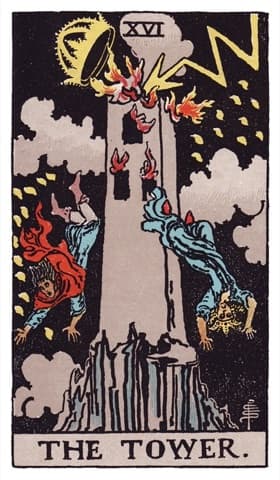
The image: a tall stone tower struck by lightning, two figures falling from it, crown blown off the top. What's being shown is not random catastrophe. It's a structure that was already wrong having its wrongness exposed all at once. The lightning is sudden; the rot was slow. The Tower is the moment the gap between what you'd built and what was true becomes impossible to ignore.
That's why The Tower keeps showing up in readings about relationships you knew weren't working, jobs you'd been quietly outgrowing, beliefs you'd been holding even though life kept contradicting them. The Tower doesn't create the problem. It ends the era of being able to pretend the problem isn't there.
When you read it that way — not "something bad happens" but "the truth that was hiding comes out fast" — the reversed reading becomes much clearer.
The three honest readings of The Tower reversed
When you flip The Tower upside down, what changes is the relationship to the collapse, not the collapse itself. There are three useful readings, and almost every reversed Tower you'll ever pull is one of them.
Reading 1: Delayed Tower — you saw it coming, you're putting it off
This is the most common reversed reading. The structure is still going to fall. You know it. Some part of you has known it for a while. You're just stalling.
The lightning hasn't struck because you've been quietly holding the tower up with both hands — managing, coping, performing, paying down emotional credit cards. The reversal is the universe asking: how much longer do you want to do this?
This is honestly the hardest reversed reading because nothing has visibly changed yet. The card is showing you a future you're trying to delay. If the upright Tower says "the collapse happened to you," the delayed reversed says "the collapse will happen if you don't choose first."
Reading 2: Internal Tower — the collapse is private, not public
The second reading: the structure that's coming apart isn't the visible one. From the outside, nothing looks wrong. Internally, something foundational has already given way — your belief in someone, your sense of who you are at work, the version of your relationship you'd been telling yourself.
This is a Tower that no one else sees. It's still real. It still ends an era. But you're going to live through it with everyone around you assuming you're fine. That gap — between what the world sees and what you're actually going through — is often the hardest part.
If you're someone who tends to keep your inner life private, reversed Towers are usually this one.
Reading 3: Tower you partially chose — controlled demolition
The third reading is the closest thing to "good news," and it's the rarest. The reversal means: you saw the structure was wrong, you decided to take it down yourself, on your timeline, with some of your dignity intact.
This is the version where the Tower comes down by your hand — you ended the relationship, you quit the job, you walked away from the belief system, you said the thing that couldn't be unsaid. The aftermath is still rubble. But you held the lighter. That changes everything about what comes next.
Most people who pull reversed Tower hope this is the reading. Usually it's Reading 1 or 2 first, and Reading 3 is what happens if you actually act on what Reading 1 was warning you about.
How to tell which one you pulled
A few diagnostic questions, in order:
- Is there something you've been quietly avoiding for months? If yes, you probably pulled Reading 1.
- Is there a story you tell other people about your life that you no longer believe yourself? If yes, probably Reading 2.
- Did you recently make a hard decision that's costing you something you cared about? If yes, probably Reading 3.
If multiple are yes — which is common — read the spread as overlapping. The Tower is rarely just one of these. It's often Reading 1 becoming Reading 3 if you finally make the call, or Reading 2 exposing into Reading 1 if the internal collapse stops being containable.
The position of the card in your spread matters too. In a three-card past-present-future layout (more on that here), reversed Tower in the past position usually means a collapse you've already partially processed but haven't fully integrated. In the present, you're inside one of the three readings right now. In the future, the spread is showing you what the current direction leads to if nothing changes.
Reading this for a card you pulled?
Pull three cards free →What to do when reversed Tower shows up
The temptation with reversed Tower is to read it as a reprieve and exhale. That's the most expensive mistake you can make with this card. A more useful response:
| Reading | What to do |
|---|---|
| Delayed Tower (Reading 1) | Name the thing you've been not naming. Out loud, in writing, to a friend. The point isn't to decide; the point is to stop pretending you don't know. |
| Internal Tower (Reading 2) | Find one person you can tell the actual story to. Not the version where you're fine. The one where you're not. Internal Towers metastasize when nobody is allowed to see them. |
| Chosen Tower (Reading 3) | Grieve. You did a hard thing. You're not a coward, you're not heartless, you're not behind on healing. The rubble is supposed to be there for a while. |
Notice what's not on this list: "make a big decision right now." Reversed Tower is a clarity card, not a verdict card. Like everything else in tarot, it's a reflection tool, not a forecast. The action it asks for is naming, not deciding.
When reversed Tower is misleading
A few situations where the reversed Tower has been over-interpreted:
- Small frustrations. If you pulled it about whether you'll have a bad day at work tomorrow, you didn't pull a Tower-level question. The card is overshooting the question. Pull again or, more honestly, sit with why you needed a tarot reading for that in the first place.
- Other people's collapses. Reversed Tower is about your structure, not someone else's. If you pulled it in a reading about whether someone you love is about to fall apart, the card is reflecting your fear, not their fate. The work is on your side of the spread.
- Already-fallen Towers. If a collapse already happened — a breakup, a layoff, a death — and reversed Tower shows up, it's usually not predicting a second collapse. It's the integration card. The structure is gone; you're now sitting in the aftermath. The work is grief and rebuilding, not bracing.
The bigger reframe
The reason The Tower reversed scares people more than the upright is that the upright is at least clear. Something collapsed. You know what happened. You're standing in rubble and the next steps, while hard, are at least visible.
Reversed Tower is foggier. You're either pre-collapse and trying to ignore the smell of smoke, or post-collapse but invisibly, or mid-collapse by your own design. None of those states give you the cleanness of "the worst already happened."
But that's also where reversed Tower is honest in a way upright Tower isn't. Upright Tower is what life does to you. Reversed Tower is what you do about it. That's the harder card. It's also the one that gives you agency back.
If you've been sitting with a reversed Tower from a recent draw and want to spread it out further — past, present, future — the free three-card reading on this site is built to do exactly that. Pull two more cards around your Tower and read them as an arc. The Tower isn't the whole story. It's one position in a longer one.
Pull three cards on what you're still propping up → What's wobbling. What you've been holding together. What wants to be let down so you can rebuild.