If you pulled The Devil and Googled "devil tarot card meaning," you've probably found two extremes: spooky-sounding takes about "evil energy" and "dark forces," or hand-wavy reframes like "it's just about temptation."
Neither is quite right. The Devil is one of the most psychologically honest cards in the deck, and reading it well means looking carefully at what's actually in the image — specifically at what's not there.
What the picture is showing
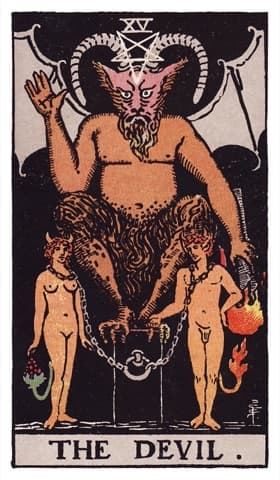
The Devil card depicts a horned figure (Baphomet-inspired) perched on a black altar. Below the altar, a naked man and woman are chained at the neck. They look like the Lovers card's couple — same figures, different scene. There's fire on the woman's tail. The Devil holds an inverted torch in one hand and a raised hand of "blessing" in the other.
Now look at the chains.
They're loose. The chains around the figures' necks are large enough to lift over their heads. Not locked. Not even tight. The two figures could walk away at any moment.
That's the whole reading. The Devil is the card of bondage you could break but don't. Not because something is forcing you to stay. Because staying feels easier than the discomfort of leaving.
What The Devil actually means
When this card appears, it's almost always pointing at one of three patterns. Notice none of them are about external evil — they're all about internal contracts.
Pattern 1: An attachment you call necessary
The thing you keep saying you can't live without. The job that drains you that you "have to" stay in. The relationship you've outgrown but "can't" leave. The substance, habit, or behavior you've told yourself is part of who you are.
The Devil draws when you've started using the word "can't" for things that are actually "won't" (or more honestly, "haven't decided to yet").
The card isn't judging you for the attachment. It's noticing that you've stopped seeing it as an attachment. It's become invisible — just "how things are." That invisibility is exactly what the loose chains depict.
Pattern 2: A pattern you keep recreating
The same kind of partner. The same kind of conflict at work. The same way you sabotage right when things are about to go well. The Devil shows up when you're caught in a loop you can see but can't seem to step out of.
This is the harder reading because there's no clear villain. You're not being kept in the pattern by anyone but you. Some part of you keeps choosing the trap because the trap is familiar, and familiar feels safer than unknown.
Pattern 3: A belief that's lying to you
You believe you're not enough. You believe nobody will love the real you. You believe success will cost you connection. You believe you have to earn rest. The Devil card sometimes shows up not as a behavior but as a belief — a story you've been telling yourself that's quietly running your whole life.
The belief isn't true. It feels true because you've been operating inside it long enough that you can't see around it. The Devil is the card pointing at the wall and saying that wall doesn't actually exist; you've just stopped trying the door.
The one honest question
Every Devil card reading boils down to a single question worth answering carefully:
What am I getting out of this that makes leaving harder than staying?
The card doesn't ask you to leave. It asks you to be honest about why you're not.
Some honest answers I've heard people land on:
- Leaving means admitting I was wrong about who I am.
- Staying lets me keep blaming someone else.
- I don't actually want the responsibility of choosing.
- I'm afraid the alternative will be worse and I won't be able to recover.
- Being miserable in something familiar is more comfortable than being uncertain in something new.
None of these are bad people answers. They're just real answers. The Devil's whole job is to surface them.
Once you can answer that question honestly, the Devil card has done its work. The next move is yours.
What The Devil does NOT mean
A few interpretations to push back on:
- "Someone's putting a curse on you." No. The Devil isn't about external malice — it's about internal contracts. The card consistently points inward.
- "Avoid temptation." Too small. The Devil isn't a warning sign — it's a mirror. Treating it as "avoid X" misses the deeper question of why you keep choosing X.
- "You're being controlled by dark forces." This frame is unhelpful at best and disempowering at worst. The chains in the image are loose for a reason: the card explicitly rejects the "I have no agency" reading.
- "Reversed Devil means you're free." Sometimes. More often reversed Devil means the moment of recognition — you're starting to see the chains. Recognition isn't the same as freedom, but it's the only thing freedom can grow out of.
Reading this for a card you pulled?
Pull three cards free →Devil paired with other cards
Devil + The Lovers
The most common Devil pairing in relationship readings. Lovers is conscious choice; Devil is the same energy turned compulsive. Together they often describe a relationship that started as a real connection and has become a habit you can't quite name. The work isn't necessarily to leave — it's to figure out which one of those (choice or compulsion) you're currently inside.
Devil + Eight of Cups
Eight of Cups is the card of walking away. Devil + Eight together usually means you've recognized the trap and you're working out the courage to actually leave. If they're in past/present/future order with Eight in the future, the spread is saying: the walking-away is coming.
Devil + The Tower
Two endings, but very different kinds. Devil is what you could end by choice; Tower is what ends whether you choose or not. Together they often describe a situation where you can choose to walk out now or wait for it to collapse around you. The card isn't subtle about which it recommends. (More on Tower-energy here.)
Devil + Three of Pentacles
An unusual pairing that shows up in career readings. The trap isn't the work itself — it's something about how you're approaching the work (often perfectionism, over-identification with the job, or staying in a role you've outgrown because the team needs you). The fix usually isn't quitting; it's renegotiating.
Devil + Death
Sometimes shows up when you're approaching a major ending and the Devil is the grip you have on the past that's keeping the ending from completing. The work is loosening the grip enough to let Death do its work. (Death card in depth here.)
How to read Devil by position
| Position | What Devil usually means |
|---|---|
| Past | A pattern that shaped you — a trap you've already escaped or are starting to see clearly in retrospect. |
| Present | You're in it. The chains are around your neck right now. The question is: are you ready to look at them? |
| Future | A pattern is forming that will trap you if you don't change course. Often the most actionable position. |
| Hopes / Fears | You fear becoming trapped, OR you secretly hope something stays the same so you don't have to grow. Either reading is uncomfortable. |
In the present position especially, The Devil is asking for stillness, not action. Not "do something." Just "see this clearly first."
When The Devil is genuinely hard
Some Devil readings are harder than others. A few honest cases:
- When the chain is real. Addiction, abusive relationships, financial dependency on someone harmful — these aren't "just" psychological traps. The Devil drawn in these contexts is naming a real prison, not a loose chain. The card still asks the same question, but the answer involves real-world resources (therapy, financial support, safe housing), not just insight.
- When the trap is generational. Family patterns, inherited beliefs about money/love/work that go back three generations. The Devil here is naming something bigger than you. Breaking the pattern in your life is the work, and it's often slow.
- When you recognize the trap and still can't leave. This is the most common honest reaction to a Devil card. Recognition doesn't equal freedom. Sometimes the card is just naming where you are, and the leaving is months or years of work after that.
The Devil isn't a card to "fix" in a single reading. It's a card to start a conversation that may take a long time to finish.
The bigger reframe
Most cards in the tarot have an arc — a problem, a question, a resolution. The Devil is unusual because it doesn't resolve in the card. The card just shows you the chain. What you do with that information happens off the card, in your life.
That's why this card scares people who read it superficially — they're waiting for the card to tell them what to do, and it never does. And it's why this card delights people who read it carefully — it's the most respectful card in the deck about your agency.
The Devil never says "you're trapped." It says "look at this. Now decide."
If you've pulled The Devil recently and you want to see the larger story — what's holding you in, what's pulling you out, what comes next — the free three-card draw on this site is built for exactly that. Pull two more cards around your Devil card. The pattern, the door, and the courage to walk through it tend to show up as a trio.
The chains are loose. They've always been loose. The card is just the moment you finally noticed.
Pull three cards on the chains you noticed → What's holding you. What you're getting out of it. What would change if you stepped out.