If you pulled the Ten of Swords, you pulled the suit's painful conclusion. Tens complete their suit, and Swords are the suit of mind, conflict, and hard truth — so the Ten of Swords is the end of all that struggle: a painful ending, rock bottom, the dramatic finish of a difficult cycle. It's one of the deck's heaviest-looking cards.
But there's a strange mercy hidden in it, and it's right there in the dawn breaking on the horizon. The Ten of Swords is the bottom — and the thing about the bottom is that there's nowhere lower to fall. The worst has already happened. What looks like the deck's most defeated card is also, quietly, the moment the only remaining direction is up.
What the picture is showing
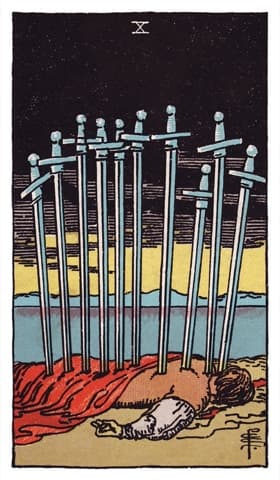
The Ten of Swords shows a figure lying face down, with ten swords stuck in their back. The sky above is black. But on the horizon, a golden dawn is breaking — the first light coming up beneath the darkness.
Look at how excessive it is. Ten swords — far more than needed. This is the card acknowledging that yes, this is dramatic, this is the worst, this is total. There's no pretending it's a minor wound. And yet, deliberately, the artist put a sunrise at the bottom of the image. The black sky is already lifting at the edge. The card stages its own despair fully and plants the dawn in the same frame.
That's the whole card. The Ten of Swords is rock bottom — a painful ending taken all the way to the floor, with the dawn already breaking because there's nowhere lower to go.
What the Ten of Swords actually means
When this card appears, it's usually pointing at one of three things. All of them are about an ending that has reached its absolute limit.
A painful ending
The most common Ten of Swords reading. Something is over — and it ended with real hurt. A relationship, a job, a chapter, a situation that collapsed rather than gently closed. The card doesn't soften the pain; it names that this was a hard finish.
Betrayal and being wounded
The swords are in the back, and the Ten of Swords often carries the specific sting of betrayal — being hurt by someone you trusted, stabbed in the back, or wounded in a way that feels like a final blow. It's the card of the worst kind of ending: the one you didn't see coming.
Rock bottom — and the turn
This is where the card surprises people. The Ten of Swords is the floor, and reaching the floor has its own brutal gift: it's over now, the worst is behind, and recovery can finally begin. The dawn in the image is not decoration — it's the card's actual message. Bottom is where the climb starts.
How to read the Ten of Swords in love
In a love reading, the Ten of Swords is one of the harder cards — it points to a painful ending: a breakup, a betrayal, the definitive close of a relationship. There's often real hurt, sometimes the specific pain of being let down by someone you trusted. It's not a gentle parting; it's an ending that lands hard.
But the card is specifically about an ending, not an ongoing wound — and that distinction is the mercy. The worst has happened; the situation has bottomed out. Drawn for love, the Ten of Swords often marks the close of something that genuinely needed to end, however much it hurt, and the dawn it carries is the real possibility of healing and a cleaner new beginning once the grief has run its course. Reversed, it leans fully into that recovery — surviving the heartbreak and slowly rising.
How to read the Ten of Swords in career
At work, the Ten of Swords can mean a painful professional ending — a job loss, a project's collapse, being undermined or betrayed by a colleague, or a career situation hitting its lowest point. It's a hard card to draw about work. But its core message holds: this is the bottom of a difficult cycle, not the start of one. The dramatic ending clears the ground, and what the card points toward is recovery, lessons learned the hard way, and a fresh start built on more solid footing. If it appears, it often signals that the painful part is concluding rather than beginning.
Reading this for a card you pulled?
Pull three cards free →The Ten of Swords in combination
Ten of Swords + Three of Swords
The suit's two cards of heartbreak together. The Three of Swords is the sharp pain of the wound; the Ten of Swords is that pain reaching its full conclusion and bottom. Together they describe a heartbreak taken all the way through — but read in sequence, they also trace the arc from wounding to ending to the dawn that follows. Heavy, but pointed toward the other side of grief.
Ten of Swords + Eight of Swords
A release from the trap. The Eight of Swords is feeling stuck and powerless; the Ten of Swords is the ending of the very thing that felt inescapable. Together they often describe a situation you felt trapped in finally collapsing — painful, but freeing. Sometimes the thing you couldn't see a way out of ends on its own, and the bottom becomes the exit.
Ten of Swords + Death
Two endings reinforcing each other — but with a strong upside. Death is transformation and necessary endings; the Ten of Swords is a painful conclusion. Together they emphatically signal that a chapter is fully, completely over — and that something genuinely new is meant to rise in its place. A powerful clearing, however hard the clearing was.
Ten of Swords + The Sun
The card's hidden dawn made explicit. The Ten of Swords is rock bottom with sunrise breaking; the Sun is full daylight, joy, and recovery. Together they strongly signal coming through the worst into genuine light — the climb up from the bottom completing into real happiness. One of the most hopeful pairings the Ten can land in.
How to read the Ten of Swords by position
| Position | What the Ten of Swords usually means |
|---|---|
| Past | A painful ending or rock-bottom moment that shaped you — something that collapsed hard, and that you've been recovering and rebuilding from since. |
| Present | You may be at the bottom right now. The card names the pain fully, then points to the dawn: the worst is here, which means the only way left is up. |
| Future | A difficult ending may be ahead — but framed as a conclusion to something, with recovery on the other side rather than ongoing decline. |
| Hopes / Fears | You fear a painful ending or betrayal, OR (read with the dawn) you hope to finally reach the end of a draining cycle and begin to recover. |
When the Ten of Swords is genuinely hard
A few honest notes, because this card lands in real pain:
- When the betrayal is fresh. If you're drawing this in the middle of being hurt, the talk of "dawn" can feel hollow. The card isn't rushing you past the pain — it's holding both at once: full acknowledgment of how bad it is, and the truth that this is an ending, not a permanent state. You're allowed to be at the bottom before you can feel the sunrise.
- When you can't believe it's the worst. Sometimes the fear is that the Ten of Swords isn't bottom — that it could get worse still. The card's reassurance is structural: ten swords is the maximum, the suit's completion, the floor of the floor. It's specifically the image of enough — the point past which there's no further down.
- When recovery feels impossible. Rising from rock bottom isn't a single triumphant moment; it's slow and unglamorous. The Ten of Swords reversed especially honors this: survival first, healing gradually, the dawn coming up by degrees. You don't have to leap into recovery. You just have to still be here when the light reaches you.
The bigger reframe
The Ten of Swords looks like the deck's bleakest card — and it doesn't flinch from the pain. Ten swords, a black sky, a figure on the ground. But the artist made a deliberate choice to break dawn at the bottom of that exact image, and that choice is the meaning. The card is not "everything is over and that's the end." It's "the worst has happened, and look — the light is already coming up underneath it."
That's the teaching, and it's oddly comforting once you see it: rock bottom is not a place you stay. It's the turning point. The Ten of Swords names the full weight of a painful ending and, in the same frame, promises the recovery on its other side. When there's nowhere lower to fall, the only thing left to do is rise — and the dawn in the picture says you will.
If you've pulled the Ten of Swords and something has ended hard, the free three-card draw on this site is built for exactly that. Pull two more cards around your Ten of Swords: what's truly over, what the bottom is clearing space for, and where your dawn begins.
Ten swords, a black sky, a breaking dawn. The card is just asking you to notice that the worst is behind you now — and that the light at the bottom of the picture is yours.
Pull three cards on the ending you're moving through → What's genuinely over. What rock bottom is clearing. Where your recovery starts.