If you pulled the Nine of Swords, you pulled the card of the 3am mind. Nines are nearly complete, and Swords are the suit of mind, thought, and mental conflict — so the Nine of Swords is that suit turned all the way toward torment: anxiety, dread, worry, the sleepless night where every fear gets louder in the dark.
But there's a detail in the image that changes everything about how to read it, and almost everyone misses it. The swords aren't piercing the figure. They're hanging on the wall behind them. The Nine of Swords is not a wound — it's the fear of one. The suffering is real, but it's mental anguish, not an actual blow landing. That single fact is the card's entire teaching: this is the suffering your mind makes, and minds exaggerate in the dark.
What the picture is showing
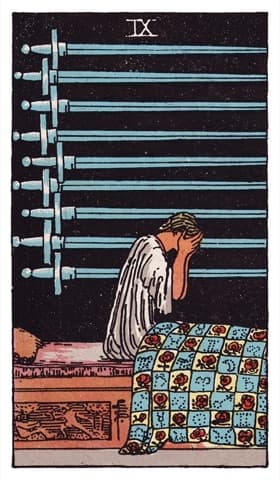
The Nine of Swords shows a person sitting up in bed, face in their hands, woken in the night by distress. Nine swords hang on the wall behind them. The bed's base is carved with a scene of struggle, and the blanket is patterned with roses and zodiac signs — small reminders of life going on beneath the panic.
Look at where the swords are. They're behind the figure, mounted on the wall — not stabbing, not touching the body at all. This is deliberate and it's the whole point. The Nine of Swords is the picture of waking at night in dread, the mind replaying fears and worst cases, while the actual swords — the real threats — just hang there, separate, not striking. The person is in genuine pain, but it's the pain of anticipation and fear, not of a wound.
That's the whole card. The Nine of Swords is anxiety in the dark — the suffering of a mind running its worst scenarios, while the feared blow hasn't actually fallen.
What the Nine of Swords actually means
When this card appears, it's usually pointing at one of three things. All of them live in the gap between what you fear and what is real.
Anxiety and sleepless nights
The most common Nine of Swords reading. Worry that won't switch off, the mind spinning at night, dread about something ahead. It's the card of lying awake while your thoughts run away with the worst version of events — the classic shape of anxiety taking over after dark.
Fear, guilt, and mental torment
The Nine of Swords often carries the specific weight of guilt, regret, or a fear you can't put down — replaying a mistake, dreading a consequence, or carrying mental anguish that feels heavier in isolation. It's suffering that lives in the head and grows when you face it alone.
Catastrophizing — fear outgrowing fact
This is the card's hidden message. Because the swords are on the wall and not in the body, the Nine of Swords very often marks fear that has outgrown reality — the 3am conviction that everything is ruined, which looks very different in daylight. The card names the torment honestly and quietly asks whether the feared thing is as real as it feels.
How to read the Nine of Swords in love
In a love reading, the Nine of Swords points to anxiety, worry, and fear inside a relationship — often more in your head than in your life. It can signal sleepless nights over a partner, fear of betrayal or loss, jealousy, insecurity, or relentless overthinking about where you actually stand. The mind builds scenarios and then suffers them as if they were already true.
The card's gift is the swords on the wall. Before acting on the dread, check whether it's real. Sometimes the Nine of Swords reflects a genuine problem you've been avoiding facing in daylight — but very often it's fear that has outgrown the facts, anxiety feeding on silence and the dark. Reversed, it usually means the worry is lifting, perspective returning, or the realization that the catastrophe you dreaded never came. Either way, the medicine is the same: bring the fear out of the 3am dark and check it against the actual situation.
How to read the Nine of Swords in career
At work, the Nine of Swords is the card of work stress and dread — anxiety about a deadline, fear of failure or being found out, sleepless nights over a job, or the mounting pressure that keeps you up worrying. It's mental rather than circumstantial: the situation may be manageable, but the fear around it has grown large. Its message is to separate the real problem from the catastrophized one. Name what you're actually afraid of, check whether it's as likely as it feels at midnight, and — crucially — stop carrying it alone, because this card's torment thrives in isolation and shrinks when spoken aloud.
Reading this for a card you pulled?
Pull three cards free →The Nine of Swords in combination
Nine of Swords + Eight of Swords
The trap and the dread that fills it. The Eight of Swords is feeling stuck and powerless; the Nine of Swords is the anxiety that floods in when you feel that trapped. Together they describe a mind convinced it's cornered and tormented by the conviction — but read with both cards' secrets (the Eight's loose bindings, the Nine's swords on the wall), they point to the same way out: the trap and the terror are both more mental than real.
Nine of Swords + Ten of Swords
Dread meeting the ending it feared. The Nine of Swords is the sleepless anticipation; the Ten of Swords is the painful conclusion arriving. Sometimes they describe fearing the worst and then living it — but the Ten carries a breaking dawn, so together they often trace the arc from dread, through the feared ending, to the relief on the other side. The thing you couldn't stop worrying about happens, and you survive it.
Nine of Swords + The Moon
Two cards of fear and illusion. The Nine of Swords is anxiety in the dark; the Moon is the realm of fears, dreams, and things that aren't what they seem. Together they strongly emphasize that what you're afraid of may be distorted — fear projected onto shadows, the mind making monsters in the dark. A powerful pairing for "check whether this is real before you suffer it."
Nine of Swords + The Star
The night and the relief after it. The Nine of Swords is the sleepless dark; the Star is hope, calm, and healing returning. Together they're one of the most reassuring sequences the Nine can land in: the anxiety passing, peace coming back, and the realization that even the worst nights end. The Star is the cool morning air after the fevered dark.
How to read the Nine of Swords by position
| Position | What the Nine of Swords usually means |
|---|---|
| Past | A period of anxiety, dread, or sleepless worry that shaped you — a hard mental stretch you've come through, often one where the fear proved larger than the reality. |
| Present | You may be caught in worry right now. The card names the torment honestly, then points to the swords on the wall: check whether the thing you dread has actually happened, or is fear running ahead of fact. |
| Future | A period of anxiety or worry may be ahead — but framed as a mental state to move through, not a fixed fate. Forewarned, you can meet it with perspective rather than panic. |
| Hopes / Fears | This is often a Fears card by nature: you dread a worst-case outcome. Read with its secret, it asks whether the fear is proportionate — and frequently answers no. |
When the Nine of Swords is genuinely hard
A few honest notes, because this card lands in real distress:
- When the anxiety is real and relentless. Sometimes "the swords are on the wall" can sound dismissive, as if the fear isn't valid. It is. The card isn't saying your suffering is fake — it's saying the suffering is mental, which is exactly why it's so hard and so loud. Naming it as anxiety rather than fact isn't minimizing it; it's the first step to loosening its grip.
- When you're carrying it alone. The Nine of Swords figure sits awake in the dark by themselves, and that isolation is half the torment. This card's most practical message is the least mystical one: say it out loud to someone. Fear spoken in daylight rarely keeps the size it had at 3am.
- When the fear is pointing at something real. Occasionally the dread isn't distortion — it's your mind insisting on a problem you've been refusing to face in the light. The Nine of Swords doesn't only mean "you're catastrophizing." Sometimes it means "look at the thing directly, in daylight, instead of letting it haunt the dark." The work is telling which one you're in.
The bigger reframe
The Nine of Swords looks like one of the deck's most tormented cards — a person woken in anguish, nine blades looming. And the pain is real; the card doesn't pretend otherwise. But the artist made one deliberate choice that reframes the whole image: the swords are on the wall. They are not in the body. Nothing has actually struck.
That's the teaching, and it's quietly liberating once you see it: most of what the Nine of Swords suffers is anticipation, not injury. The mind, alone and in the dark, builds the catastrophe and then lives inside it as though it were already true. The card's gift is to point at the gap — between the swords hanging on the wall and the figure that hasn't been touched — and ask you to notice it. The fear is real. Whether the thing you fear is real is a separate question, and a far more hopeful one.
If you've pulled the Nine of Swords and your mind has been running in the dark, the free three-card draw on this site is built for exactly that. Pull two more cards around your Nine of Swords: what you're actually afraid of, how much of it is real, and what daylight would show you.
Nine swords on the wall, a figure waking in the dark, and nothing actually piercing. The card is just asking you to notice that the blow you dread hasn't fallen — and may never.
Pull three cards on the fear that's keeping you up → What you're really afraid of. How much is real. What the morning would show.