If you pulled The Hermit and Googled "hermit tarot card meaning," the first results probably gave you something close to "solitude, introspection, soul-searching, take time for yourself." Vague enough to be useless, gentle enough to feel like a permission slip. The card is doing something much more specific.
The Hermit isn't telling you to take a bath and journal. It's telling you that you already know what you've been asking everyone else to tell you, and the work is to stop asking long enough to hear what's underneath.
What the picture is showing
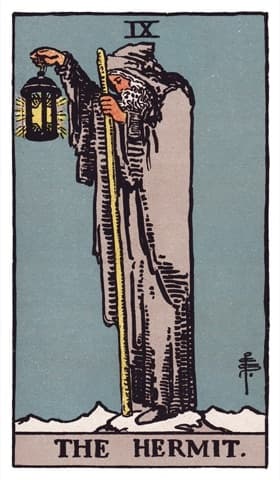
The Rider-Waite Hermit depicts an old, bearded figure standing alone on a snowy mountain peak. He's wrapped in a long gray robe with a deep hood pulled up. In his left hand he holds a wooden staff — the staff of a traveler who's been walking a long time. In his right hand, raised in front of him, is a lantern.
Inside the lantern is not a flame. It's a six-pointed star — the Seal of Solomon, a symbol of wisdom synthesizing opposites. The lantern is the only light in the picture; the mountain is dim, the sky is gray-blue, the ground is bare.
Notice three things:
The Hermit is standing still. He's not climbing higher. He's reached a high place and stopped.
The lantern is in front of him, raised slightly. He's not looking down at it. He's looking at where the light falls — not for himself, but lighting the way for whoever comes next.
The figure is alone, but not lost. There's no fear in his posture. He's settled. The solitude is chosen, not endured.
That's the whole reading. The Hermit is the card of the high place you climbed to, where you finally stopped, and where the light you carry is for whoever is climbing behind you.
What The Hermit actually means
When this card appears, it's almost always pointing at one of three patterns:
Pattern 1: You need to withdraw, not consult further
The most common Hermit reading. You've been processing something by talking to people — friends, family, your therapist, the internet, every podcast in your feed, every book that promised to explain. The Hermit shows up and the deck is gently suggesting that none of the next answer is going to come from outside.
This is the card of the conversation you keep having that never resolves anything. Of the next book that won't actually unlock the thing the last six didn't unlock. Of the friend's opinion you'll absorb and then immediately want to re-process with another friend. At some point, more input becomes noise.
The Hermit's instruction isn't to think harder. It's to stop adding input and let what's already in there settle. The mountain isn't a place you go to figure something out. It's a place you go to let the figuring-out finally happen.
Pattern 2: A chapter ended, and you haven't sat with it
The second Hermit reading is subtler. Something in your life finished — a job, a relationship, a project, a phase of parenting, an identity — and you've rushed straight into the next thing. The Hermit shows up because the previous chapter never got integrated.
The pattern is: you handled the ending logistically, you talked about it appropriately, you moved on. What you skipped was the slow private metabolism of what that chapter meant, what it cost, what it built in you that you can carry forward, what it ended in you that you have to grieve.
The Hermit doesn't show up to make you sad about the past. He shows up because the integration is the bridge to whatever's next, and you've been trying to cross the bridge without building it.
Pattern 3: You're being asked to share what you know
The third Hermit reading is the rarest and the most easily missed. Sometimes the card doesn't appear because you need to learn more. It appears because you've learned enough, and the next stage is to hold the lamp for someone else.
Notice that the Hermit isn't holding the lantern for himself. He's holding it out. He's at the top of the mountain — he's done the climb. The lamp is now positioned to light the path for whoever's coming up behind him.
This reading often shows up at career mid-points (the moment you're ready to mentor, teach, or write down what you've figured out), at later phases of parenting (when your role shifts from controlling to witnessing), and in spiritual or healing work (when you stop being the seeker and become available to others who are seeking).
The Hermit is the card of quiet authority. Not the loud kind, not the credential kind. The kind you earn by having actually walked the path.
The one honest question
Every Hermit card reading boils down to a single question worth answering carefully:
What do I already know that I keep trying to learn from someone else?
The card isn't asking you to become a know-it-all. It's asking you to notice the specific truth you've been outsourcing, and to admit that you've known it for a while.
Some honest answers people land on:
- I know I need to leave this job, and I've been asking everyone whether I should because I don't want to be the one to decide.
- I know what's wrong in this relationship, and I've been reading articles instead of having the conversation.
- I know what kind of work I want to do, and I've been taking more courses instead of doing it.
- I know what I need to forgive (myself, my parent, the past), and I've been processing it intellectually for a decade.
- I know I'm the expert in the room on this, and I keep deferring to people with more credentials and less experience.
The fifth one — deferring to credentials when you have the experience — is one of the most common things The Hermit surfaces in career readings. The lantern is in your hand. You've climbed the mountain. Stop pretending the answer is going to come from someone else's TED talk.
What The Hermit does NOT mean
A few interpretations to push back on:
- "You'll be alone forever." Almost never the right read. The Hermit's solitude is a chosen phase, not a permanent state. The card is about a specific period of withdrawal for a specific purpose — not a forecast about your relationship life.
- "Cut everyone off and become a recluse." The card supports withdrawal, not avoidance. There's a real difference. Withdrawal is going to the mountain on purpose to integrate what you've learned. Avoidance is hiding from people because you can't face what they'd reflect back.
- "You need to find a guru / teacher / mentor." Older interpretations sometimes read the Hermit as a seeker. He isn't. He's already arrived. The lantern is the wisdom he's carrying, not the light he's looking for. Don't read the card as a sign to enroll in another program.
- "Reversed Hermit means forced to socialize." Almost never the right read. Reversed Hermit usually means over-isolation that's stopped serving its purpose — hiding instead of integrating, using "I need my space" as a way to avoid hard conversations, spiritual bypass dressed up as wisdom-seeking. The fix isn't more parties; it's honest examination of what the isolation is protecting you from.
Reading this for a card you pulled?
Pull three cards free →Hermit paired with other cards
Hermit + The Star
The most healing-oriented Hermit pair. Star is hope and quiet renewal after collapse; Hermit is the integration that lets the hope actually take root. Together they often describe a post-difficult-period chapter where the work is slow inner rebuilding rather than dramatic new starts. (The Star in depth here.)
Hermit + The High Priestess
The two-modes-of-inner-knowing pair. High Priestess is the receptive intuitive knowing that arrives in stillness; Hermit is the synthesized wisdom you've earned through years of walking. Together they often describe a moment requiring both — the surface intuition that something is true, and the deeper wisdom that confirms it from lived experience. (The High Priestess in depth here.)
Hermit + The Hanged Man
A both-withdrawal pair. Hanged Man is being suspended in a situation you can't act in; Hermit is choosing the withdrawal deliberately. Together they often describe a transition from forced pause (Hanged Man) into chosen integration (Hermit) — the moment you stop fighting the suspension and start using it. (The Hanged Man in depth here.)
Hermit + The Fool
A whole-arc pair. Fool is the beginning (no map, willing to walk); Hermit is the end of that walk (the map is now in you). Together they often describe a complete cycle — the moment you realize you've actually become the kind of person who knows the territory, who was once the Fool stepping off the cliff. (The Fool in depth here.)
Hermit + Three of Pentacles
A diagnostic pair. Three of Pentacles is collaborative work; Hermit is solitary work. Together they often appear when a project is at a junction — should this stage be done in collaboration or in solitude? The card combination is asking you to honestly examine which mode the current task actually needs.
Hermit + The Devil
A diagnostic pair about withdrawal. Both involve being in a confined space. Hermit is chosen solitude that creates wisdom; Devil is bound isolation that creates suffering. Together they often appear when withdrawal has tipped from healthy into avoidant — when the mountain has become the prison, when "I need my space" has become "I can't let anyone close." (The Devil in depth here.)
Hermit + Nine of Cups
A solo-fulfillment pair. Nine of Cups is the satisfaction of having what you wanted; Hermit is the contentment of being alone with what you've learned. Together they often describe a person whose chosen solitude is a positive state, not a deprivation — quiet, settled, full in their own company.
How to read Hermit by position
| Position | What Hermit usually means |
|---|---|
| Past | A period of withdrawal or solitude that shaped who you are now. Often a chapter where you figured something out that no one else could have given you. |
| Present | You're in (or about to enter) a withdrawal phase. The work right now is internal, not relational. Stop seeking input. Start sitting with what's already there. |
| Future | A solo period is coming, often by choice but sometimes by circumstance. The card promises it will be productive if you treat it as integration rather than isolation. |
| Advice | Withdraw. Stop consulting. The answer is in you. The card is unambiguous here. |
| Hopes / Fears | You hope for quiet wisdom and the right to be the authority on your own life. You fear that going inward means losing connection, or that the light you're carrying isn't bright enough to count. |
When The Hermit is genuinely hard
Some Hermit readings are harder than others. Three honest cases:
- When you actually do need community, not solitude. The card has a strong gravitational pull toward "go inward," and sometimes that's exactly wrong. People in genuine isolation, depression, or grief sometimes need the opposite — to resist the Hermit's pull and intentionally reach out. The card isn't always prescriptive; sometimes it's diagnostic, naming a pattern you've been overusing rather than recommending more of it.
- When the withdrawal becomes avoidance. The Hermit and the avoidant introvert can look identical from the outside. The difference is internal: is the solitude building something (integration, wisdom, the next chapter)? Or is it protecting you from something (a conversation, a decision, a person, the truth)? Only you can answer honestly, and the card is asking the question.
- When you keep climbing the mountain and the answer doesn't come. Sometimes The Hermit shows up and you take the withdrawal, and the integration still doesn't happen — the truth is too big, the grief is too fresh, the chapter hasn't fully ended yet. The card's harder teaching is that the mountain is available to you, but the timeline of what gets revealed there isn't on your schedule.
The Hermit isn't a card to "use as an excuse." It's a card to take seriously enough to actually stop consulting, this week.
The bigger reframe
The Hermit is the ninth card of the Major Arcana, and the deck's most explicit answer to the modern condition of too much input. The card existed long before social media, but it's never been more useful. Every Hermit reading is, in some quiet way, the deck noticing that you've been outsourcing your inner life to feeds, conversations, and frameworks — and inviting you back to the only place wisdom actually lives, which is in you, after you've stopped looking outside.
What The Hermit is really teaching is that the lantern is yours and you've been holding it the whole time. The wisdom you've been seeking from gurus, books, partners, parents, podcasts — most of what you need is already in you, integrated quietly over years of living. The Hermit doesn't promise that solitude reveals anything new. He promises that solitude lets you finally hear what you've already known.
And the second teaching, harder to absorb: the light is for others, too. The Hermit at the top of the mountain isn't just for himself. He's the figure who's done the climb, and now his job is to hold the lamp where the next climbers can see it. There comes a point in any person's life where the most useful thing they can do is stop seeking and start carrying — not loudly, not as performance, but as quiet availability for whoever needs the light their walk has earned them.
If you've pulled The Hermit recently and want to sort out what to withdraw from, what to integrate, and what you've been knowing without admitting it — the free three-card draw on this site is built for exactly that. Pull a card for what you've been seeking outside, a card for what you actually already know, and a card for what the integration wants to look like.
The mountain is high. The lantern is lit. The Hermit is just the moment you stop climbing and finally raise the light.
Pull three cards to find what you already know → What you've been seeking outside. What you actually know already. What the integration wants to look like.