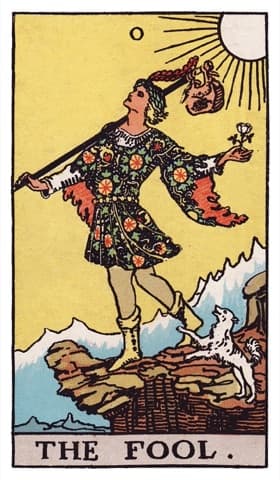
If you pulled The Fool and Googled "fool tarot card meaning," you probably found the two extremes: "new beginnings, fresh starts, exciting possibilities" (the optimistic version) and "recklessness, naivety, walking into trouble" (the cautionary version).
Both are partly right. Neither captures what the card actually is. The Fool is one of the most psychologically sophisticated cards in the deck — and the only one with the number zero, which matters more than people realize.
What the picture is showing
The Rider-Waite Fool depicts a young person stepping forward off the edge of a cliff. Look at the composition carefully:
The figure wears bright, almost flamboyant clothing — colorful tunic, feathered cap, patterned tights. They carry a small bundle on the end of a staff, slung over one shoulder. In the other hand, a single white rose.
A small white dog runs at their heels — sometimes read as a warning ("don't step!"), more often as a loyal companion celebrating the leap.
Behind them, snow-capped mountains stretch into the distance. Above, the sun shines at full brightness. The figure looks not down at the cliff edge but up — toward the horizon, the sky, the future.
The cliff is the obvious detail everyone notices. But notice what's not there: there's no panic in the figure's posture. No second-guessing. No checking the ground. They're not falling — they're stepping, with intention, into something they can't yet see.
That's the whole reading. The Fool is the card of stepping with full commitment into territory you can't yet see. Not because you don't know the cliff is there. Because you've decided the alternative — staying where you are — is the bigger risk.
What the zero means
The Fool is card 0 in the Major Arcana. Every other card has a number (Magician = 1, High Priestess = 2, and so on through The World = 21). The Fool's zero is doing a specific thing.
Zero in tarot represents pure potential — before anything has been chosen, narrowed, or shaped. The number signals that The Fool exists outside the sequence of the other cards. It's not the first card; it's the card that could become any of the other cards. The Magician's mastery, the Empress's abundance, the Hermit's solitude — all of them are paths the Fool could take.
This is why The Fool is often described as the protagonist of the entire Major Arcana, with the other 21 cards as the journey. Each card is something The Fool encounters and integrates. The Hermit is the Fool who learned to be alone. The Tower is the Fool whose certainty got destroyed. The World is the Fool who completed the cycle.
When The Fool appears in a reading, the card is reminding you: all of this — every other archetype, every other path — is still possible for you. You haven't been narrowed down yet. The leap is real because the destination genuinely isn't fixed.
What The Fool actually means
When this card appears, it's almost always pointing at one of three patterns:
Pattern 1: A real beginning is in front of you
The most common Fool reading. Not "something new is coming someday" — much more specific. The Fool shows up when a genuine threshold is in front of you, and the question is whether you'll cross it.
A new job, a new city, a new relationship, a new chapter of life, a creative project that requires putting yourself out there for the first time. The Fool isn't shown at the planning stage — that's the Magician. The Fool is shown at the stepping stage, the moment where you commit before you have evidence.
The card is asking: are you going to step or aren't you? And it's not patient about the question. The Fool's energy goes flat if you sit at the edge too long.
Pattern 2: A return to beginner's mind
The second Fool reading is subtler. Sometimes the card shows up when you've been doing something for a long time — a career, a relationship, a practice — and you've started reading from your accumulated experience instead of actually paying attention.
The Fool here is asking you to drop your expertise temporarily. Look at the situation as if you'd never seen it before. What would a beginner notice that you've stopped noticing? What questions would they ask that you've stopped asking?
This reading often shows up at midlife, during professional plateaus, or when a long-term relationship has gone quietly stale. The leap isn't to a new external thing — it's back to actually seeing what's in front of you.
Pattern 3: A reminder that the cliff is mostly imagined
The third Fool reading is the hardest to articulate. Sometimes the card shows up when you've been talking yourself out of something — building elaborate reasons why you can't do the thing you actually want to do.
The Fool gently points out: the cliff is mostly in your head. The risks you're imagining are larger than the actual risks. The certainty you're waiting for isn't coming. The "right moment" is already here and you keep refusing to recognize it.
This isn't permission to be reckless. It's permission to stop pre-failing. Most of what stops people from stepping isn't the actual cliff — it's the imagined cliffs they've built to justify not stepping.
The one honest question
Every Fool card reading boils down to a single question:
If I knew nothing about how this could go wrong, would I step?
The card isn't asking you to be naive. It's asking you to separate the genuine risks from the imagined ones — and to notice that you've often been confusing the two.
Some honest answers I've heard people land on:
- Yes, but I've been waiting for the "right time," which keeps not arriving.
- Yes, but I'm afraid of being judged by people whose opinions don't actually run my life.
- Yes, but I want a guarantee that doesn't exist for anything worth doing.
- No — and that's information. I've been pretending I want this when actually I don't.
The fourth answer is the one beginners often miss. The Fool can also reveal that you don't actually want to step, and the resistance you've been calling fear is honest no. The card doesn't push you in any direction; it just asks you to be honest about which it is.
Reading this for a card you pulled?
Pull three cards free →What The Fool does NOT mean
A few interpretations to push back on:
- "You're being foolish; don't do it." Almost never the right read. The Fool isn't a warning card. The character on the card isn't a fool in the modern English sense — they're a free agent, a beginner, a soul before commitment.
- "Reckless; consequences ahead." Sometimes, but the deck has clearer warning cards for this (Seven of Swords, Five of Pentacles). The Fool's energy is fundamentally generative, not cautionary.
- "You're naive about this situation." Occasionally. More often the card is saying you're not naive enough — you've over-thought, over-analyzed, and lost the directness of beginning.
- "Reversed Fool means hesitation." Sometimes. More often reversed Fool means a leap taken without genuine readiness — moving forward before you've actually committed internally, which usually produces a stumble. The card asks you to either fully commit or wait until you can.
Fool paired with other cards
Fool + The Magician
The classic "real beginning" pair. Fool is the willingness to step; Magician is the skill to execute once stepped. Together they often describe a new venture that has both the inspiration and the capability behind it — a strong combination.
Fool + Death
A surprising but powerful pair. Death is the ending that makes new beginnings possible; Fool is the beginning itself. Together they often describe a major life pivot where something has to end before the next chapter can start. The order matters: Death usually has to land before the Fool's leap is actually available. (Death card in depth here.)
Fool + The Tower
A hard but honest pair. Tower is sudden destruction (often unwanted); Fool is the radical beginning that follows. Together they often describe a situation where the old structure is collapsing and you're being asked to step into the unknown not by choice but by necessity. The Fool's energy is what gets you through it.
Fool + Two of Pentacles
The juggling pair. Two of Pentacles is the act of holding multiple commitments at once; Fool is the new commitment you're about to add. Together they often describe a moment where you're being asked to take on more than feels sustainable, and the card is testing whether you can hold the new while keeping the old in balance.
Fool + The World
The full-cycle pair, and the most thematically resonant. The Fool is card 0 (the beginning); The World is card 21 (the completion). Together they often describe a long arc finishing — you've completed something — and the card combination is saying you're now ready to begin again, with everything you learned this round informing the next.
Fool + Three of Swords
A painful pair. Three of Swords is heartbreak; Fool is starting over. Together they often describe a leap that comes with grief — a beginning that requires you to leave a loved version of your life behind. The card combination doesn't ask you to skip the grief; it asks you to step anyway. (Three of Swords here.)
How to read Fool by position
| Position | What Fool usually means |
|---|---|
| Past | A beginning that shaped your current path. Often a leap you took when you were younger that you're now reaping the results of. |
| Present | A real threshold is in front of you right now. The card is asking whether you'll step. |
| Future | A beginning is coming. Useful warning — you'll soon face a leap, so don't over-commit to the current path expecting it to last. |
| Advice | Step. The card is unambiguously pro-action in this position. |
| Hopes / Fears | You hope for a fresh start. You fear the responsibility of choosing one. |
When The Fool is genuinely hard
Some Fool readings are harder than others. Three honest cases:
- When the leap requires giving up something good. The hardest Fool readings aren't about leaving bad situations — those are easy to see clearly. They're about leaving good-enough situations for genuinely unknown ones. The card doesn't promise the unknown will be better. It just asks if "good enough" is the size of life you actually want.
- When you've been here before. Sometimes The Fool shows up for the third or fourth time in a year, and you realize you've been at this same cliff edge repeatedly without stepping. The card isn't gentle about this; it asks you to notice the pattern and decide whether you're going to break it or accept that you won't.
- When the cliff is real. Not every cliff is imagined. Sometimes The Fool shows up before a leap that genuinely won't work out, and the card is asking you to step anyway because the lesson is in the falling. This is a hard reading, but the deck does occasionally call for it — usually around early-career failures, first relationships, formative mistakes that teach more than caution could.
The Fool isn't a card to "be excited about." It's a card to step toward, eyes up, even when you can't see the next foothold.
The bigger reframe
Most cards in the tarot have a fixed meaning. The Fool is unusual because it's the card of meaning-not-yet-made. Everything else in the deck is a path the Fool could take. Every reading you do, in some sense, is The Fool checking in on which path you're currently walking.
That's why this card is the gateway to the rest of the Major Arcana. The Fool's leap is what makes any of the other 21 cards possible. Without the willingness to step into the unknown, none of the rest of the journey happens — there's no Magician without the choice to begin, no Death without the willingness to let things end, no World without the Fool's original commitment to start walking.
The Fool isn't asking you to be foolish. It's asking you to remember that you started as zero, and you can return to zero any time you need to begin again.
If you've pulled The Fool recently and want to see what's actually waiting on the other side of the leap, the free three-card draw on this site is built for exactly that. Pull a card for what the leap looks like, a card for what you'd be leaving, and a card for what wants to grow if you step.
The cliff is still there. The dog is still running beside you. The card is just the moment you remember that staying is also a choice — and not always the safer one.
Pull three cards on the leap in front of you → What you'd be leaving. What you'd be stepping into. What wants to be born from the choice.