If you pulled The Hanged Man and Googled "hanged man tarot card meaning," you probably found two opposing takes: "sacrifice, suffering, waiting in limbo" (the grim version) and "enlightenment, new perspective, spiritual awakening" (the sunny version).
Both are pointing at the same thing from different angles, and both miss the most useful part. The Hanged Man is not about suffering and not about transcendence. It's about what becomes available when you voluntarily stop struggling against a situation you can't currently change.
What the picture is showing
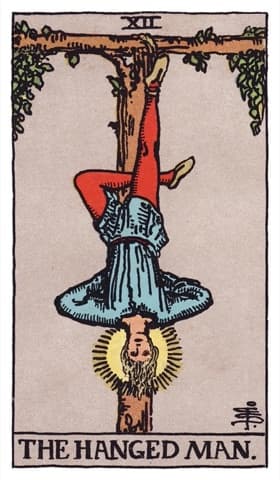
The Rider-Waite Hanged Man depicts a man suspended upside-down from a T-shaped wooden frame (often interpreted as a Tau cross or a living tree). His left leg is bent behind his right at a 90-degree angle, forming a figure-4 shape. His hands are behind his back.
But look more carefully at his face. He's not in pain. His expression is calm, even mildly serene. There's a golden halo around his head — the same kind that appears around saints in religious iconography. He's not being punished. He's there voluntarily, or at least at peace with being there.
And notice his hands. They're behind his back. He could untie himself or scream for help, but he's not. The pose is one of deliberate stillness inside a uncomfortable position.
The tree he hangs from is alive — green leaves still grow from its branches. This isn't a dead structure. It's a living moment of suspension.
That's the whole reading. The Hanged Man is the card of voluntary surrender to a situation you can't currently change, and the access to a completely different view that becomes possible because of it.
What The Hanged Man actually means
When this card appears, it's almost always pointing at one of three patterns:
Pattern 1: A situation you can't change, and the work is in how you relate to it
The most common Hanged Man reading. You're in a holding pattern. A job decision is out of your hands while you wait for someone else to move. A health issue requires waiting for recovery. A relationship is paused while the other person figures their stuff out. A creative project needs time to incubate.
You've been trying to push through, force a resolution, find a workaround. The Hanged Man shows up to say: the work isn't to escape the situation; the work is to be present in it differently.
That sounds soft. It's actually radical. Most of the suffering in a Hanged Man period comes from the struggle against the situation, not from the situation itself. Once you stop struggling, the experience of being in it changes substantially.
Pattern 2: A new perspective is available if you stop insisting on the old one
The second Hanged Man reading is about seeing. The figure is upside-down for a reason — the card is literally saying you'll see this situation differently if you let yourself look at it from the opposite angle.
This shows up when you've been convinced of one read on a situation for a long time, and the card is suggesting that the opposite read might be at least partly true. The relationship you've been calling unhealthy might be teaching you something you couldn't learn otherwise. The job you've been calling a waste might be exactly the right preparation for what's next. The setback you've been calling failure might be the redirect that saves you from a worse outcome.
The card isn't saying the original read is wrong. It's saying both reads are partly true, and your insistence on only one is what's keeping you stuck.
Pattern 3: A voluntary pause that goes against every instinct
The third Hanged Man reading is the hardest. Sometimes the card shows up when nothing external is forcing you to wait — and the deck is asking you to wait anyway, deliberately, against your impulse to act.
This is the Hanged Man's hardest mode. Action-oriented people feel waiting as weakness or laziness. The card insists it isn't. Some moves require ripening time that can't be shortcut. Some relationships need silence before the next conversation. Some careers need an unstructured pause before the next direction reveals itself.
This reading often shows up after major endings (a breakup, a job loss, a project completion) when you're tempted to jump straight into the next thing. The Hanged Man says: the next thing doesn't exist yet, and rushing toward it produces a worse version than waiting would.
The one honest question
Every Hanged Man card reading boils down to a single question worth answering carefully:
What would change if I stopped trying to escape this and let it be what it is?
The card isn't asking you to be passive. It's asking you to notice how much energy you've been spending on resistance — and to consider what becomes possible if you redirect that energy from struggle to presence.
Some honest answers people land on:
- I'd stop catastrophizing the waiting period and notice that life is actually fine right now.
- I'd see that this person isn't actually doing anything to me; I've been performing a story about them.
- I'd stop applying for jobs I don't want just to prove I'm "doing something" about being laid off.
- I'd let myself be uncertain instead of pretending to know what I want.
- I'd actually rest, instead of treating rest as failure.
The last one is the most common honest answer The Hanged Man surfaces. Most modern adults have completely lost the capacity to genuinely rest. The card is the deck's most direct invitation back.
What The Hanged Man does NOT mean
A few interpretations to push back on:
- "You're being punished / you have to suffer." No. The Hanged Man is voluntary. The figure isn't being held captive — he's stayed in the position on purpose. Reading the card as forced suffering misses the entire point.
- "Sacrifice — give something up." Sometimes this is part of the reading, but the card isn't really about sacrifice. It's about suspension — letting something be paused rather than rushed.
- "You're stuck and can't do anything." Wrong frame. You can do things — the card is saying that doing things right now would make it worse, and the most powerful move is voluntary stillness.
- "Reversed Hanged Man means you'll get free." Sometimes. More often reversed Hanged Man means you're struggling against the suspension — trying to force action that the moment doesn't actually support, often producing the worse outcomes the card was trying to prevent.
Reading this for a card you pulled?
Pull three cards free →Hanged Man paired with other cards
Hanged Man + Death
The two transformation cards together. Death is the ending; Hanged Man is the suspension between the old and the new where neither is fully real yet. Together they often describe a major transition where the old life is over but the new one hasn't begun, and the work is to live in the gap without rushing it. (Death card in depth here.)
Hanged Man + The Tower
A surprising but powerful pair. Tower is the sudden collapse; Hanged Man is what's required in the aftermath — voluntary stillness rather than reactive scrambling. Together they often describe the period after a major loss when the worst move is to rebuild quickly. (Tower in depth here.)
Hanged Man + Eight of Cups
A walking-away pair. Eight of Cups is the leaving; Hanged Man is the suspended period after leaving where the next direction isn't yet visible. Together they often describe a transition where you've ended something but haven't yet begun anything — and the card is saying that gap is the point, not a problem to solve.
Hanged Man + The Hermit
The two contemplative cards together. Hermit is active solitude with purpose; Hanged Man is more passive suspension. Together they often describe an extended period of inner work, where action would be premature and reflection is the actual job.
Hanged Man + The Fool
A complete-opposite pair. Fool is the leap forward; Hanged Man is the radical stop. Together they often describe a moment where you're being asked to choose between the two — and the card is rarely subtle about which. Usually it's not the leap. (The Fool here.)
Hanged Man + Two of Swords
A diagnostic pair. Both involve a kind of stillness. Two of Swords is avoidant stillness — refusing to look. Hanged Man is receptive stillness — looking, but not yet acting. Together they often appear when you've been confusing one with the other.
How to read Hanged Man by position
| Position | What Hanged Man usually means |
|---|---|
| Past | A period of waiting that taught you something action wouldn't have. Often a chapter you originally resented and now value. |
| Present | You're in the suspended moment. The card is asking you to stop trying to escape it and start being present in it instead. |
| Future | A pause is coming. Useful warning — prepare to not over-schedule, not chase the next thing, leave room for incubation. |
| Advice | Wait. Suspend action. Look at it upside-down. The card is unambiguously pro-stillness here. |
| Hopes / Fears | You hope to be released from the holding pattern. You fear that the pause means something is wrong with you. |
When The Hanged Man is genuinely hard
Some Hanged Man readings are harder than others. Three honest cases:
- When the situation really is intolerable. Some Hanged Man situations are actually too painful to sit in (chronic abuse, severe illness without treatment, financial crisis with no buffer). The card isn't asking you to suffer endlessly. It's asking you to distinguish between situations where the waiting itself is the work, and situations where the exit is the work but it's not yet clear how.
- When waiting feels like wasting your life. The Hanged Man is hardest for people who measure self-worth by productivity. If you're in your mid-30s, in a forced pause, and watching others advance while you wait — the card requires you to renegotiate your relationship with productivity itself. That's slow work.
- When you've been waiting too long. Sometimes the card shows up as a warning — you've been in Hanged Man mode for so long that it's become avoidance, not surrender. The distinction is whether real movement would now be possible. If yes, the card is asking you to step out of the suspension. If no, stay.
The Hanged Man isn't a card to "get past." It's a card to learn from, often slowly.
The bigger reframe
The modern world has almost no good vocabulary for what The Hanged Man asks. "Be still." "Stop trying." "Wait." These read as weakness, defeat, depression. The card pushes back.
In older spiritual traditions, this kind of voluntary suspension was central — fasting, retreat, vigil, contemplative practice, the Buddhist concept of equanimity, the Christian Sabbath, the Jewish shmita. All cultures have a name for the deep wisdom of deliberately not doing. We've largely forgotten ours.
The Hanged Man is the card that remembers. He's not stuck. He's not suffering. He's not waiting to be rescued. He's chosen the position and is letting the position do its work on him.
If you've pulled The Hanged Man recently and want to see what you've been trying to escape, what the situation might look like upside-down, and what becomes possible if you stop struggling, the free three-card draw on this site is built for exactly that kind of inquiry.
The frame is still there. The halo is still around his head. The card is just the moment you finally stop trying to climb down and start looking at the world from where you actually are.
Pull three cards from inside the pause → What you've been trying to escape. What the situation looks like upside-down. What becomes possible when you stop struggling.