If you pulled Temperance and looked it up, you probably found a string of mild words: moderation, balance, patience. All technically true, all completely missing the point. Temperance is one of the quietest cards in the deck, and quiet gets mistaken for boring.
It isn't boring. Temperance is the card of alchemy — the slow, deliberate blending of things that don't obviously go together into something that didn't exist before. That's not "everything in moderation." That's patient, skilled, deeply intentional work. And it's hard precisely because it can't be rushed.
What the picture is showing
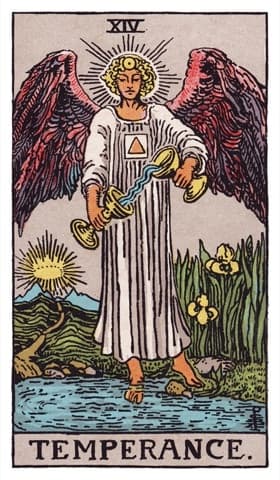
Temperance shows a winged angel standing with one foot on land and one foot in water, pouring liquid between two cups. The stream flows between them at an angle that shouldn't work by gravity. On the path behind, a road leads up to a crown of light between two mountains.
Look at the details. One foot on land, one in water — the conscious world and the unconscious, held at once. The two cups with liquid flowing between them — not one poured into the other, but a continuous exchange, back and forth, mixing. The angle of the stream defies physics, which is the card telling you this is not ordinary mixing; it's alchemy, the making of something greater than its parts.
That's the whole card. Temperance is the art of combining opposites — not compromising between them, but blending them into a third thing.
What Temperance actually means
When this card appears, it's usually pointing at one of three things. Notice none of them are "do everything in moderation."
Patient blending instead of forcing
The most common Temperance reading. Two things in your life are being combined — two needs, two people, two parts of yourself — and the card is saying the work is slow, careful mixing, not a forced merger. You can't rush this. The liquid has to flow back and forth until it becomes one thing.
Finding the third option
Temperance often draws when you're stuck between two choices and the card is hinting there's a way to blend them rather than pick. Not compromise (which loses something from each), but synthesis (which makes something new). The middle path here isn't lukewarm — it's a genuine third way.
Healing through time and balance
Temperance is also a card of recovery and integration — emotional, physical, situational. After upheaval (it often follows Death or the Tower), Temperance is the slow re-balancing, the body and mind knitting back together. The work is patience.
How to read Temperance in love
In a relationship reading, Temperance is one of the most reassuring cards in the deck. It usually means harmony built slowly — two people blending their lives, their differences, their rhythms into something that works. Patience, give-and-take, the daily small adjustments that real partnership runs on. If a relationship has been turbulent, Temperance is the calming after, the finding of a sustainable middle.
Poorly aspected, Temperance in love can mean imbalance — one person pouring more than the other, or a relationship that needs patience you're not giving it. The medicine is the same: slow down, let it blend, stop forcing the mix.
How to read Temperance in career
At work, Temperance often points at integration and pacing — combining skills, balancing competing demands, finding a sustainable rhythm rather than burning hot and crashing. It's a strong card for collaboration (blending different people's strengths) and for the long game (steady progress over dramatic sprints). If you've been operating at extremes — overwork then collapse — Temperance is naming the moderate, sustainable middle as the actual path forward.
Reading this for a card you pulled?
Pull three cards free →Temperance in combination
Temperance + Death
A natural and powerful sequence — they sit next to each other in the Major Arcana for a reason. Death is the ending; Temperance is the patient re-integration that follows. Together they often describe healing after a loss or transformation — not rushing back to normal, but slowly blending the old life and the new reality into something whole. One of the most hopeful pairings for a hard transition.
Temperance + The Tower
The Tower is sudden collapse; Temperance is the slow rebuilding from the rubble. Together they often mean: the disruption already happened, and now comes the patient work of re-balancing. Temperance after the Tower is the deck reassuring you that the chaos resolves — gradually, through deliberate blending, not all at once.
Temperance + Strength
Two cards of quiet inner work. Strength is the calm hand on the wild thing; Temperance is the patient blending of opposites. Together they describe someone doing deep, unglamorous self-integration — meeting their own extremes with both gentleness and patience. Slow, internal, real.
Temperance + The Devil
A pointed pairing. The Devil is the extreme — the compulsion, the all-or-nothing grip. Temperance is the antidote: moderation, balance, the slow loosening of the chain through patient re-balancing rather than dramatic willpower. Together they often mean the way out of a trap is gradual and steady, not a single heroic break.
How to read Temperance by position
| Position | What Temperance usually means |
|---|---|
| Past | A period of patient blending or healing that brought you to balance — slow work that paid off. |
| Present | Something is being combined or healed right now, and the card is saying: don't rush it. Let the liquid flow back and forth. |
| Future | Balance and integration are coming, but through patience, not speed. The card promises synthesis if you let it take its time. |
| Hopes / Fears | You hope to find harmony or a third way through a tension, OR you fear the slow patience it'll take to get there. |
When Temperance is genuinely hard
A few honest cases where this gentle-looking card asks more than it seems:
- When you're out of patience. Temperance's whole medicine is time, and sometimes you've run out — you need the thing resolved now, and the card is asking for slowness you don't have. The honest read isn't "be more patient" as a scold; it's naming that the rushing itself is what keeps the blend from setting.
- When the two things genuinely don't blend. Not every pair of opposites can be alchemized. Sometimes Temperance shows up for a situation where you keep trying to find a third way that isn't there, and the harder truth is that one of the two has to be chosen, not blended. The card's patience can become avoidance if you're using "finding balance" to dodge a real decision.
- When balance looks like numbness. Temperance is calm, but calm taken too far becomes flatness — avoiding all extremes including the good ones. Read alongside cards of passion or action, Temperance can be a caution that you've over-moderated yourself into not feeling much at all.
The bigger reframe
Temperance is the card people skip past because it doesn't shout. There's no drama, no warning, no obvious gift. Just an angel patiently pouring water between two cups. But that quiet image holds one of the deck's deepest teachings: the most valuable things are made slowly, by combining what doesn't obviously fit, with patience most people don't have.
That's harder than moderation. Moderation is just "less." Temperance is alchemy — the deliberate making of a third thing from two, and the willingness to let it take exactly as long as it takes.
If you've pulled Temperance and there's something in your life that needs blending rather than forcing, the free three-card draw on this site is built for exactly that. Pull two more cards around your Temperance card: what two things are being combined, what the patient path looks like, and what the third thing wants to become.
The angel never hurries. The water flows at its own angle. That's the card's whole quiet secret.
Pull three cards on what's being blended → The two opposites in play. The patient path between them. The third thing they could become.