If you pulled the Knight of Swords, you pulled the deck's card of the charge. Knights are action — the suit's energy in motion — and Swords are intellect, ambition, and force of will. So the Knight of Swords is pure mental drive turned into speed: the headlong rush toward a goal, the courage to act fast, the brilliant, reckless momentum of someone who has decided and is already moving.
It's one of the fastest, most forceful cards in the deck. At its best, the Knight of Swords is bold, decisive, and unstoppable — the person who cuts through hesitation and just goes. At its worst, that same speed becomes recklessness: charging before thinking, steamrolling everything in the way, arriving in a storm and leaving just as fast. The card usually shows up when something demands action, or when you (or someone near you) are moving so fast that the question becomes whether you're aimed at the right thing.
What the picture is showing
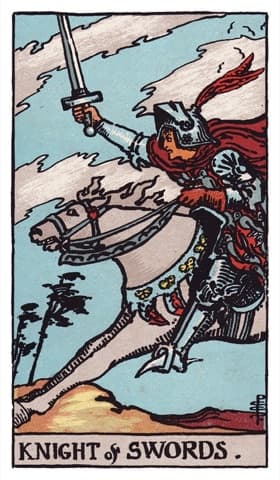
The Knight of Swords shows an armored knight on a white horse, charging at full gallop, sword raised high and pointed forward. He leans into the rush. The sky behind him is wild — clouds torn by wind, the trees bent flat — and the horse's mane and the knight's cloak stream backward with the speed. Everything in the image is motion.
Three details carry the meaning. The full-tilt charge: total commitment to forward motion, courage and urgency, no hesitation — the body language of someone who has already decided. The raised sword pointed ahead: intellect and will aimed like a weapon at the goal; sharp, focused, direct. And the storm-torn sky: the turbulence the speed kicks up — the wind, the chaos, the sense that this much force doesn't move gently. The white horse is intelligence and energy at a gallop; the knight is barely holding it, riding the edge between brilliant and out of control.
That's the whole card. The Knight of Swords is fast, decisive action driven by intellect and ambition — the courage to charge straight at a goal, powerful when aimed and reckless when not.
What the Knight of Swords actually means
When this card appears, it's usually pointing at one of three things. All of them run at full speed.
Fast, decisive action
The most common Knight of Swords reading. The time for thinking is over; the card is the charge itself. It marks moving quickly, acting boldly, cutting through hesitation to just do the thing. When you've been stuck or overthinking, the Knight of Swords is the kick that says go — decide and move. It's courage in motion, the willingness to commit and charge.
Ambition and single-minded drive
The Knight of Swords is intensely goal-focused. Sword raised, eyes forward, he sees the target and nothing else. The card often marks ambition, determination, the drive to push hard toward what you want. That focus is its great strength — it gets things done that more cautious energy never would. The shadow is tunnel vision: so locked on the goal that everything (and everyone) else becomes an obstacle.
Going too fast
The same speed that makes the Knight powerful is its central risk. The card frequently shows up as a caution: you're moving faster than is wise. Acting before thinking, speaking before considering, rushing into something without checking the ground. The Knight charges so hard he can ride straight past the warning signs. When this card appears, it's worth asking not should I act but am I aimed at the right thing, and am I going too fast to tell.
How to read the Knight of Swords in love
In a love reading, the Knight of Swords brings speed and intensity. It can mean a whirlwind romance that moves fast, a bold and direct pursuit, or a partner who is ambitious, sharp, and exciting to be around. There's a real thrill here — the Knight doesn't do lukewarm. When he wants something, he charges, and that directness can be refreshing in a world of mixed signals.
But the warning rides right alongside the thrill. The Knight rushes, and in love that can mean moving too fast — declaring too soon, pushing too hard, pursuing so single-mindedly that you don't notice whether the other person is actually ready or even interested. The same bluntness that feels honest can also wound; the Knight says the true thing without always checking whether it's the kind thing. Reversed, it can mean a relationship that burns out as fast as it ignited, or a partner who's all intensity and no staying power. The card's counsel: keep the boldness, lose the rush. Charge toward someone, yes — but make sure they're running with you, not being run over.
How to read the Knight of Swords in career
At work, the Knight of Swords is a powerhouse. It often marks a phase of fast progress, bold moves, and ambitious drive — launching the project, pushing the deal through, charging at the promotion. If you've been hesitating, the card is permission to act decisively. It's especially strong for anything that rewards speed, courage, and directness: the Knight gets more done in a week of charging than a cautious mind does in a month of planning.
The watch-out, again, is the speed. The Knight can act before the plan is ready, burn bridges with bluntness, start more than he finishes, or barrel ahead without buy-in from the people he needs. Reversed, it's recklessness at work — rash decisions, aggression, or energy scattered across too many fronts. The fix isn't to slow the Knight to a crawl; it's to give him a direction. Pair the charge with the gathering of the Page of Swords and the cool judgment of the King of Swords, and you get force that's actually aimed.
Reading this for a card you pulled?
Pull three cards free →The Knight of Swords in combination
Knight of Swords + Page of Swords
The full arc of a Swords impulse. The Page of Swords is the curiosity and the idea; the Knight is the charge that acts on it. Together they're idea-into-action at speed — the spark of wanting to know, then the headlong rush to do something about it. Strong momentum, with one note: let the Page finish asking the questions before the Knight goes thundering off with half an answer.
Knight of Swords + The Chariot
Drive doubled — and a question about control. The Chariot is willpower steering opposing forces; the Knight is raw charging force. Together they're enormous forward momentum, almost unstoppable. The pairing's whole lesson is in the contrast: the Chariot holds the reins, the Knight barely does. Together they ask whether all that speed is being steered or just unleashed. Aimed, it's a juggernaut; unaimed, it's a runaway.
Knight of Swords + Eight of Swords
Charge meeting paralysis. The Eight of Swords is feeling trapped, bound, unable to move; the Knight is pure decisive action. Together they can be the exact medicine — the bold charge that cuts through the self-made cage, the kick that breaks the paralysis. Often a hopeful pairing: the trap is real but the Knight proves it was never as locked as it felt. Sometimes you escape the Eight by simply, finally, moving.
Knight of Swords + Temperance
Speed meeting the brakes. Temperance is patience, balance, the right measure; the Knight is full-tilt rush. Together they're a direct conversation between fast and steady — and usually a clear message to temper the charge. The pairing rarely means stop; it means modulate. Bring the Knight's courage, but pour it at Temperance's pace. The goal you're racing toward will still be there if you arrive a little more measured.
How to read the Knight of Swords by position
| Position | What the Knight of Swords usually means |
|---|---|
| Past | A burst of fast, bold action that shaped your situation — a charge you made, a quick decisive move, or a whirlwind period that swept you forward (for better or worse). |
| Present | Things are moving fast, or want to. The energy now is decisive action and forward charge. Use the boldness — but check you're aimed right before you fully commit to the gallop. |
| Future | Fast movement is coming — a chance to act decisively, or a rush of events to ride. The card says be ready to move with courage, and ready to steer. |
| Hopes / Fears | You long to charge ahead, act boldly, finally move — OR you fear acting too fast, being reckless, or someone steamrolling you. The card says the drive is power; the work is aiming it. |
When the Knight of Swords is genuinely hard
A few honest notes, because the charge has a cost:
- When the speed outruns the thinking. The Knight's whole danger is acting before the mind catches up — sending the message you can't unsend, making the move you can't reverse, charging through a door before checking what's on the other side. If the card shows up while you're about to do something fast and irreversible, it's worth treating as a yellow light, not a green one. The Knight rarely regrets moving; he regrets where he aimed.
- When directness becomes a blade. Swords cut, and the Knight swings hard. The same bluntness that feels brave can flatten people — the truth delivered at a gallop, no time for tact, no notice of the damage. Honesty without care isn't courage; it's just collateral. The Knight has to learn that being right at full speed can still leave a wreck behind him.
- When the charge has no target. A galloping horse with no direction isn't progress; it's just chaos. Reversed especially, the Knight's energy scatters — a dozen launches, no landings; constant motion, no arrival. The hardest lesson for this card is that speed only matters once you know where you're going. Sometimes the bravest thing the Knight can do is rein in for one minute and pick the hill worth charging.
The bigger reframe
The Knight of Swords charges across the card at a full gallop, sword high, the storm tearing at his cloak — and the whole image is a single question wearing armor: where are you going so fast? The courage is undeniable. The drive is magnificent. No one ever changed their life by hesitating, and the Knight is the part of you that finally, decisively, moves. That force is precious. Most of what's worth doing requires exactly this kind of nerve.
But raw speed is morally and practically neutral — it makes a good aim better and a bad aim catastrophic. The Knight of Swords doesn't need to be slowed into timidity; he needs to be steered. Keep the boldness that cuts through hesitation. Keep the directness that says the true thing. Just add the half-second of aim that turns a reckless charge into a decisive one — the glance at the map before the gallop, the check that the door you're about to crash through is the right door. Charge, by all means. Just know which hill is worth it.
If you've pulled the Knight of Swords and you're about to move fast on something, the free three-card draw on this site can help you aim before you charge. Pull two more cards around your Knight of Swords: what you're racing toward, whether the speed is serving you, and what you might be charging past without seeing.
A knight at a gallop, sword raised, storm in his wake. The card is the courage to move — and the reminder to know where you're pointed before you do.
Pull three cards on the thing you're about to charge into → What you're racing toward. Whether the speed serves you. What you might be missing.