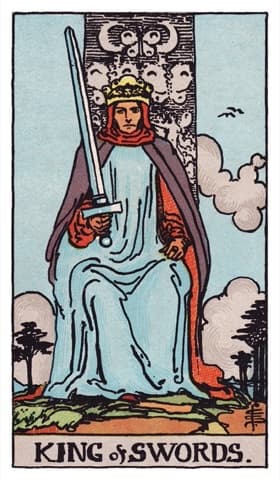
If you pulled the King of Swords, you pulled the master of the mind. Kings are mastery and authority, and Swords are the suit of intellect, truth, and reason — so the King of Swords is the highest expression of clear thinking: the judge, the strategist, the authority who rules by logic, principle, and unflinching honesty.
But the image carries a quiet warning along with its power. This is the deck's coolest head — and a perfectly cool head has a cost. The King of Swords sees clearly because he stands a little apart from his feelings, and that same distance, taken too far, becomes coldness. The card hands you the power of pure reason and asks the hard question underneath it: can you be clear and warm, or does your clarity cost you your heart?
What the picture is showing
The King of Swords sits on his throne, facing forward, holding a single upright sword tilted slightly to one side. He wears blue robes and a cape; butterflies and a crescent moon are carved into his throne. Above him the sky holds a few firm clouds, and trees bend in a steady wind.
Three details carry the meaning. The upright sword, held straight and forward: the clear, active intellect — truth held up plainly, judgment ready. The forward-facing, still posture: unlike the other Sword court cards, he looks directly at you, composed and unmoving — authority that doesn't flinch. And the butterflies and clouds: symbols of the mind and the air element, but also of transformation and changeable thought now mastered and held steady. This is a man who has disciplined his thinking into a tool he can wield at will.
That's the whole card. The King of Swords is mastery of the mind — clear judgment, intellectual authority, and honest truth-telling, wielded by someone who leads with the head and holds his feelings at a deliberate distance.
What the King of Swords actually means
When this card appears, it's usually pointing at one of three things. All of them are about the disciplined intellect in command.
Intellectual authority
The most common King of Swords reading. He represents mental mastery — the power to think clearly, analyze sharply, and lead through intelligence and sound reasoning. Where other cards feel or act, the King of Swords reasons. When he appears, the situation calls for (or is governed by) clear-headed authority and good judgment.
Truth and ethics
The King of Swords holds his sword like a standard of truth. He stands for honesty, principle, and ethical clarity — the refusal to lie to himself or others, and the willingness to make the fair call even when it's hard. He's the card of the judge for a reason: he rules by what's right, not what's convenient.
Clear, impartial judgment
The King of Swords is decision made with the head, not the heart. He weighs the facts, sets aside bias and emotion, and rules. This is his great strength — the ability to see a situation as it actually is and decide accordingly — and, taken too far, his great limitation: a judgment so detached it forgets the human cost.
How to read the King of Swords in love
In a love reading, the King of Swords brings the head into matters of the heart. It can represent a partner who is intelligent, principled, and direct — someone you can genuinely reason with, who values honesty and clear communication over drama. Or it can be advice: handle this romantic situation with clarity and truth, not impulse or wishful thinking.
Its shadow matters here more than anywhere. The same cool reason that makes the King fair can make him distant — logic used as a wall, feelings kept at arm's length, a partner who explains when you need him to feel. Reversed, this tips into cold detachment or using cleverness to win arguments rather than understand. The card's best counsel in love is integration: be honest, be clear, communicate like an adult — but don't let the cool head crowd out the warm one. Truth without tenderness isn't wisdom; it's just sharpness.
How to read the King of Swords in career
At work, the King of Swords is in his element. He signals clear strategy, sound judgment, intellectual leadership, and decisions made on facts rather than feelings or politics. He can represent an authoritative mentor or boss — fair, sharp, principled — or a call to step into that role yourself: think strategically, communicate precisely, lead with reason. He's excellent for legal matters, analysis, negotiation, and any situation that rewards a clear, disciplined mind. The caution is the same as always: don't let "rational" become an excuse for ruthless. The strongest King of Swords leadership is clear and humane — decisive without being cold.
Reading this for a card you pulled?
Pull three cards free →The King of Swords in combination
King of Swords + Queen of Swords
The two masters of the mind, side by side. The King and Queen of Swords both rule by clarity, but the King leads outward with authority and judgment while the Queen leads with perceptive, hard-won independence. Together they often signal a situation governed almost entirely by intellect and honesty — powerful clarity, but worth asking whether any warmth is in the room. Two clear heads; make sure there's a heart too.
King of Swords + Ace of Swords
Authority meeting pure breakthrough. The King of Swords is mastered intellect; the Ace of Swords is the first flash of clarity and truth. Together they're an exceptionally sharp pairing — a decisive insight wielded with full authority. Strong for cutting through a problem cleanly, making a clear ruling, or seeing and acting on the truth with confidence.
King of Swords + Justice
Two cards of judgment and truth — and both hold an upright sword. The King of Swords is clear-headed authority; Justice is fairness, accountability, and cause-and-effect. Together they strongly emphasize fair, principled decision-making — legal matters, reckonings, rulings that must be made honestly. A combination that demands you do the right thing for the right reasons.
King of Swords + The Emperor
Two kinds of authority. The King of Swords rules through intellect and truth; the Emperor rules through structure, power, and order. Together they're a heavyweight authority pairing — strong leadership, firm control, decisions made and enforced. Powerful, but worth watching that all this command stays fair rather than rigid or domineering.
How to read the King of Swords by position
| Position | What the King of Swords usually means |
|---|---|
| Past | A clear-headed decision or authoritative figure that shaped your situation — a time you (or someone) ruled by reason and truth, setting the course you're now on. |
| Present | The situation calls for clear judgment and honest authority. Step into your cool head: weigh the facts, set bias aside, and decide fairly — without losing your humanity in the process. |
| Future | A decision made with reason, or an authoritative figure, is ahead. The card promises clarity and sound judgment; the work is to keep it fair and warm, not just correct. |
| Hopes / Fears | You hope for clarity, fairness, and a clear-headed resolution, OR you fear cold authority — judgment without mercy, being on the wrong side of someone's ruthless logic. |
When the King of Swords is genuinely hard
A few honest notes, because a cool head cuts both ways:
- When clarity curdles into coldness. The King's gift is seeing clearly by standing apart from his feelings — but stand too far apart and you stop feeling at all. It's easy to call detachment "being rational" when it's really just avoidance of the heart. The card's hardest lesson is that the goal isn't to eliminate emotion; it's to think clearly with your feelings in the room, not by exiling them.
- When you're on the receiving end of it. Sometimes the King of Swords is someone else — a person using intelligence and authority against you, winning every argument while missing every point that matters. Reversed especially, he can be manipulative, cold, or tyrannical. The card's counsel here is to meet sharpness with your own clarity: don't let someone's cleverness convince you that being right and being fair are the same thing.
- When the fair call is the lonely one. The King of Swords often has to make the unpopular, honest decision — the one that's correct but costs him warmth, approval, or ease. That's real, and the card doesn't pretend otherwise. But it asks you to make sure you're choosing truth because it's right, not because being the cold, clear one is a place you hide. Integrity should serve people, not wall you off from them.
The bigger reframe
The King of Swords looks like the deck's most admirable figure — composed, intelligent, principled, the one who keeps his head when everyone else loses theirs. And he is that. But the image sets him slightly apart, facing forward and alone on his throne, and that distance is the whole teaching. A perfectly clear head, held too far from the heart, doesn't become wisdom. It becomes a beautiful, lonely sharpness.
So the King of Swords hands you real power — the ability to see the truth, reason clearly, and decide fairly — and then asks the question that completes it: can you stay warm while you stay clear? The card's mastery isn't cold logic; it's the much harder discipline of being honest and kind, decisive and humane, the judge who rules justly without forgetting that the people in front of him are people. Wield the sword. Just don't mistake the cutting for the point.
If you've pulled the King of Swords and you're facing a decision that needs a clear head, the free three-card draw on this site is built for exactly that. Pull two more cards around your King of Swords: what the situation needs you to see clearly, what the fair call actually is, and how to make it without going cold.
A king on his throne, sword held straight, eyes forward. The card is just asking you to think clearly — and to stay human while you do it.
Pull three cards on the decision that needs a clear head → What to see clearly. What the fair call is. How to make it without going cold.