If you pulled The Emperor and Googled "emperor tarot card meaning," the first results probably gave you one of two readings: the soft version ("father figure, stability, authority — embrace your inner leader") or the modern-critical version ("patriarchy, rigid control, masculine energy you should question"). Both readings are missing what the card actually does.
The Emperor isn't about gender, age, or authority for its own sake. It's about the discipline of building a structure that protects the thing growing inside it. That's a more specific job than "be in charge," and a more useful one than "be soft."
What the picture is showing
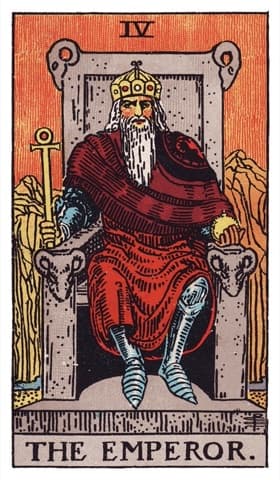
The Rider-Waite Emperor depicts a stern, bearded figure seated on a massive stone throne in a barren mountain landscape. He wears a long red robe, with armor visible underneath — the robe is ceremonial, but the armor is real. On his head is a heavy crown. In his right hand he holds an ankh (the Egyptian symbol of life-as-structure); in his left, a golden orb (sovereignty, dominion).
The throne is carved with four ram heads at its corners — the symbol of Aries, the sign of the warrior, ruled by Mars. The setting is mountains, rocks, almost no vegetation. A small river winds through the background.
Now look at the contrast: The Empress sits in a flowering garden. The Emperor sits on bare stone. The Empress wears soft, flowing fabric. The Emperor wears armor. The Empress's energy is generative — things grow around her without her doing anything. The Emperor's energy is structural — he is what holds the shape, and without him the shape collapses.
Notice also: the armor is under the robe. The protection isn't performance. It's load-bearing.
That's the whole reading. The Emperor is the card of the structure that has to exist before anything inside it is safe.
What The Emperor actually means
When this card appears, it's almost always pointing at one of three patterns:
Pattern 1: You need to set boundaries or make rules
The most common Emperor reading. You've been saying yes to too much, accommodating too many people, leaving too many decisions ambiguous. The Emperor shows up and the deck is gently pointing out that the lack of structure is itself causing the problem you're trying to solve by being flexible.
This is the card of the no that protects the yes. Of "the meeting is over at 4, not whenever the conversation finishes." Of "my workday ends at 6 and I'm not available after that." Of "this is the budget, and we'll make decisions inside it." Boundaries aren't unkind; they're the conditions under which kindness can be sustained.
The Emperor often appears at exactly the moment a person realizes they can't keep saying yes to everyone and have anything left for the people who matter most. The card is the deck telling you the structure isn't optional.
Pattern 2: A situation needs structure imposed on chaos
The second Emperor reading. Something in your life — a team, a household, a project, a creative practice — has been running on goodwill and improvisation, and it's reaching the point where the lack of system is producing real failure.
The Emperor is the card that says build the framework. Make the schedule. Define the roles. Write down the rules. Create the calendar. Set up the recurring meeting. The unstructured version was working when the load was small; the load has grown, and the unstructured version is now the bottleneck.
This is one of the least romantic Emperor readings, and one of the most useful. The card doesn't promise the structure will be exciting. It promises that the structure will let the interesting work happen, because the interesting work won't survive constant firefighting.
Pattern 3: Stepping into authority you've been resisting
The third Emperor reading is the most personal. Sometimes the card shows up not because there's a structural problem in your external life, but because you've been avoiding sitting in the seat of authority in your own life.
The pattern: someone has to make the decision, and you've been waiting for someone else to make it. You've been deferring — to a partner, a parent, a boss, a system, the group consensus. The Emperor shows up and the deck is suggesting that the seat is yours and you've been pretending it isn't.
This reading often appears when someone is being asked to step up — into a leadership role, into the decision-maker role in a family, into being the adult in a relationship where the other person has been holding that weight, into being the one who calls the shot in their own life instead of waiting for permission.
The one honest question
Every Emperor card reading boils down to a single question worth answering carefully:
Where am I refusing to take responsibility for the structure my life actually needs?
The card isn't asking you to become controlling. It's asking you to notice the specific places where you've been avoiding the work of setting up the container, and to do the work.
Some honest answers people land on:
- I've been letting my calendar be filled by other people because I haven't decided what my own priorities are.
- I've been complaining about the team being chaotic and I'm the one who could write the operating system.
- I've been waiting for my partner to set the rules about screens / money / time with extended family because I don't want to be the bad guy.
- I've been a great parent on the affection side and underbuilt on the structure side, and the kid is asking for the structure in ways I'm not hearing.
- I've been treating "having a routine" as restrictive, and my creative work is actually starving for one.
The fifth answer is one of the most common things The Emperor surfaces in creative readings. The Emperor and the artist are usually framed as opposites. They're not. Almost every artist who sustains a practice has a strong Emperor running underneath — the schedule, the workspace, the routine that makes the unrouted work possible.
What The Emperor does NOT mean
A few interpretations to push back on:
- "You're going to meet a powerful older man." Older symbolism that occasionally still shows up. The Emperor is an internal archetype before it's ever a literal person. Don't read the card as a dating prediction.
- "You need to be more masculine." This is a frame the card doesn't require. The Emperor's energy — structure, authority, decision-making, protection — is present in people of any gender. The card is about a mode, not a demographic.
- "Control everything." This is the misuse of the card. The Emperor's job is to build structure that protects the things growing inside it, not to micromanage what grows. The healthy Emperor sets the walls and steps back; the unhealthy Emperor sets the walls and then inspects the wheat every five minutes.
- "Reversed Emperor means weakness." Almost never the right read. Reversed Emperor usually means structure used as domination — rigid rules, abuse of authority, control without responsibility, the parent who issues commands without listening, the boss who enforces policies without judgment. The fix isn't less structure; it's more accountability with the structure.
Reading this for a card you pulled?
Pull three cards free →Emperor paired with other cards
Emperor + The Empress
The most thematically complete pair. Emperor is the structure; Empress is what grows inside it. Together they describe a full dynamic — the walls of the garden and the wheat that ripens in it. They often appear in readings about partnerships where the question is who's bringing which role, or in readings about a person who's been doing one and needs to integrate the other. (The Empress in depth here.)
Emperor + The Hierophant
The two-faces-of-authority pair. Emperor is secular authority (rules, decisions, structures of the visible world); Hierophant is institutional / spiritual authority (tradition, doctrine, the rules handed down). Together they often describe a moment where you're being asked to operate inside both at once — the literal Emperor of the situation and the deeper tradition or value system behind it.
Emperor + The Tower
A diagnostic pair. The Emperor is structure that protects; The Tower is structure that collapses because it was built on something false. Together they often warn that the structure you've been defending was the wrong structure — built to protect a story that wasn't true, and the collapse is the deck's correction. Read carefully when these two appear together. (The Tower in depth here.)
Emperor + Justice
An ethics pair. Emperor is the power to set rules; Justice is the principle that the rules apply equally, including to the one who set them. Together they often appear in readings about leadership integrity — the question of whether the Emperor's structure is just, and whether the person in the Emperor seat is willing to be measured by their own rules.
Emperor + The Devil
A warning pair. Both cards involve power. The Emperor uses structure to protect; The Devil uses structure to bind. Together they often appear when authority has slipped into control — when rules that were meant to enable something have become a prison around it. The card combination is asking you to honestly examine whether the structure is still serving the thing it was built to protect. (The Devil in depth here.)
Emperor + Four of Pentacles
A rigidity pair. Both cards involve holding-on. Four of Pentacles is hoarding (resources, control, status); Emperor here is the structure that allows the hoarding to feel justified. Together they often appear when a person has used structure (rules, budgets, "the way we've always done it") to defend against change they're afraid of.
Emperor + The Fool
An odd-couple pair that's actually one of the most useful in the deck. Fool is unstructured beginner-energy; Emperor is the container that lets the beginner-energy go somewhere useful. Together they often describe the maturation of a creative life or a business — the moment you stop being purely the Fool (winging it) and start building the Emperor underneath so the Fool can keep playing. (The Fool in depth here.)
How to read Emperor by position
| Position | What Emperor usually means |
|---|---|
| Past | A structure or authority figure that shaped you — often a parent, a teacher, an institution, or a discipline you submitted to that's still affecting how you operate. |
| Present | You are being asked to be the adult in the room. The structure isn't going to set itself. The card is unambiguous about who's supposed to set it. |
| Future | A period of increased responsibility is coming. Often a role expansion, a leadership role, or the natural next step in a maturation arc. Prepare by getting clear about what you actually believe. |
| Advice | Set the structure. Make the decision. Stop waiting for someone else to. The card is direct here. |
| Hopes / Fears | You hope to be respected and taken seriously. You fear that taking authority means losing connection, or that being decisive means being unkind. |
When The Emperor is genuinely hard
Some Emperor readings are harder than others. Three honest cases:
- When you grew up with a destructive authority figure. The Emperor archetype can feel viscerally unsafe to people whose early experience of authority was domineering, abusive, or arbitrary. The card isn't asking you to become that version of authority. It's asking you to build the version that was missing — the structure that protects rather than punishes. Reclaiming the Emperor in your own life is often part of healing from a bad one in your past.
- When the system you're in doesn't actually grant you authority. Sometimes The Emperor shows up but the literal external situation doesn't support taking the seat — a job where you have responsibility without authority, a family where the structural decisions aren't yours to make, a system stacked against you. The card then shifts: it's not "take the throne externally," it's "be the Emperor of your own internal life, even when the external structure doesn't reflect it."
- When the structure you'd build conflicts with what you actually want. Sometimes The Emperor surfaces a real tension — the responsible structure asks you to commit to something the rest of you doesn't want. The card doesn't resolve this tension; it just makes sure you're not avoiding it. The honest version of the Emperor reading is sometimes that the structure you'd build is the wrong structure for the life you actually want, and the conflict is the information.
The Emperor isn't a card to "submit to." It's a card to take seriously enough to build a real structure on, this week.
The bigger reframe
The Emperor is the fourth card in the Major Arcana sequence, following The Empress (generative space) and before The Hierophant (inherited wisdom). His job in the sequence is specific: after the generative work begins, something has to hold the shape.
Modern culture has had a complicated relationship with The Emperor. The card has been read as the patriarchy, as paternalism, as the worst of authoritarian instinct. Some of that critique is fair — authority used badly is one of the most destructive forces in human life. But the response of abandoning the Emperor archetype entirely leaves a vacuum, and vacuums get filled by worse versions of authority.
What The Emperor is really teaching is that structure is a form of care. The schedule that protects your creative hours. The boundary that lets the relationship breathe. The budget that lets the family plan. The rule in the household that lets the kid know what's solid. The boss who actually decides instead of leaving the team to drift. None of this is glamorous. All of it is load-bearing.
The healthy Emperor isn't the one with the most power. It's the one who takes the responsibility of building the container so the things inside can grow safely — and who is willing to be measured by whether the container is actually serving its purpose.
If you've pulled The Emperor recently and want to see where the structure of your life needs you to actually sit down and build it — what you've been deferring, what you've been resisting, where the seat is empty — the free three-card draw on this site is built for exactly that. Pull a card for where structure is missing, a card for what you've been avoiding deciding, and a card for what would become possible if you set the container.
The throne is stone. The armor is under the robe. The Emperor is just the moment you stop performing flexibility and finally sit down in the seat.
Pull three cards to see where your life needs structure → Where the container is missing. What decision you've been deferring. What becomes possible once you set the rules.