If you pulled The Chariot and looked it up, you've probably seen the same three words everywhere: victory, willpower, control. None of them are wrong. All of them are shallow.
The Chariot is one of the most misread cards in the deck, because the easy reading ("you'll win, push harder") is the opposite of what the image is actually teaching. Read carefully, this is a card about a very specific and uncomfortable kind of control — the kind you hold over forces that don't want to go the same direction.
What the picture is showing
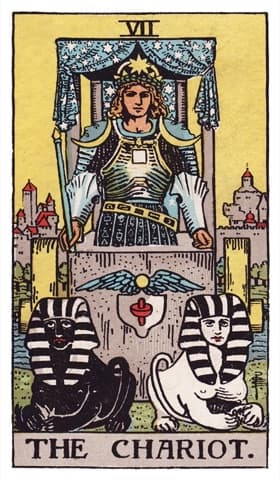
The Chariot shows an armored figure standing inside a stone chariot. In front of it, two sphinxes — one black, one white — are harnessed and ready to pull. The figure holds no reins.
Look at that again. No reins.
The two sphinxes face opposite tendencies. One pulls one way, one pulls the other. They are not a matched team. And the driver controls them not by yanking on straps, but by sheer focused will — by holding a direction so clearly in mind that the opposing forces are forced to move as one anyway.
That's the whole card. The Chariot isn't about everything lining up in your favor. It's about holding a direction steady while two parts of you pull against each other.
What The Chariot actually means
When this card appears, it's almost always pointing at one of three situations. Notice none of them are "you'll win easily."
A conflict you're winning by will, not by ease
Two impulses inside you want different things. Stay or go. Speak or hold back. Safe or bold. The Chariot draws when you've stopped letting them fight and started driving — choosing a direction and making both halves serve it. The win is real, but it's effortful. The moment you stop concentrating, the sphinxes drift apart again.
Forward motion after a stuck period
The Chariot often follows cards of waiting or struggle. It's the moment the wheels finally turn. If you've been stalled — in a decision, a project, a relationship — this card is the green light. But it's a driven green light. Nothing moves unless you keep steering.
Discipline as the real engine
The armor, the stillness of the driver, the absence of reins — they all point at the same thing. This card rewards control over self, not control over circumstances. You can't make the sphinxes friends. You can only out-focus their disagreement.
How to read The Chariot in love
In a relationship reading, The Chariot usually isn't about romance sweeping you away — it's about steering something that has competing pulls. A relationship where two strong people want slightly different things, and it works because someone is holding a shared direction. Or a personal moment where you want closeness and independence at once, and the card is asking you to drive both rather than pick one.
Reversed or poorly aspected, The Chariot in love can mean the opposite: the sphinxes have won. You're being pulled in two directions and calling it "complicated" instead of choosing. The card's medicine is the same either way — pick the direction, then hold it.
How to read The Chariot in career
This is one of the Chariot's strongest positions. It speaks to ambition that's actually going somewhere — a project you're driving, a goal you're disciplined toward, a moment where focus is paying off. If you've been scattered across too many priorities, the Chariot is telling you the win comes from narrowing to one direction and refusing to be pulled off it.
The warning version: motion without direction. Lots of effort, lots of speed, no clear destination. A chariot with no driver is just two sphinxes going nowhere fast.
Reading this for a card you pulled?
Pull three cards free →The Chariot in combination
The Chariot + Strength
A powerful pairing about two kinds of control. The Chariot is outer will — driving forward through opposing forces. Strength is inner mastery — the quiet hand on the lion. Together they often describe someone who's learned to combine drive with patience: pushing hard and staying gentle with themselves while they do it. When these two appear together, the reading is usually "you have what it takes — both halves of it."
The Chariot + The Tower
Forward momentum meeting sudden collapse. (More on Tower-energy here.) Sometimes this pairing means you're driving hard toward something that's about to break — and the kindest reading is to check the direction before you accelerate. Other times it means you'll push through a disruption that would stop most people. Context and position decide which.
The Chariot + The Devil
The Chariot is direction by choice; the Devil is direction by compulsion. Together they ask an honest question: are you driving, or are you being driven? Sometimes what looks like disciplined ambition is actually a trap you can't stop running on. The Chariot + Devil is the deck's way of asking you to check which one you're inside.
The Chariot + Justice
Drive meeting consequence. The Chariot pushes; Justice weighs. Together they often mean a forceful decision is about to meet its results — and the reading is asking whether you've steered fairly, not just successfully.
How to read The Chariot by position
| Position | What The Chariot usually means |
|---|---|
| Past | A period of focused drive that got you here — a win earned through will, or a direction you held when it would've been easier to drift. |
| Present | You're steering right now. Two forces are pulling, and the card is confirming you have the control to hold your direction — if you keep concentrating. |
| Future | Forward motion is coming, but it won't be automatic. The card promises movement if you drive. A passive future here stalls. |
| Hopes / Fears | You hope to finally take control of a divided situation, OR you fear being pulled apart by competing demands. Often both at once. |
When The Chariot is genuinely hard
A few honest cases where this card is harder than the cheerful "victory" reading suggests:
- When you don't actually know the direction. The Chariot can't help you choose where to go — it only rewards holding a direction once you've picked one. Drawn during genuine confusion, it's not telling you the answer. It's telling you that not choosing is the thing keeping you stuck.
- When the two sphinxes are people, not impulses. Sometimes the opposing forces are real: two people, two obligations, two loyalties. The Chariot's "drive both as one" is much harder when the forces have their own opinions. The card still asks for a held direction — it just won't pretend it's easy.
- When the drive is the problem. Occasionally The Chariot shows up for someone already over-driving — white-knuckling a direction that needs to be released, not steered harder. Read alongside cards of rest or surrender, the Chariot's lesson inverts: the discipline you need is the discipline to stop.
The bigger reframe
Most people want The Chariot to mean "the universe is clearing your path." It isn't. The card is almost the reverse: the path is not clear, the forces are not aligned, and you win anyway — by holding a direction so steadily that disagreement has to follow.
That's a less comforting reading than "victory." It's also far more useful, because it points at the one thing you actually control: your own focus. The sphinxes will never agree. The driver wins anyway.
If you've pulled The Chariot and you're not sure which direction to hold — or whether you're driving or being driven — the free three-card draw on this site is built for exactly that. Pull two more cards around your Chariot: what's pulling left, what's pulling right, and the direction worth holding through both.
The reins were never the point. The focus was.
Pull three cards on the direction you're steering → What's pulling you one way. What's pulling you the other. The direction worth holding anyway.