If you pulled the Four of Swords, you pulled the card of the pause. Fours are about stability and structure, and Swords are the suit of the mind and its battles — so the Four of Swords is the deliberate stillness the mind retreats into after a fight: rest, recovery, a stepping-back to heal before the next round.
But the image is easy to misread as something darker than it is. A figure lies stretched out on a tomb, perfectly still. It looks like death. It isn't. Look again and you'll see he's not gone — he's resting, hands in prayer, recovering his strength in a quiet sanctuary. The Four of Swords isn't an ending. It's the rest you take so there can be a continuation. And usually, when this card shows up, it's because the rest is exactly what you've been resisting.
What the picture is showing
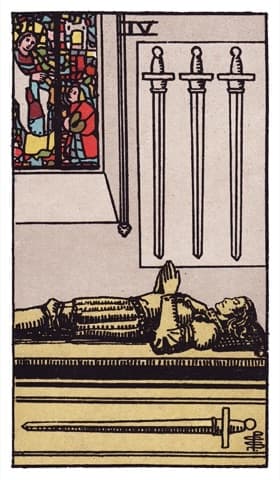
The Four of Swords shows a knight lying on top of a tomb, carved in effigy, hands pressed together as if in prayer. Three swords hang point-down on the wall above him; a fourth lies beneath him, along the side of the tomb. A stained-glass window glows in the background, lit and peaceful.
Three details carry the meaning. The reclining figure: he's still, but the prayerful pose and the calm of the scene say rest and restoration, not death — a deliberate retreat, not a defeat. The three swords on the wall: the battles, the mental strain, the conflicts — set aside, hung up, out of his hands for now. And the one sword beneath him: he hasn't given everything up; one blade stays close, meaning the rest is temporary and he'll take it up again. The whole scene is a sanctuary — a quiet, lit space set apart for recovery.
That's the whole card. The Four of Swords is a deliberate pause — rest and recovery after struggle, a stepping-back to heal, with the clear promise that you'll rise and re-enter when you're restored.
What the Four of Swords actually means
When this card appears, it's usually pointing at one of three things. All of them are about deliberate stillness.
Rest and recovery
The most common Four of Swords reading. After a period of stress, conflict, illness, or hard mental effort, the card calls for recuperation — real rest, not just a break you feel guilty about. It's the body and mind insisting on time to heal. The Four of Swords says the most productive thing you can do right now is stop.
Retreat and contemplation
The Four of Swords often marks a withdrawal — pulling back from the noise to think, pray, meditate, or simply be quiet. Not avoidance, but a chosen retreat into a sanctuary where the mind can settle. Sometimes you need distance from a problem before you can see it clearly, and this card grants the permission to step away.
A pause before the next phase
The single sword beneath the figure is the card's honest note: this is an intermission, not a finale. The Four of Swords often marks the breath you take between rounds — the regrouping before you re-engage. The rest has a purpose: to restore you for what's coming, not to remove you from it.
How to read the Four of Swords in love
In a love reading, the Four of Swords usually counsels a pause. It can mean taking space after conflict, cooling down rather than pushing, or a healthy period of quiet while one or both people recover. If the relationship has been tense or draining, the card suggests stepping back to restore yourself before trying to move things forward.
It's rarely about ending — it's about resting so love can recover. Sometimes it points to your own need to refill before you can show up well for someone else; you can't pour from an empty cup, and the Four of Swords names the empty cup. Reversed, it can warn that you're skipping that rest — forcing a draining relationship forward on fumes, or refusing the space you both clearly need. The upright message is gentle: retreat, restore, and come back to each other from a calmer place.
How to read the Four of Swords in career
At work, the Four of Swords is often a direct signal: you need a break. It can mark burnout brewing, the need to step back from a demanding project, take real time off, or pause before making a big professional decision. It frequently shows up when you've been pushing hard and running low, gently insisting that recovery isn't a luxury — it's how you stay effective. The card's counsel is to rest deliberately rather than collapse involuntarily. Reversed especially, it warns that ignoring the need for rest leads straight to exhaustion. Sometimes the most strategic career move is to stop, recover, and return sharp.
Reading this for a card you pulled?
Pull three cards free →The Four of Swords in combination
Four of Swords + Nine of Swords
Anxiety and the rest that answers it. The Nine of Swords is sleepless worry and mental anguish; the Four of Swords is the rest and recovery the mind is desperate for. Together they're a powerful "you need to stop and heal" pairing — the Nine's torment pointing straight at the Four's sanctuary. Often a sign that the way out of the spiral is genuine rest, not more thinking.
Four of Swords + Three of Swords
Heartbreak and recovery. The Three of Swords is painful sorrow and grief; the Four of Swords is the healing retreat afterward. Together they trace a gentle arc — the wound, then the rest that lets it close. A reassuring sequence: after the heartbreak comes the quiet, necessary time to recover. Permission to retreat and let the pain settle.
Four of Swords + Ten of Swords
The bottom and the recovery from it. The Ten of Swords is rock bottom, a painful ending; the Four of Swords is the rest that follows. Together they say the worst has happened, and now the work is to recuperate. Strongly about healing after collapse — the card pair that insists you stop and recover before trying to rebuild.
Four of Swords + The Star
Rest meeting renewal. The Four of Swords is recovery and retreat; the Star is hope, healing, and renewal after hardship. Together they're one of the most restorative pairings in the deck — the quiet rest of the Four opening into the genuine hope and replenishment of the Star. Deep healing, the kind that actually restores you, not just a pause but a refilling.
How to read the Four of Swords by position
| Position | What the Four of Swords usually means |
|---|---|
| Past | A period of rest, retreat, or recovery that restored you — a pause you took (or were forced to take) that let you heal before moving on. |
| Present | You need rest right now. The card affirms that stepping back, recovering, and being still is the right move — not avoidance, but necessary restoration before the next phase. |
| Future | A period of rest or retreat is coming, or is needed. The card promises a sanctuary ahead; let yourself take it rather than pushing straight through. |
| Hopes / Fears | You long for rest and peace, OR you fear stopping — worried that resting means falling behind or giving up. The card says the pause is strength, not surrender. |
When the Four of Swords is genuinely hard
A few honest notes, because rest is harder to accept than it sounds:
- When you feel guilty for resting. For a lot of people, stopping feels like failing — like everyone else is moving and you're falling behind. The Four of Swords meets that guilt head-on: the knight isn't lazy, he's recovering, and recovery is what makes the next fight survivable. The card reframes rest as a deliberate, honorable act, not a moral lapse. You're allowed to stop before you're broken.
- When you can't actually afford to stop. Sometimes the rest the card prescribes feels impossible — bills, kids, deadlines, no margin. The Four of Swords isn't naive about that. But it insists that even small sanctuaries count: an hour, a quiet morning, one boundary held. The alternative — pushing until you collapse — costs far more than the rest would. The card asks you to find the rest you can take, not to wait for permission you'll never get.
- When the stillness gets loud. Retreat sounds peaceful, but for an anxious mind the quiet can be where the worry gets louder (the Nine of Swords often lurks here). The Four of Swords doesn't promise the rest will be comfortable — only that it's necessary. Sometimes the work of the sanctuary is learning to let the mind settle, not forcing it to. The point isn't a perfect peace; it's stopping the bleeding long enough to heal.
The bigger reframe
The Four of Swords looks, at first glance, like one of the deck's heavier cards — a body on a tomb, swords overhead, a scene that whispers of endings. And that misreading is the whole lesson. Because the figure isn't dead. He's resting. The tomb is a sanctuary, the pose is prayer, and one sword waits beside him for when he rises. Nothing here is final. Everything here is recovery.
That's the teaching, and it pushes against everything a busy, achievement-anxious mind wants to believe: that rest is necessary, not optional, and that stopping is part of going on — not the opposite of it. The Four of Swords doesn't tell you you're done. It tells you you're tired, and that being tired is information, not weakness. Lie down in the sanctuary. Hang the swords on the wall for a while. The fight will still be there. You'll just be strong enough to meet it.
If you've pulled the Four of Swords and you've been running on empty, the free three-card draw on this site is built for exactly that. Pull two more cards around your Four of Swords: what you need to rest from, what the retreat is meant to restore, and what you'll rise to meet when you're ready.
A knight at rest, swords hung up, light through the window. The card is just giving you permission to stop — long enough to heal, before you rise again.
Pull three cards on the rest you've been resisting → What you need to recover from. What the pause is for. What you'll rise to meet.