If you pulled the Wheel of Fortune and looked it up, you probably got some version of "good luck is coming, things are about to change for the better." That's the gift-shop reading. It's not wrong so much as it's only half the wheel — and the half it leaves out is the half that matters.
The Wheel of Fortune is the card of cycles and turning points — the recognition that life moves in turns, that what's up comes down and what's down comes up, and that some of this is genuinely outside your hands. That's a bigger, stranger, more useful idea than "you'll get lucky."
What the picture is showing
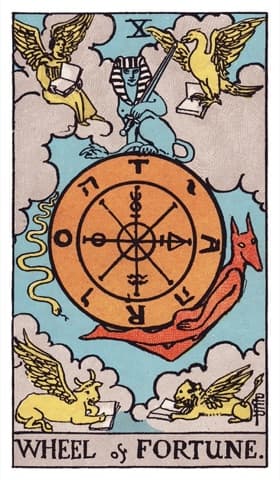
The Wheel of Fortune shows a great wheel suspended in the sky, marked with mysterious letters (often T-A-R-O and the Hebrew name of God) and alchemical symbols. Creatures surround it: a sphinx sits at the top holding a sword, a snake descends on the left, a dog-headed figure rises on the right. In the four corners, four winged beings read books — the fixed signs of the zodiac.
Look at the structure. The wheel turns — that's the whole image. Something rises on one side while something falls on the other, continuously. The sphinx at the top holds steady at the turning point, calm amid the motion. The four corner figures study books — wisdom is fixed and stable even while fortune spins.
That's the whole card. The Wheel of Fortune is the turning point — the moment the cycle moves — and the reminder that you're on a wheel, not a straight line.
What the Wheel of Fortune actually means
When this card appears, it's usually pointing at one of three things. Notice none of them are simply "good luck."
A turning point you didn't fully choose
The most common Wheel reading. Circumstances are shifting — a change of fortune, an unexpected development, a door opening or closing — and a lot of it is outside your direct control. The Wheel is naming the turn, the moment things move. Often for the better, but the deeper message is: the cycle is moving, get ready to move with it.
What goes around
The Wheel carries an echo of cause and effect across time — things you set in motion coming back around, cycles completing. Not as judgment (that's the Justice card's job) but as pattern. The Wheel says: notice where you are on the cycle, because it will keep turning.
Accepting what you don't control
The hardest and most valuable Wheel reading. Some of life is genuinely up to fortune — timing, luck, forces bigger than you. The Wheel isn't asking you to be passive; it's asking you to tell the difference between what you steer and what you ride. The sphinx stays calm at the top because it knows which is which.
How to read the Wheel of Fortune in love
In a relationship reading, the Wheel usually signals a turning point — a shift in the connection, a change of phase, fate bringing something into motion. It can mean a fortunate development (a relationship moving forward, a reconnection, lucky timing) or simply that the situation is changing and you're not fully in the driver's seat. The advice is usually to stay open and adaptable rather than gripping the wheel too tightly.
Poorly aspected, the Wheel in love can point at feeling at the mercy of circumstances — a relationship in flux you can't control. The card's medicine: focus on your response (the part you steer), not the turn itself (the part you ride).
How to read the Wheel of Fortune in career
At work, the Wheel often marks a change in fortune or a pivotal moment — an unexpected opportunity, a shift in direction, luck (good or testing) entering the picture. It's a card of timing and cycles: a sign that a phase is turning. If things have been down, the Wheel suggests the upswing; if they've been up, it's a quiet reminder that staying humble and adaptable matters, because the wheel keeps turning. Be ready to move when the moment comes.
Reading this for a card you pulled?
Pull three cards free →The Wheel of Fortune in combination
Wheel of Fortune + Justice
A meaningful pairing about how outcomes arrive. The Wheel is fortune and cycles — what comes around; Justice is precise cause and effect — what you've weighed out. Together they often describe a turning point that's also a reckoning: a change of circumstance that's connected to what you set in motion. The Wheel turns, and Justice makes sure it lands fairly.
Wheel of Fortune + The Tower
Two cards of change, very different in kind. The Wheel is the natural turning of cycles; the Tower is sudden, structural collapse. Together they often mean a turning point that arrives abruptly — a change you don't control that breaks something open. The reading usually asks you to ride the turn rather than resist it.
Wheel of Fortune + Strength
Fortune meeting inner steadiness. The Wheel spins; Strength is the calm hand that stays composed through the spinning. Together they describe meeting a change of circumstance with patience and self-mastery — not gripping, not panicking, just staying centered while the wheel turns. The sphinx energy.
Wheel of Fortune + Death
Death is a definite ending; the Wheel is the larger cycle that ending sits inside. Together they often mean a major phase completing and a new one beginning — the turn of a big wheel, not just a small one. Endings as part of an ongoing cycle, not the stop of the line.
How to read the Wheel of Fortune by position
| Position | What the Wheel usually means |
|---|---|
| Past | A turning point that shaped your path — a change of fortune, lucky or testing, that set the current cycle in motion. |
| Present | The wheel is turning right now. Circumstances are shifting, much of it outside your control. The card asks you to stay adaptable and ready to move. |
| Future | A turning point is coming — often fortunate, always a change of phase. Be prepared to ride the turn rather than resist it. |
| Hopes / Fears | You hope for a lucky change or a turn upward, OR you fear being at the mercy of circumstances you can't control. Usually both. |
When the Wheel of Fortune is genuinely hard
A few honest cases where this card asks more than the cheerful "good luck" reading:
- When the wheel turns down. The Wheel doesn't only go up. Sometimes it's naming a downturn — a phase ending, fortune receding. The card's real comfort isn't "it'll be good"; it's "it's a wheel, not a wall — this turns too." That matters most exactly when things are getting harder.
- When you want control you don't have. The Wheel's hardest lesson is the boundary between what you steer and what you ride. People in a tough spot often exhaust themselves trying to control the turn itself. The card asks for the harder discipline: act fully on your part, and release the part that was never yours.
- When "fate" becomes an excuse. The flip side — the Wheel can be misread as "it's all out of my hands, so I'll do nothing." But the four corner figures are studying, and the sphinx holds a sword. The card describes cycles you don't fully control, not a reason to stop steering the parts you do.
The bigger reframe
The Wheel of Fortune is one of the few cards that's explicitly about the limits of control — and that's why the gift-shop "you'll get lucky" reading does it such a disservice. The card's real teaching is subtler and far more useful: you are on a wheel. It will turn whether you want it to or not. Your power isn't in stopping the turn — it's in how you meet it.
Stay humble when you're at the top, because the wheel turns. Stay hopeful when you're at the bottom, because the wheel turns. And in either position, do the one thing the corner figures are doing: keep learning, stay steady, and read the cycle clearly enough to move well when your part of it comes.
If you've pulled the Wheel of Fortune and something in your life is turning, the free three-card draw on this site is built for exactly that. Pull two more cards around your Wheel: where you are on the cycle, what's turning, and how to meet it well.
The wheel never stops. The wisdom is in reading where you are on it.
Pull three cards on the turn you're facing → Where you are on the cycle. What's changing. How to meet the turn well.