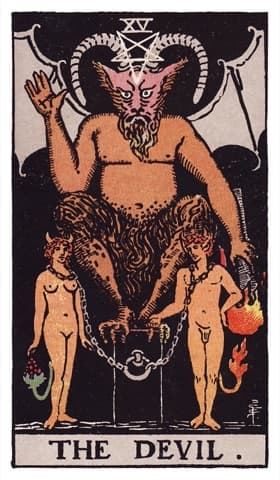
The Devil reversed reads as good news, and often is. But it's one of the few reversals that carries two nearly opposite meanings, and telling them apart is the whole job.
What upright means first
The Devil is about being held by something. A habit, a person, money, status, a story about who you are that's stopped being true.
The detail everyone points to is worth repeating because it's the actual key to the card: the chains on the two figures are loose. They could step out. They don't — because the attachment provides something, and leaving would cost more than staying appears to.
That's the mechanism. Not evil, not punishment. A trade you're still making.
Reading one: the grip loosening
The common and encouraging reading. Something you've been held by is losing its hold.
This tends to look unremarkable from outside. You stop checking their profile. The thing you couldn't imagine giving up becomes something you just... don't do this week. Recovery of any kind is boring from the outside, and the card is describing that.
Supporting signals: the Star, Six of Swords, Eight of Cups, or Temperance nearby all strengthen this reading.
Reading two: you've stopped seeing it
The uncomfortable one. The attachment is intact; what changed is that you've talked yourself out of noticing it.
This is genuinely hard to catch from inside, because denial and freedom feel similar in the moment — both involve not thinking about the thing. The difference is entirely in behaviour.
The test: has anything actually changed in what you do, or only in how you describe it? If you can point to different behaviour, it's reading one. If what changed is the framing — it's fine now, it's not really a problem, I've made peace with it — be suspicious.
Supporting signals: Seven of Swords (something not being said straight), Four of Cups (disengaged rather than resolved), or the Moon (unclear read on your own situation).
Reading three: partway out
Common and worth naming separately. You've seen the thing clearly, you've begun stepping out, and you're not finished. The chain is off and you still reach for it.
This reads as failure to people in it and isn't — it's the ordinary shape of leaving anything. Most exits are a series of partial ones.
Reading this for a card you pulled?
Pull three cards free →Telling them apart
| Signal | Which reading |
|---|---|
| Behaviour has changed | Loosening |
| Only the framing changed | Denial |
| Behaviour changed and keeps slipping | Partway out |
| You feel relief reading this | Worth checking which kind |
That last row is the useful one. Relief at "the Devil reversed means freedom" is exactly the response denial produces, and also exactly the response genuine progress produces. It doesn't distinguish anything — so go back to the behaviour question.
The Devil reversed in love
Usually: leaving, or starting to leave, a dynamic that wasn't good. Recognising it as a pattern rather than a series of unrelated bad weeks is often the moment this card describes.
The harder version: minimising something real. Not "it's fine" as a conclusion you reached, but "it's fine" as a thing you now say.
If this is where you are, see is this relationship worth saving and should I trust him. And plainly — if what's being minimised involves harm, that belongs with a person rather than a deck.
The Devil reversed in career and money
Frequently: leaving a role that had you by the salary, or recognising that the lifestyle grew to consume the raise. Four of Pentacles nearby supports the money reading specifically.
Also: getting out from under an identity built on a job. That one takes longer than the resignation.
See should I quit my job.
The honest part
Reversals are a convention, not a law. Many experienced readers don't use them and read the same cards perfectly well from context.
What this particular reversal is good for: it forces the behaviour-versus-framing question, which is a genuinely useful test that has nothing to do with cards and that most people rarely apply to themselves. Whether or not you believe anything about the deck, has my behaviour changed or only my description of it is worth asking about anything you've decided you're over.
Read it as reflection, and answer that one honestly.
Where to go next
- The Devil (upright) → — the full card meaning.
- The Tower reversed → — the other major reversal people hope is good news.
- Death reversed → — for the blocked-ending version.
- All 78 reversed meanings → — the full reference.
Pulled the Devil reversed? Pull a free 3-card spread → and ask whether the behaviour changed or just the story.