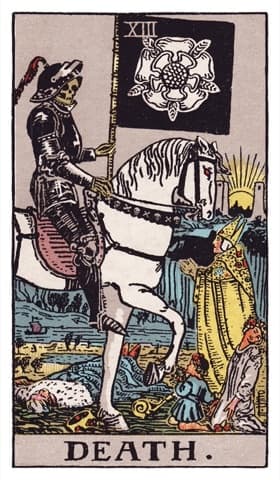
Most people who pull Death reversed feel a small flicker of relief. The scary card, upside down — surely that's the good version.
It usually isn't, and understanding why makes this one of the more useful cards in the deck.
Start with what upright Death actually means
Death is not about literal death, and every tarot writer says so, but the correction usually stops short of the interesting part.
Upright Death is a completed ending. Something concludes, definitively, and the space it leaves is the entire point of the card. That's why it's constructive despite the imagery — the ending is what makes the next thing possible. In the traditional sequence it sits between the Hanged Man (suspension) and Temperance (rebalancing), which tells you exactly what it does: it's the moment the suspended thing finally resolves.
So if upright is the ending completes, reversed is that process blocked.
Three readings of Death reversed
1. Resistance — the most common
You know something is over. You haven't let it be over.
The job you've mentally left. The relationship you're maintaining rather than living in. The version of yourself you outgrew two years ago and still introduce yourself as.
This reading is uncomfortable because the card isn't saying the ending won't happen. It's saying you're paying for the delay. Reversed Death situations tend to cost more than the ending would have, spread thinly enough that the cost doesn't register as a decision.
2. Stalled transition — you're mid-way
Sometimes nothing is being resisted; the change simply hasn't finished. You left the thing and haven't arrived anywhere. The old identity is gone and the new one hasn't formed.
This is genuinely uncomfortable and genuinely normal, and the useful thing the card offers is the reassurance that the in-between is a phase rather than a destination. Check the surrounding cards: if Temperance or the Star show up, this reading strengthens considerably.
3. Fear holding the shape
The third version is quieter. Nothing is actively being clung to — it's just that fear of what comes after has frozen the situation. Nobody makes a move, so nothing ends, so nothing starts.
The Devil or the Eight of Swords nearby tend to support this one, both being cards about self-imposed constraint.
Telling them apart
| If you… | It's likely | The move |
|---|---|---|
| Know it's over and haven't acted | Resistance | Name the date you'll act |
| Already left and feel unmoored | Stalled transition | Wait it out; it's a phase |
| Can't picture what's after | Fear | Sketch the after, badly |
The distinction matters because the responses are opposite. Resistance calls for action. A stalled transition calls for patience. Doing the wrong one makes it worse — pushing through a phase that needs time, or waiting out something that needs a decision.
Death reversed in love
The most frequent version: a relationship that should have ended and is instead ending very slowly. Neither person quite says it. It degrades by increments.
The less common but real version: a relationship genuinely changing form rather than ending — the shape shifting while the connection survives. That reading needs support from other cards; Two of Cups or Temperance nearby make it plausible. Absent that support, the slower-ending reading is usually the honest one.
And a third: you're past a breakup but still carrying the old version around. Not stuck exactly — just not finished.
More on that in will my ex come back and should I stay or go.
Reading this for a card you pulled?
Pull three cards free →Death reversed in career
Usually the job you've already left in your head. The tell is that you can describe your exit in detail and haven't taken a single step toward it.
Occasionally the opposite and better reading: a role transforming under you — new responsibilities, a shifting remit — which is disorienting without being bad.
See should I quit my job and am I wasting my time for the decision side.
Why this card is worth taking seriously
Upright Death gets the fear and reversed gets the relief, and it's almost backwards. A clean ending hurts sharply and finishes. A blocked one doesn't hurt as much on any given day and can run for years.
If you pull this card and your first reaction is good, not yet — that reaction is arguably the reading.
The honest part
A card doesn't know what's ending in your life or whether you should let it. Reversals in particular are a convention rather than a fixed system: plenty of experienced readers don't use them at all, and they're not wrong to.
What this card is good for: it puts a specific, uncomfortable question on the table — is there something here I already know is over? Most people can answer that immediately, which is the sign it was worth asking.
Read it as reflection, and if the answer came fast, that's your reading.
Where to go next
- Death (upright) → — the full card meaning.
- The Tower reversed → — the other big "is this good news?" reversal.
- Reversed tarot cards → — how reversals work generally.
- All 78 reversed meanings → — the full reference.
Pulled Death reversed? Pull a free 3-card spread → and ask which of the three readings your situation is.