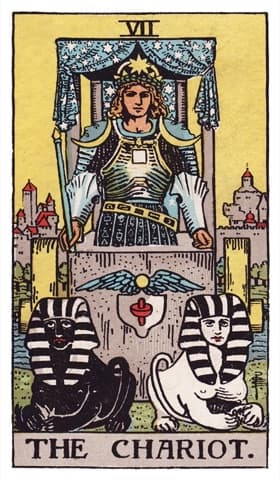
The Chariot reversed gets flattened into "you have lost control." Sometimes that is the reading. The more useful version asks a colder question: is there no destination, or is there a destination you are forcing onto a team that will not go there together?
Those feel similar — effort, noise, little progress. They need opposite moves.
Upright first: one line through two pulls
The Rider-Waite Chariot has no reins. Black sphinx, white sphinx, armour, a driver who holds direction by attention rather than by straps. The card is not "you will win." It is competing forces made to serve one destination.
Upright is not ease. The moment concentration drops, the team drifts. That is the job: keep the line.
Reversed, the line is gone, or it was never agreed.
This is a different card from Strength reversed. Strength is how you stay in contact with something that can bite — a feeling, a person, a piece of work. The Chariot is whether one destination is being held. You can be patient with the lion and still have no city you are driving toward. You can have a destination and still be punching the thing that needs a hand on the mane. Do not treat them as synonyms.
Reading one: the sphinxes have the reins
The search-result version, and a real one. Motion everywhere. No city on the map.
Three projects, two job tracks, a relationship that is also a maybe-move. The week is full. Nothing arrives. You call it busy. It is two animals walking in a circle.
The tell is speed without a sentence you could finish: "I am going to ___." Seven of Cups nearby is the haze. Two of Pentacles nearby is the juggling that has replaced a destination. Eight of Wands reversed can mean the messages and tasks are flying and none of them land.
This is the reading people want, because "pick one" sounds like wisdom. It is correct here. It is the wrong medicine for the other two.
Reading two: forcing a team that is not harnessed
The under-diagnosed pole, and the one that looks like discipline.
You have a destination. The parts have not agreed to pull it. A partner who never signed the five-year plan. A body you are treating as a vehicle. A team that is smiling in the meeting and stalling in the work. You add more will. The heat goes up. The wheels do not.
Upright Chariot assumes the sphinxes are at least in the traces. This version is yelling at animals that were never hitched. Five of Wands nearby means the fight has become the activity. the Emperor reversed nearby can mean you are using rules as a whip. The Lovers reversed is the neighbour if the split is values, not effort — you cannot drive two people toward a life only one of them chose.
People who pride themselves on being driven land here more often than they land in scatter, because scatter would feel like failure and this feels like effort.
Reading three: victory as the only allowed outcome
The inward version. The destination is not a place. It is not losing.
You cannot stop because stopping would mean the last six months were a waste. The chariot is now a way to avoid a reckoning. Six of Wands nearby is the audience you are still performing for. Death reversed sits next to this when the honest move is to let the campaign end. Justice reversed is useful if the question is whether you will look at the cost, versus whether you will keep driving past it.
This still is the Chariot reversed. The function — one chosen line — has been replaced by compulsion. The Devil nearby asks the same question in a heavier voice: are you driving, or being driven?
Reading this for a card you pulled?
Pull three cards free →The test
Is there no destination, or is there one you are forcing?
| What it feels like | Reading | The move |
|---|---|---|
| A full week and no sentence that ends with a place | Scatter | Name one destination. Park the rest for thirty days. |
| More will is producing more heat, not more miles | Unharnessed | Stop adding force. Ask what has not actually agreed to pull. Hitch or drop. |
| You cannot stop because stopping would rewrite the story | Compulsion | End the campaign long enough to weigh it. A pause is not a surrender of the destination. It is how you check you still have one. |
These are opposite medicines. Adding focus to an unharnessed team produces a more expensive crash. Adding rest to scatter without picking a city produces a quieter circle. If you cannot tell which you are in, look at the last hard week: was the problem too many destinations, or one destination nobody else is on?
The Chariot reversed in love
Two common pictures.
One: drift. Two lives running in parallel, both in motion, no shared city. "It's complicated" is doing the work a decision should do.
Two: one driver. A timeline, a label, a city, a family plan — held so tightly the other person has become a sphinx being shouted at. The upright card needs two forces serving a line. It does not need one person turning the other into a vehicle.
If the question is whether the connection can be steered at all, is this relationship worth saving is the decision page. If the question is whether to name the split, should I say something is closer. This card is the diagnostic underneath: is there a shared destination, or only speed?
The Chariot reversed at work
Frequently the person on three tracks, or the person white-knuckling a launch the rest of the room has already left.
A promotion you are forcing because the alternative is admitting the current role is the destination. A product being driven past a market that has not hitched. If the question is whether to stay, should I quit my job frames the decision. This reversal asks whether the pain is scatter, or a destination that was never agreed.
Am I on the right path is useful when you have a line and doubt the city. The Chariot reversed is prior: do you have a line at all, and is anyone else on it?
The honest part
No card knows whether your week needs a narrower map or less whip. Reversals are a convention. Plenty of readers never use them.
What this one is good for: it refuses the lazy story that "try harder" or "let go of control" is wisdom. Those are the same axis. The useful question is whether a destination exists and whether the team is in the traces. If you have no city, pick one. If you have a city and no team, stop yelling and hitch or drop. If you cannot stop, you are no longer driving.
Read it as reflection, and pick a pole before you pick a pep talk.
Where to go next
- The Chariot (upright) → — the full card meaning.
- Strength reversed → — when the problem is how you meet intensity, not whether you have a destination.
- The Emperor reversed → — when the missing thing is a rule, not a direction.
- All 78 reversed meanings → — the full reference.
Pulled the Chariot reversed? Pull a free 3-card spread → and ask whether you need a destination, or need to stop forcing one.