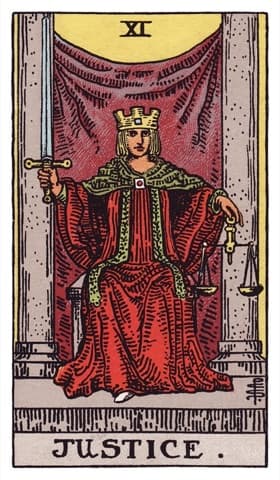
Justice reversed gets flattened into "something unfair is happening." Sometimes that is the reading. The more useful version asks a colder question: is the scale lying, or have you refused to step on it?
Those feel similar — a sour taste around "this isn't right." They need opposite moves.
Upright first: cause, effect, no thumb
The Rider-Waite Justice sits between pillars with a sword and a level scale. The sword cuts both ways. The scale measures what is, not what would be kinder. Upright is not "good things come to good people." It is proportion: what was set in motion is arriving in the size it actually earned.
Upright includes you. The card has no interest in the version of the story where you are only the injured party.
Reversed, the proportion is off — because someone is pressing the pan, or because nobody will weigh.
This is a different card from the Devil reversed. Devil reversed asks whether the behaviour changed or only the story about it. Justice reversed asks whether you will measure at all, and whether the measurement is honest. You can leave a pattern and still refuse the bill. You can pay a bill and still be inside a chain.
It is also not the Lovers reversed. Lovers is values versus behaviour. Justice is the ledger: what was given, what was taken, what is owed. Do not collapse them.
Reading one: thumb on the scale
The search-result version, and a real one. The facts are being arranged.
You remember your patience in high resolution and their failure in the same. You count what you gave and round down what you received. A workplace story where "the process" always lands on the same person. A family myth in which one sibling is the problem so the rest of the system never has to be weighed.
The tell is a conclusion that arrived before the evidence finished speaking. Five of Swords nearby means winning has replaced fairness. Seven of Swords nearby means something is being hidden from the weigh-in, including from yourself. The Moon nearby is fog; if the question is whether you can see, start there. If you can see and are editing, stay here.
This is the reading people want when they feel wronged, because it confirms a villain. Sometimes there is one. The card still asks whether your pan is being pressed too.
Reading two: you will not get on the scale
The under-diagnosed pole. Not a biased weigh-in. No weigh-in.
You will not look at the bank statement, the sent folder, the actual hours. You will not ask what you contributed to the stall. You keep the situation in language — "it's messy," "it's complicated," "we'll see" — because a number would require a next move.
This is still Justice reversed. The function is missing. People who are allergic to being "judgmental" land here constantly, then wonder why the same bill returns.
Supporting signals: Two of Swords (the unmade look sitting where a measurement should be), Four of Pentacles when you are clutching the story, the Hanged Man reversed when looking already happened and you will not come down into a consequence. The High Priestess reversed is the neighbour if the unused thing is inner knowing rather than a ledger — you already know, and you will not let the knowing become a number.
Reading three: a real unfairness used as cover
The inward version, and the one that is easiest to defend.
Something was unfair. A decision, a parent, a company, a partner. That part is true. It has become a shield that keeps your own later choices off the scale. Every new outcome is filed under the original injury. The books never get a second line.
This still is Justice. The first entry can be accurate and the rest of the ledger still be dishonest. Five of Cups nearby is the gaze locked on what was lost. Judgement nearby is the call you will not answer because answering would include you. The Emperor reversed sits next to this when the missing thing is a rule you will not apply to yourself.
Reading this for a card you pulled?
Pull three cards free →The test
Is the scale biased, or have you refused to weigh?
| What it feels like | Reading | The move |
|---|---|---|
| The conclusion was ready before the facts finished | Thumb | Write both columns. Include what you did. If you cannot put your name on a line, that is the finding. |
| You can describe the situation and cannot point to a single number or date | Refusal | Weigh one thing. Money, hours, messages, or a specific choice. One honest unit. |
| An old injury explains every new outcome | Cover | Keep the first entry. Add the later ones. The original unfairness does not retire the rest of the book. |
These are opposite medicines. Adding more "fairness" talk to a refusal produces a prettier stall. Adding more self-critique to a thumb already on your own pan produces collapse, not honesty. If you cannot tell which you are in, look at the last argument: did you distort a fact, or decline to look at one?
Justice reversed in love
Two common pictures.
One: a running ledger that only one person is allowed to keep. Scorekeeping dressed as memory. Or the reverse — a story so edited that the actual imbalance (who pays, who plans, who apologises) never gets a number.
Two: both of you off the scale. No one will say what they want, what they have given, or what they will not do again. Atmosphere instead of terms. This one gets defended as not being "transactional." Justice does not require you to invoice affection. It requires you to stop pretending the exchange is invisible.
If the question is whether the connection can be rebalanced, is this relationship worth saving is the decision page. If the question is whether to name the imbalance, should I say something is closer. Should I trust him is useful when the missing thing is evidence versus the story you prefer. This card is the diagnostic underneath: will you weigh, and will you include your hand?
Justice reversed at work and money
Frequently the process that always lands the same way, or the freelancer who will not look at the actual rate.
A promotion story you have been telling that does not match the emails. A partnership where "equity" is a word and the split is not. If the question is whether to leave, should I quit my job frames the decision. This reversal asks whether you have measured the situation, or only narrated it.
Contracts belong here in the literal sense. If the card keeps arriving around a signature, the move is not a vibe check. It is the document.
The honest part
No card knows whether you are being cheated or doing the editing. Reversals are a convention. Plenty of readers never use them.
What this one is good for: it refuses the lazy story that "the world is unfair" or "I should blame myself" is wisdom. Those are the same axis. The useful question is whether a weigh-in is happening and whether both pans are visible. If the scale is biased, take the thumb off — including your own. If there is no scale, put one thing on it. If an old injury is covering the new lines, add the new lines.
Read it as reflection, and pick a pole before you pick a verdict.
Where to go next
- Justice (upright) → — the full card meaning.
- The Devil reversed → — when the question is whether the behaviour changed, not whether the books were opened.
- The Hanged Man reversed → — when the problem is a pause that will not become a consequence.
- All 78 reversed meanings → — the full reference.
Pulled Justice reversed? Pull a free 3-card spread → and ask whether the scale is biased, or whether you have refused to step on it.