If you pulled the Six of Swords, you pulled the card of the crossing. Sixes are about movement and recovery after the crisis of the fives, and Swords are the suit of the mind and its struggles — so the Six of Swords is the journey away from troubled thinking and hard times toward something calmer: a transition, a moving-on, a passage from rough water to still water.
But the image is honest about what that journey is like, and it's why this card lands so true. You don't arrive instantly, and you don't travel empty-handed. The swords come with you in the boat — the baggage, the lessons, the memories of what you're leaving. The Six of Swords isn't a triumphant escape. It's the quiet, bittersweet act of moving toward peace while still carrying the weight of what you're moving away from.
What the picture is showing
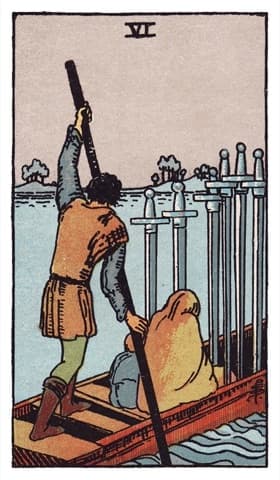
The Six of Swords shows a ferryman poling a small boat across water, carrying a hunched, cloaked figure and a child. Six swords stand upright in the front of the boat. Look closely at the water: on one side it's choppy and disturbed; ahead, toward the far shore, it's smooth and calm.
Three details carry the meaning. The two kinds of water — turbulent behind, calm ahead — show the whole arc of the card: you're moving from difficulty toward peace. The swords in the boat: you can't leave the pain entirely behind; it travels with you, upright and present, the baggage of the journey. And the hunched figures: this isn't a joyful escape — there's grief in it, the weariness of someone who's been through something. But the boat is moving, steadily, in the right direction.
That's the whole card. The Six of Swords is a transition toward calmer water — carrying your baggage with you, leaving the turbulence behind, moving gradually toward peace even if you can't feel it yet.
What the Six of Swords actually means
When this card appears, it's usually pointing at one of three things. All of them are about movement away from difficulty.
Transition and moving on
The most common Six of Swords reading. You're in a passage from one state to another — leaving a hard situation, a difficult chapter, a turbulent period behind, and heading toward something more stable. The card marks the in-between: not where you were, not yet where you're going, but moving.
A journey toward calmer waters
The Six of Swords often specifically signals improvement — that things are getting better, even if slowly. The far shore is calmer. After turbulence, this card is the quiet promise that you're heading somewhere more peaceful, and that the worst of the rough water is behind you.
Carrying baggage forward
The swords in the boat are the card's honest note: you don't get to leave everything behind. The Six of Swords often marks moving on while still carrying the weight — the memories, the lessons, the grief. You're not erasing what happened; you're taking it with you to calmer water, where you'll have room to set it down eventually.
How to read the Six of Swords in love
In a love reading, the Six of Swords is about transition toward calmer water. It can mean a couple moving through a hard patch and gradually finding peace together — weathering the storm and reaching steadier ground. Or it can mean moving on from a relationship that needed to end, leaving painful water behind and heading, however sadly, toward healing.
The card's tone is bittersweet either way. There's loss in it — you're leaving something — but the direction is hopeful: toward peace, toward recovery, toward calmer conditions than what you're leaving. The swords coming along mean the feelings travel with you; you don't simply switch them off. Reversed, the Six of Swords in love often means struggling to make this move — unable to leave a turbulent relationship, or clinging to a shore you know you need to push off from. The upright message is gentle: the crossing is worth making, even carrying what you carry.
How to read the Six of Swords in career
At work, the Six of Swords often marks a transition — leaving a difficult job, moving to a new role, relocating, or coming out of a stressful period into something more stable. It frequently signals that you're heading toward calmer professional waters after turbulence, even if the move itself is tiring or tinged with regret. The swords remind you that you carry your experience (and your scars) into the new situation. Its counsel is to trust the direction: the far shore is calmer, the move is usually the right one, and the weariness of the crossing doesn't mean you're going the wrong way.
Reading this for a card you pulled?
Pull three cards free →The Six of Swords in combination
Six of Swords + Ten of Swords
The bottom and the crossing away from it. The Ten of Swords is rock bottom, a painful ending; the Six of Swords is the journey onward toward calmer water. Together they trace a clear arc — from the worst of it to moving on and recovering. A reassuring sequence: the ending has happened, and now you're crossing toward something more peaceful. Strongly about healing after a low point.
Six of Swords + Five of Swords
Conflict and the departure from it. The Five of Swords is a costly conflict or hollow victory; the Six of Swords is leaving that turbulent water behind. Together they often describe walking away from a fight that wasn't worth it and heading toward calmer ground — the wisdom of departure after conflict. Sometimes the healthiest move after the Five's battle is the Six's boat.
Six of Swords + The Star
Transition meeting hope and healing. The Six of Swords is the journey toward calmer water; the Star is renewal, hope, and peace after hardship. Together they're a beautifully gentle pairing — the crossing arriving at genuine calm and restoration. Among the most hopeful sequences the Six can land in: you're not just leaving the turbulence, you're heading somewhere that heals.
Six of Swords + Ace of Swords
Moving on with new clarity. The Six of Swords is transition; the Ace of Swords is breakthrough and clear sight. Together they can mark a move made with fresh understanding — leaving the old situation behind because you finally see clearly what you need. The clarity that makes the crossing possible, and points the boat in the right direction.
How to read the Six of Swords by position
| Position | What the Six of Swords usually means |
|---|---|
| Past | A transition or moving-on that shaped you — a difficult period you crossed away from, carrying its lessons, that brought you to where you are now. |
| Present | You're in transition right now. The card affirms you're heading toward calmer water, even if you can't feel it yet — the rough part is behind you and the direction is right. |
| Future | A transition or move toward better conditions is ahead. The card promises calmer water on the far shore; the crossing itself may be tiring, but it leads somewhere more peaceful. |
| Hopes / Fears | You hope to leave a hard situation for calmer water, OR you fear the journey — the loss of leaving, or carrying your baggage into the new place. The card says the crossing is worth it. |
When the Six of Swords is genuinely hard
A few honest notes, because the crossing isn't painless:
- When you don't want to leave. Sometimes the calmer shore requires leaving something you love or are attached to, and the Six of Swords' grief is real. The card doesn't pretend the departure is easy. It only insists the water ahead is calmer than the water behind — that the move, however sad, is toward healing rather than away from it.
- When the baggage feels too heavy. The swords come with you, and sometimes the weight of what you're carrying makes the whole crossing feel impossible. The card's quiet reassurance is that you don't have to unpack it mid-journey. You carry it to calmer water first, where there's finally room and stillness to set it down. The crossing comes before the healing, not after.
- When you're stuck on the near shore. Reversed especially, the Six of Swords can mean you know you need to move but can't push off — clinging to turbulent water because leaving feels harder than staying. The card's compassion here is to name that the rough water is not actually safer for being familiar. The boat is waiting. The calmer shore is real. The only hard part left is letting go of the bank.
The bigger reframe
The Six of Swords looks like a melancholy card — hunched figures, a grey crossing, swords standing in the boat like a burden you can't put down. And that melancholy is honest; the card never pretends moving on is pure relief. But look where the boat is pointed. The water ahead is calm. The whole image is built around a single direction: away from turbulence, toward peace.
That's the teaching, and it reframes the sadness without denying it: a hard transition is still movement toward something better. The Six of Swords doesn't promise you'll arrive unburdened or that leaving won't hurt. It promises something quieter and truer — that you're heading the right way, that the rough water is behind you, and that the weight you're carrying is coming with you to a place calm enough to finally set it down. Keep crossing. The far shore is calmer than the one you left.
If you've pulled the Six of Swords and you're in the middle of a hard transition, the free three-card draw on this site is built for exactly that. Pull two more cards around your Six of Swords: what you're leaving behind, what you're carrying with you, and what the calmer water ahead actually holds.
A small boat, still water ahead, and swords you couldn't leave behind. The card is just telling you you're heading the right way — toward calmer water, even carrying all that.
Pull three cards on the transition you're moving through → What you're leaving behind. What you carry with you. What the calmer water holds.