If you pulled the Seven of Swords, you pulled the deck's trickiest card — and trickiest in two senses. Sevens are about strategy and assessment, and Swords are the suit of mind — so the Seven of Swords is the mind being clever: strategy, cunning, acting alone, and, in its shadow, deception and getting away with something.
But the card holds two readings at once, and which one applies is the whole art of reading it. The figure is sneaking off with swords — that can mean a thief, a liar, someone being dishonest. Or it can mean a strategist: someone acting independently, thinking ahead, taking a clever and unconventional route. The Seven of Swords isn't simply "deception." It's cunning — and cunning can be a betrayal or a wisdom depending on who's using it and why.
What the picture is showing
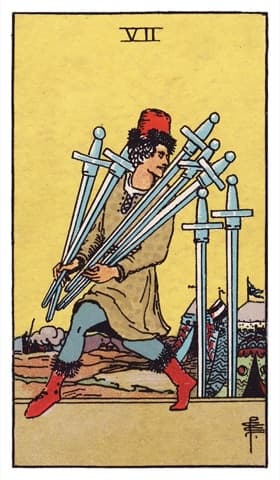
The Seven of Swords shows a figure tiptoeing away from a camp, carrying five swords bundled awkwardly in their arms, glancing back over their shoulder with a sly look. Two swords stay behind, stuck upright in the ground. In the distance, tents and figures suggest the camp they're slipping away from, apparently unnoticed.
Look at the details. The figure is sneaking — on tiptoe, looking back to see if they're seen. That's the deception reading: stealth, theft, doing something they don't want observed. But notice they couldn't carry all the swords — two are left behind. The clever plan is imperfect; something gets dropped. And notice it could be read the other way: someone making a strategic exit, taking what they need, acting alone rather than with the group. The card holds the thief and the strategist in the same posture.
That's the whole card. The Seven of Swords is cunning and acting alone — which can mean deception and getting away with something, or strategy and independent thinking, depending on how it's used.
What the Seven of Swords actually means
When this card appears, it's usually pointing at one of three things. The trick is telling which.
Deception and dishonesty
The most common Seven of Swords reading. Someone is being dishonest — lying, hiding something, sneaking around, or getting away with something they shouldn't. It can be another person deceiving you, or a nudge to notice deception you've been ignoring. The sly backward glance is the tell: something here is being done out of sight.
Strategy and acting alone
The card's other face. The Seven of Swords can mark clever strategy, thinking ahead, or choosing to act independently rather than relying on the group. Sometimes the "sneaking" is just an unconventional, self-reliant approach — taking your own route, keeping your plans to yourself, outmaneuvering an obstacle by wits rather than force. Cunning in service of something legitimate.
Getting away with something — and the dropped swords
The Seven of Swords often carries the specific energy of almost getting away with it. The figure took five swords but dropped two — the clever plan that doesn't fully work, the deception that leaves a trace, the corner cut that comes back around. Read this way, the card is a quiet warning: schemes have loose ends, and what you sneak off with is rarely the whole of it.
How to read the Seven of Swords in love
In a love reading, the Seven of Swords most often points to deception or things kept out of sight — a partner who isn't being fully honest, a secret, an affair, or someone acting behind the scenes. It can also turn the question on you: are you holding something back, keeping a part of yourself hidden, or not being transparent? Its core caution is a lack of openness somewhere in the relationship.
Read in its lighter sense, the Seven of Swords can occasionally mean needing some independence or strategy in love — space to act on your own, or a situation that calls for thinking ahead rather than wearing your heart on your sleeve. But the more common message is the warning one: something here isn't being said in the open. Reversed, the card usually means that hidden thing surfacing — a secret revealed, a confession, or the choice to come clean. Either way, the Seven of Swords asks you to bring what's been kept in the dark into the light.
How to read the Seven of Swords in career
At work, the Seven of Swords can cut both ways. In its shadow, it warns of dishonesty, office scheming, someone taking credit that isn't theirs, cut corners, or unethical tactics — yours or a colleague's. In its brighter sense, it can mark smart strategy, working independently, an unconventional approach that gets results, or the wisdom of keeping your plans close until they're ready. The card's job is to make you ask which one is in play: are you (or someone near you) being clever in a way that's legitimate, or in a way that will drop a sword and come back around? When the Seven of Swords appears about work, the honest test is whether your strategy would survive being seen.
Reading this for a card you pulled?
Pull three cards free →The Seven of Swords in combination
Seven of Swords + The Moon
Two cards of things not being what they seem. The Seven of Swords is deliberate deception or hidden action; the Moon is illusion, confusion, and obscured truth. Together they strongly signal that something is being concealed and the full picture isn't visible — a powerful "don't trust the surface, something is hidden here" pairing. Worth slowing down and looking for what's out of sight.
Seven of Swords + Five of Swords
Stealth and open conflict — two faces of swords-as-tactics. The Seven of Swords is sneaking and deception; the Five of Swords is open, costly conflict. Together they can describe a situation where someone is both fighting and scheming — winning by a mix of force and dishonesty — or a conflict with hidden moves underneath it. A caution that the game being played isn't clean on either front.
Seven of Swords + Nine of Swords
The scheme and the sleepless conscience. The Seven of Swords is getting away with something; the Nine of Swords is the anxiety and guilt that follow. Together they often describe the cost of deception that doesn't show on the surface — lying awake over what you hid, or the dread of being found out. The dropped swords coming back as 3am worry.
Seven of Swords + The Magician
Cunning meeting genuine skill. The Seven of Swords is strategy and cleverness; the Magician is mastery, will, and the power to make things happen. In its bright reading, together they mark real strategic capability — outsmarting a problem with skill and resourcefulness. In its shadow, they can warn of manipulation: skill bent toward deception. Same talent, two very different uses.
How to read the Seven of Swords by position
| Position | What the Seven of Swords usually means |
|---|---|
| Past | A deception, strategic move, or act of self-reliance that shaped you — something done out of sight, or a clever route taken alone, whose consequences (good or loose-ended) you're living with now. |
| Present | Deception or strategy is active right now. The card asks you to tell which: is someone being dishonest (you or another), or is independent, clever action genuinely called for? Look for what's hidden. |
| Future | A situation calling for strategy — or one involving deception — may be ahead. Forewarned, you can choose to act with honest cunning rather than be caught out by someone else's. |
| Hopes / Fears | You may fear being deceived or betrayed, OR hope to get away with something / pull off a clever plan. Read with the dropped swords, it asks whether the scheme is as airtight as you'd like to believe. |
When the Seven of Swords is genuinely hard
A few honest notes, because this card sits on a real edge:
- When you're the one being deceived. Sometimes the Seven of Swords is naming a betrayal you've half-noticed and not wanted to face — a partner, a colleague, a friend acting behind your back. The card's hard gift is to stop discounting the backward glance. If something feels hidden, the Seven of Swords is permission to look directly at it rather than explain it away.
- When you're the one sneaking. The harder version is recognizing yourself in the tiptoeing figure — cutting a corner, keeping a secret, taking a route you wouldn't want seen. The card isn't only an accusation; it's a checkpoint. The dropped swords are its warning that this rarely stays fully hidden. Better to choose openness now than to be unraveled by it later.
- When strategy shades into manipulation. The Seven of Swords' two readings sit very close together, and the line between "clever and independent" and "deceptive and self-serving" is easy to blur in your own favor. The honest test the card offers is simple: would your strategy survive being seen by the people it affects? If yes, it's cunning. If no, it's the other thing.
The bigger reframe
The Seven of Swords looks like the deck's card of the thief — and read that way, it's a clear warning about deception, yours or someone else's. But the artist left the image deliberately double. The same tiptoeing figure is either a liar slipping off with what isn't theirs, or a strategist making a smart, self-reliant move the group can't see yet. The posture is identical; only the intent differs.
That's the teaching, and it's sharper than it first looks: cunning is morally neutral until you aim it. The Seven of Swords hands you cleverness, stealth, and the ability to act alone, and then asks the only question that matters about those gifts — what are you using them for? Strategy in service of something honest is wisdom. The same strategy in service of deception drops swords you'll have to come back for. The card doesn't tell you which figure you are. It just makes sure you know you're holding the choice.
If you've pulled the Seven of Swords and something feels hidden — in your situation or in your own plans — the free three-card draw on this site is built for exactly that. Pull two more cards around your Seven of Swords: what's actually being concealed, who's holding the swords, and whether the clever route is wisdom or evasion.
Five swords carried off, two left behind, a glance back over the shoulder. The card is just asking what you're being clever for — and whether it would survive being seen.
Pull three cards on what's hidden in your situation → What's actually being concealed. Who's holding the swords. Whether the clever route is wise.