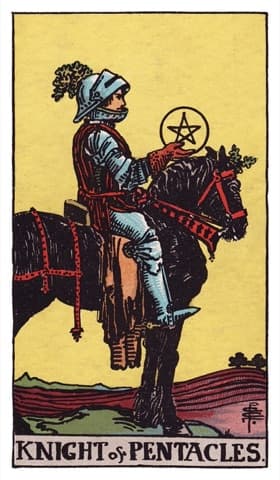
If you pulled the Knight of Pentacles, you pulled the deck's most underrated card — the only knight in the tarot whose horse is standing still. The other three knights are charging, galloping, or trotting off toward something. This one sits motionless on a heavy black workhorse, holding a single pentacle, looking out over a plowed field. He isn't going anywhere fast. That's the point.
Pentacles are the suit of the material world: work, money, craft, the slow business of building a life. And the Knight is the suit's worker — not the eager student of the Page, not the established master of the King, but the person in the middle doing the actual labor. Diligent, methodical, unhurried, and almost supernaturally reliable. The Knight of Pentacles is what follow-through looks like when nobody's watching.
What the picture is showing
The Knight of Pentacles shows an armored knight seated on a heavy, dark workhorse standing completely still in the middle of farmland. The knight holds a single pentacle out before him, but unlike the Page, he isn't studying it with wonder — he's regarding it steadily, the way a builder regards a brick. Behind him stretch freshly plowed fields, furrow after furrow of patient, finished work. His helmet is crested with a sprig of oak leaves; the horse's bridle too — growth, but the slow kind.
Three details carry the meaning. The still horse: this is the only knight not in motion, because his power isn't speed — it's persistence. A workhorse, not a charger; bred for the plow, not the battle. The plowed field: the evidence of labor already done, row by row, none of it glamorous, all of it necessary. And the steady gaze at the pentacle: not dreaming about the goal, not admiring it — assessing it, planning the next furrow. The card holds all three: patience, completed work, and the unsentimental focus of someone who measures twice.
That's the whole card. The Knight of Pentacles is the slow, sure worker — diligence without drama, progress without speed, the one figure in the deck guaranteed to finish what he starts.
What the Knight of Pentacles actually means
When this card appears, it's usually pointing at one of three things. All of them concern the unglamorous middle of real work.
Diligence and follow-through
The card's core. The Knight of Pentacles is effort sustained past the point where it stopped being exciting — the project continued in week forty, the habit kept on the gray mornings, the work done thoroughly because that's how work gets done. When this card appears, it usually affirms exactly that energy: keep going, keep the standard, don't cut the corner. It can also be a summons — the situation in front of you doesn't need brilliance or speed; it needs someone to actually do the thing, completely, and this card is asking whether you'll be that person.
Routine as a strength
The still horse is not stuck; it's planted. The Knight of Pentacles dignifies routine — the daily systems, the boring consistency, the same-thing-every-day rhythm that everyone underestimates until they see what it builds. In a culture that worships intensity, this card quietly insists that consistency beats intensity over any distance longer than a sprint. When it appears, it often counsels building the routine rather than chasing the breakthrough: the plowed field behind the knight wasn't plowed in a day, and it wasn't plowed in a frenzy either.
Slow progress that actually arrives
The Knight's promise. Things move under this card — slowly, invisibly some weeks, but they move, and unlike faster energies they don't slide backward. The Knight of Pentacles often appears when you're discouraged by the pace of something real: the savings building too slowly, the skill improving too gradually, the recovery taking too long. The card's answer is that this pace is the trustworthy one. Fast progress is loud and fragile; the Knight's progress is silent and permanent. He arrives later than the other knights. He arrives every time.
How to read the Knight of Pentacles in love
In a love reading, the Knight of Pentacles is the partner people say they want and then overlook — steady, loyal, genuinely dependable, the one whose affection shows up as acts rather than speeches. He remembers the appointment, fixes the leak, plans the future in real numbers. A relationship under this card tends to develop slowly and on solid ground: fewer fireworks than the other knights, far fewer surprises, and a foundation that actually holds weight. For couples, the card often affirms the quiet virtues — reliability, shared routines, the steady accumulation of a life built together.
The card's honest caution is monotony. Steady can shade into stagnant; the same horse that never bolts also never dances. The Knight of Pentacles relationship can settle so deep into routine that romance flattens into logistics, and the partner who never surprises you can start to feel like furniture. Reversed, the card flags exactly this — the rut, the roommate dynamic, devotion expressed entirely through chores while the emotional connection quietly starves. The remedy isn't a different horse; it's remembering that even workhorses need to leave the field sometimes. Upright, though, read this card as the reassurance it is: this person is real, this bond is built to last, and in a deck full of dramatic lovers, the one who stays is worth more than the ones who dazzle.
How to read the Knight of Pentacles in career
At work, the Knight of Pentacles is close to the best card you can pull for anything that requires sustained effort — which is nearly everything that matters. It's the card of the long project executed properly, the certification earned course by course, the business built customer by customer. When it appears, it usually means the path forward is methodical: not a pivot, not a gamble, just consistent competent work continued until it compounds. It frequently describes you at your most reliable, or a colleague who is exactly that — the person who actually ships, the one whose estimates you can trust.
Its counsel is to respect the process. The Knight doesn't skip steps, doesn't overpromise, doesn't confuse motion with progress. If you're asking about a venture, the card favors the boring fundamentals — steady output, careful money, patience with slow growth — over any dramatic move. Its warning, reversed especially, is the grind without direction: workaholism, perfectionism that never ships, or a rut where diligence has become an excuse to never reassess whether the field you're plowing is the right field. The Seven of Pentacles asks that assessment question; the Knight, at his best, pauses long enough to hear it — then gets back to work on what's worth working on.
Reading this for a card you pulled?
Pull three cards free →The Knight of Pentacles in combination
Knight of Pentacles + Eight of Pentacles
Pure work ethic, doubled. The Eight of Pentacles is devoted craftsmanship; the Knight is the temperament that sustains it. Together they're the strongest diligence signal in the deck — mastery being built the only way it ever gets built, repetition by repetition, with no shortcut wanted. For any question about skill, study, or a long project, this pairing says: the method is working, keep going.
Knight of Pentacles + Page of Pentacles
The student and the worker — two stages of the same road. The Page is eager beginning; the Knight is what that beginning must become to survive: routine, persistence, follow-through. Together they often describe a new venture maturing past its honeymoon, or counsel that an opportunity now needs less enthusiasm and more plowing. The arc they trace is hopeful: curiosity growing up into competence.
Knight of Pentacles + King of Pentacles
The road and its destination. The Knight is the years of methodical labor; the King is the established mastery and material security that labor eventually buys. Drawn together, they affirm that the slow path is the right one — the grinding middle you're in now is exactly how the King's castle got built. A deeply steadying pairing for anyone tired in the middle of something long.
Knight of Pentacles + The Hermit
Patience inward and outward. The Hermit withdraws to find what's true; the Knight works steadily at what's real. Together they describe a deliberately quiet season — unhurried, unflashy, rich in substance — where the work is done carefully and the reasons are examined honestly. The pairing counsels trusting slowness in both directions: slow work outside, slow understanding inside.
How to read the Knight of Pentacles by position
| Position | What the Knight of Pentacles usually means |
|---|---|
| Past | Patient work already done — a foundation you built through sheer consistency, discipline that got you here, or a steady person whose reliability shaped you. |
| Present | The situation calls for diligence, not brilliance. Keep the routine, do the work thoroughly, resist the urge to rush. Slow is the correct speed right now. |
| Future | Progress is coming — gradual, solid, and permanent. Or: a dependable person enters the picture. Either way, what arrives will have been earned and will hold. |
| Hopes / Fears | You long for stability and trustworthy progress — OR you fear stagnation, boredom, a life plowed into ruts. The card asks which one your routine is actually building. |
When the Knight of Pentacles is genuinely hard
A few honest notes, because the deck's most dependable card has real shadows:
- When the rut gets mistaken for the road. Routine is a tool, not a destination, and the Knight's great failure mode is continuing — diligently, admirably, indefinitely — down a furrow that should have been abandoned seasons ago. Hard work has a way of feeling like its own justification. The card turns hard when persistence becomes the reason you never ask whether this field, this job, this arrangement is still the right one.
- When steady becomes invisible. Knights of Pentacles get taken for granted — at work, where the reliable one is handed more work instead of more recognition, and in love, where the partner who never causes problems stops being seen at all. If this card is you, the hard truth is that dependability doesn't advocate for itself. The still horse never draws the eye. Sometimes you have to.
- When the pace costs you the moment. There are seasons that genuinely reward slowness, and there are windows that close. The Knight's temperament — measure twice, commit carefully, never rush — can, at its worst, watch an opportunity expire while it finishes its due diligence. The other knights crash for moving too fast; this one occasionally loses for moving too late. Knowing which season you're in is the judgment the card can't make for you.
The bigger reframe
The Knight of Pentacles sits on a horse that isn't moving, in front of a field that's already plowed, holding a coin he isn't dreaming about — and the card is a quiet argument against almost everything the culture says about how success looks. No charge, no flash, no genius hour. Just a person who decided what to build, and then built it, row by row, on the days it was interesting and the days it wasn't.
That's the teaching, and it lands harder the older you get: nearly everything durable in a life — the skill, the savings, the trust, the health, the marriage — was built by Knight of Pentacles energy, and almost none of it was built by inspiration. Inspiration starts things. This card finishes them. Its only real demand is the one that sounds easiest and isn't: keep going, properly, at the unglamorous thing, longer than feels heroic. The field behind the knight is the proof. Nobody saw him plow any single furrow. Everybody can see the field.
If you've pulled the Knight of Pentacles and you're somewhere in the long middle — of a project, a discipline, a relationship being built the slow way — the free three-card draw on this site can help you read the road. Pull two more cards around your Knight of Pentacles: what the work is actually building, where the routine needs adjusting, and what arrives if you stay the course.
A still horse, a plowed field, a steady gaze. The card is the deck's most honest picture of how things actually get done — slowly, thoroughly, and by the one who didn't stop.
Pull three cards on the long road → What the work is building. What needs adjusting. What arrives if you stay the course.