If you pulled the Seven of Pentacles, you pulled the card of the pause — the moment of leaning on your tool and looking at what you've grown. Pentacles are the suit of the material world: work, money, the slow business of building something real. The Seven is the suit's card of patience and assessment: the breath you take partway through a long effort, when you stop to weigh what's ripening and decide whether to keep tending it.
It's one of the deck's quieter, more grown-up cards. There's no triumph here and no disaster — just a person looking honestly at the slow results of their labor, holding the hardest question any long project asks: is this worth my continued patience, or is it time to put my effort somewhere else?
What the picture is showing
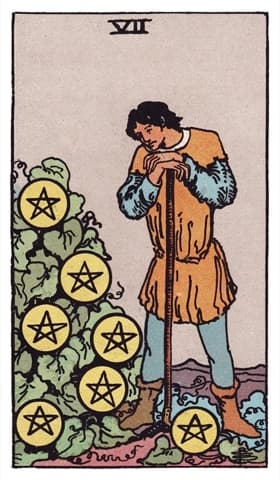
The Seven of Pentacles shows a young man leaning on a long-handled hoe, gazing at a lush green bush or vine heavy with seven pentacles growing among the leaves. He has clearly been working — the tool is in his hands, the plant is the product of his labor — but in this moment he isn't working. He's looking. His posture is thoughtful, maybe a little weary, his attention fixed on what he's grown.
Three details carry the meaning. The pause in the labor: the hoe set down, the work stopped for a moment of reflection rather than action. The fruit still on the vine: the pentacles have grown but not been harvested — results that exist but aren't yet in hand. And the contemplative gaze: the weighing, assessing look of someone deciding whether the crop is worth more waiting, or whether their effort would grow more somewhere else. The card holds all three: patience, the gap between effort and reward, and the honest assessment of a long investment.
That's the whole card. The Seven of Pentacles is the patient pause in the middle of long work — stepping back to assess what you've grown, weighing the slow gap between effort and harvest, and deciding whether to keep tending or redirect your energy.
What the Seven of Pentacles actually means
When this card appears, it's usually pointing at one of three things. All of them live in the space between planting and harvest.
Patience and the long game
The card's core. The Seven is about efforts that pay off slowly — investments, careers, gardens, relationships, anything that grows on its own timeline rather than yours. It counsels patience: the fruit is coming, but it can't be rushed, and pulling it early gets you nothing. When the Seven appears, it often means you're in the waiting stretch of a long project, and the work right now is to tend and trust rather than force.
Assessment and taking stock
The contemplative gaze is the card's active verb. The Seven is a moment of evaluation — stepping back from the labor to ask honestly: is this working? Is what I've grown worth what I've put in? Should I keep going on this path, or move my effort elsewhere? It's the mid-project review, the seasonal stock-take, the pause where you measure progress against effort before committing more.
The reckoning with sunk cost
The Seven's hardest note. Sometimes the honest assessment reveals that an investment isn't growing — that the effort poured in won't ripen into the harvest you hoped for. Here the card asks the painful question of sunk cost: do you keep watering this because it's actually growing, or only because of how much you've already spent on it? The Seven doesn't always say keep going. Sometimes its patience turns into permission to stop.
How to read the Seven of Pentacles in love
In a love reading, the Seven of Pentacles is the card of taking honest stock of a relationship. It marks a pause to look at what you've built together — the effort invested, what's grown from it, whether the partnership is bearing the fruit you've both worked for. For established couples, it can describe a thoughtful, mature moment: stepping back to assess where things stand, not in crisis, just in clear-eyed evaluation before deciding how to tend things next. That assessment, done with patience and honesty, is often exactly what a long relationship needs.
But the Seven carries its harder questions into love, too. It can flag the slow frustration of a relationship that isn't growing — effort poured in without much fruit on the vine — and it can surface sunk-cost thinking, the temptation to stay because of the years already given rather than what's actually alive now. For singles, it often means evaluating whether your dating energy is paying off, or just being spent. Reversed, it tends to point to impatience with slow progress, or the urge to walk away right before something ripens. The card's gift here is the pause itself: look honestly at what's growing before you decide whether to keep tending it or let it go.
How to read the Seven of Pentacles in career
At work and money, the Seven of Pentacles is one of the most practical cards in the deck — and almost always a counsel of patience. It frequently appears around long-term efforts that haven't paid off yet: a business still finding its feet, a skill still maturing, an investment that needs more time, a career move whose results are months away. The message is usually stay the course — what you've planted is growing, even if the harvest isn't in hand. Don't uproot it out of impatience.
Its assessment theme adds the career fine print. The Seven is a good card for stepping back and reviewing: Is this work actually building toward something? Is the effort proportionate to the return? Where would another season of labor grow the most? It can validate the patient long game, and it can also give honest permission to redirect — to admit a project has stalled and move your energy somewhere with better soil. Reversed, it warns of frustration, burnout from waiting, or sunk-cost decisions that keep you tied to something past its season. Upright, the steady message is: the results are coming, but on the harvest's schedule, not yours. Keep tending, and keep assessing.
Reading this for a card you pulled?
Pull three cards free →The Seven of Pentacles in combination
Seven of Pentacles + Eight of Pentacles
The full rhythm of long work. The Eight of Pentacles is head-down labor — skill built through focused repetition; the Seven is the pause to look at what that labor has grown. Together they describe the whole arc of any serious effort: stretches of dedicated work broken by honest assessment. Drawn side by side, they're a reassuring pair — you're putting in the real work and stepping back to make sure it's growing in the right direction.
Seven of Pentacles + Ace of Pentacles
Assessing a beginning. The Ace of Pentacles is a fresh material seed; the Seven is the patient tending it now needs. Together they can mark a venture that's past its exciting start and into the slow middle — the part where growth is invisible and patience is everything. The pairing's counsel is steady: the seed was real, but it grows on its own clock. Keep watering and resist the urge to dig it up to check.
Seven of Pentacles + Ten of Pentacles
The long game's payoff. The Seven is patient tending; the Ten of Pentacles is established, lasting abundance. Together they can show the full distance from slow effort to settled wealth — proof that the patience the Seven asks for actually leads somewhere. A genuinely hopeful pairing for anyone in the waiting stretch: what you're tending now can become the lasting foundation the Ten describes.
Seven of Pentacles + The Hanged Man
Patience doubled — and reframed. The Hanged Man is suspension, surrender, the wisdom of waiting and seeing differently; the Seven is the patient pause in long work. Together they strongly counsel against forcing anything right now. This is a time to wait, to let things ripen, and maybe to look at your effort from a new angle. The pairing says the answer isn't more pushing — it's patience, and perhaps a shift in how you see what you're growing.
How to read the Seven of Pentacles by position
| Position | What the Seven of Pentacles usually means |
|---|---|
| Past | A season of patient effort or long investment that shaped where you are — work whose fruit took time, or a pause for assessment that set your direction. |
| Present | You're in the waiting stretch now — effort planted, fruit not yet harvested. The card asks you to assess honestly and tend patiently rather than force a result. |
| Future | A time of stock-taking is coming — a moment to step back, weigh what's grown, and decide where to keep investing. Results are on their way, on their own schedule. |
| Hopes / Fears | You long for your patience to pay off — OR you fear you're wasting effort on something that won't grow. The card says: assess honestly, and let the answer guide whether to wait or redirect. |
When the Seven of Pentacles is genuinely hard
A few honest notes, because the patience card has a difficult underside:
- When patience curdles into sunk cost. The Seven's hardest trap is the one it half-warns about: continuing to water something only because of what you've already poured in. Years given, money spent, effort invested — none of it is a reason to keep going if the vine isn't fruiting. The card's patience is for things that are actually growing, not for honoring a loss. Sometimes the honest assessment is: stop.
- When the waiting has no end in sight. Patience assumes a harvest is coming. But some efforts genuinely stall, and 'be patient' becomes a way to avoid a hard call. The Seven asks you to tell the difference between fruit that's slow and fruit that's never going to set — and that's one of the harder distinctions life offers.
- When you pull it up too early. The opposite failure. Impatience, especially reversed, can have you abandoning something the season before it would have ripened. Much real growth is invisible right up until it isn't. The card's discipline is to keep tending through the unrewarding middle, when nothing seems to be happening and quitting feels reasonable.
The bigger reframe
The Seven of Pentacles is a person leaning on a hoe, looking at a vine they've grown — and the card is a meditation on the strange gap between effort and reward. We plant, we tend, we work; and then, maddeningly, the results take their own time. Nothing in nature or in life ripens on command. The Seven sits in that gap, in the pause where the work is done for now and the harvest hasn't come, holding the two questions that gap always raises: Is this growing? And is it worth my continued patience?
That's the teaching, and it's more honest than 'good things come to those who wait.' The Seven says: yes, be patient — most worthwhile things grow slowly, and forcing them gets you nothing. But patience is not the same as passivity, and it's not the same as denial. The card pairs its waiting with a clear-eyed gaze: tend what's growing, and keep looking honestly at whether it's growing at all. The wisest version of this card holds both — the patience to let real things ripen, and the honesty to stop watering what won't. Knowing which is which is most of what the Seven is here to teach.
If you've pulled the Seven of Pentacles and you're weighing a long effort — whether to keep tending it or move your energy elsewhere — the free three-card draw on this site can help you read the vine. Pull two more cards around your Seven of Pentacles: what's actually growing, what's only sunk cost, and where your patience belongs.
A hoe set down, a vine heavy with fruit, a thoughtful gaze. The card is the deck's most honest picture of the long game — patient, unhurried, and never afraid to ask whether the waiting is worth it.
Pull three cards on what you're growing → What's ripening on schedule. What's only sunk cost. Where your patience actually belongs.