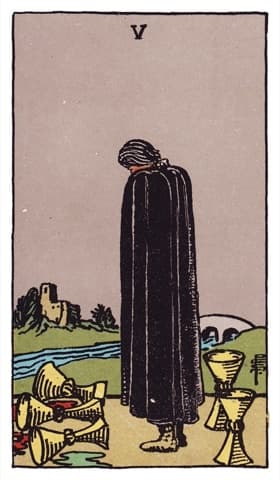
If you pulled the Five of Cups, you pulled the card of grief — but also the card of the two cups you're not looking at. Fives are the suit's crisis point, and Cups are the suit of emotion and connection, so the Five of Cups is the emotional low point: loss, disappointment, mourning, and the particular heaviness of regret.
But the card's real meaning isn't only in the loss. It's in where your attention goes. The figure in the image stands hunched over three spilled cups, so absorbed in what's gone that they haven't turned to see the two cups still upright behind them. What the Five of Cups actually puts in front of you is a question about focus: yes, something is lost — but is it everything? The grief is real. So are the two cups still standing.
What the picture is showing
The Five of Cups shows a cloaked figure, head bowed, gazing down at three cups that have tipped over and spilled their contents onto the ground. The posture is pure dejection — wrapped in a black cloak, turned inward, fixed on the loss. Behind the figure stand two more cups, still upright, still full. In the distance, a bridge crosses a river toward a house or castle: a way home, a path forward.
Look at what the figure can't see. The three spilled cups have all of their attention; the two full cups are behind them, out of the line of sight. The bridge and the home are there too, waiting. The image stages a precise emotional truth — that grief narrows your vision to what's been lost, while what remains, and the way forward, sit just outside the frame of your attention.
That's the whole card. The Five of Cups is grief, loss, and regret — and the reminder that focusing on what spilled can blind you to what's still standing.
What the Five of Cups actually means
When this card appears, it's usually pointing at one of three things. All of them live in the gap between what's lost and what remains.
Grief and disappointment
The most direct Five of Cups reading. A loss, a letdown, a hope that didn't come true. The card names the emotional weight of mourning — sadness over something that ended, fell short, or never arrived. Wherever it lands, there's something to grieve, and the card gives you permission to actually feel it rather than rush past.
Regret and dwelling on the past
This is the card's signature trap. The Five of Cups is the figure who can't stop staring at the spilled cups — replaying what went wrong, what they should have done, what might have been. Regret keeps the loss alive long after the event. The card names that fixation honestly, and gently points out the cost of it: while you're staring at the spill, the full cups go unseen.
What's still standing
The card has two upright cups for a reason, and they're the turn. The Five of Cups isn't only about loss — it's about the part of the picture grief edits out. Something remains: a relationship still alive, a chance still open, support still there. The card's deeper message is to turn around. The loss is real, but it isn't the whole of what you have.
How to read the Five of Cups in love
In a love reading, the Five of Cups is a card of emotional mourning. It points to disappointment, heartbreak, or regret about a relationship — grieving how something ended, sadness that a connection didn't become what you hoped, or carrying an old loss into the present. It can mark the period after a breakup when the grief is still heavy, or a current relationship clouded by focusing on what's gone wrong rather than what's still good.
Its medicine is the two cups. Often the Five of Cups in love is asking where your attention is: are you so fixed on the disappointment that you've stopped seeing the love still available — the partner still trying, the repair still possible, or the simple fact that one ending isn't the end of your capacity to love? It isn't a card that denies the loss. It's a card that asks you to grieve it honestly and turn around. Reversed, it usually means exactly that turn arriving: acceptance, forgiveness, and love becoming possible again once the mourning eases.
How to read the Five of Cups in career
At work, the Five of Cups often points to professional disappointment — a project that failed, a promotion that went elsewhere, a role that didn't work out, or regret over a path not taken. It can mark the slump after a setback, when the loss colors how you see everything, or a tendency to dwell on a mistake rather than salvage what's left of the situation.
Its counsel is the same as everywhere else: feel the disappointment, then count the cups still standing. The Five of Cups rarely means total professional ruin — it means a real loss that's currently absorbing all your attention. The skills, relationships, and options that survived the setback are the two upright cups, and the card is pointing you to turn toward them rather than stay bent over what spilled.
Reading this for a card you pulled?
Pull three cards free →The Five of Cups in combination
Five of Cups + Three of Swords
Grief and the heartbreak underneath it. The Three of Swords is the sharp wound — betrayal, rejection, the cut itself; the Five of Cups is the mourning that follows. Together they describe a real heartbreak and the grieving of it: first the blow, then the long, heavy sadness. A pairing that asks you to honor both the hurt and the slow work of recovering from it.
Five of Cups + Six of Cups
Loss turning toward memory and healing. The Five of Cups is grief; the Six of Cups is nostalgia, gentleness, and the comfort of the past. Together they often mark the softening of mourning into tender memory — grief that's beginning to settle into something you can hold without breaking. Sometimes they point to healing through reconnection, or finding comfort in what was good rather than only what was lost.
Five of Cups + Ten of Cups
What was lost against what's still possible. The Five of Cups is disappointment and grief; the Ten of Cups is emotional fulfillment, harmony, and a whole heart. Together they stage the card's core lesson in sharp relief: one cup spilled doesn't empty the whole picture. This pairing often points to lasting happiness on the other side of a current grief — the two full cups becoming ten once you turn around.
Five of Cups + Nine of Cups
The gap between what you grieve and what you wished for. The Five of Cups is loss and regret; the Nine of Cups is contentment and wishes fulfilled. Together they can mark the moment a disappointment makes you reassess what you actually want — or the reminder that a current grief isn't the final word on your contentment. Often this pair says: the spilled cup hurts, but your wish hasn't been canceled.
How to read the Five of Cups by position
| Position | What the Five of Cups usually means |
|---|---|
| Past | A loss or disappointment that shaped you — a grief you carried, a regret you sat in, that taught you something about mourning and moving on. It may still be coloring the present more than you realize. |
| Present | You may be in a season of grief or disappointment right now. The card asks where your attention is: honor the loss, but check whether you've turned to see the two cups still standing. |
| Future | A disappointment or loss may be ahead, or a period of mourning to move through. Forewarned, you can let yourself grieve without losing sight of what will remain. |
| Hopes / Fears | You may fear loss or being stuck in regret — or, read deeper, fear that grieving means you've lost everything. The two cups are the answer: a loss is real without being total. |
When the Five of Cups is genuinely hard
A few honest notes, because this card lives in real grief:
- When the loss is fresh. The Five of Cups doesn't rush you. If the grief is new, the two cups aren't a demand to "look on the bright side" before you're ready — they're just a quiet promise that they're there for when you are. Sometimes the only work the card asks is to feel the loss honestly. The turning-around comes later, on its own time.
- When regret has hardened into stuckness. The hardest version of this card is the grief that's become a home — the loss you keep returning to, the should-haves you can't put down. The Five of Cups reversed lives here, and its medicine is gentle: the mourning was real and necessary, but at some point staying bent over the spill costs you the cups that are still full.
- When what's still standing feels like too little. Sometimes the two cups genuinely feel small against the three that spilled. The card doesn't pretend the math is even. It only insists the two are real — and that turning toward them, even when they seem like not enough, is how the way home across that bridge becomes walkable again.
The bigger reframe
The Five of Cups looks like a card about loss — spilled cups, a bowed head, a black cloak. But the artist put two full cups in the frame on purpose, just outside the figure's line of sight. The card isn't only grieving the spill. It's showing you that grief edits your vision, cropping out what remains, and that the whole picture always has more in it than the loss.
That's the teaching, and it's kinder than it first looks: you are allowed to mourn what's gone, fully and without hurry — and the thing that's lost is almost never the whole of what you have. The Five of Cups puts three spilled cups in front of you and two full ones behind, and then it just waits — for the moment you're ready to turn around, see what's still standing, and notice the bridge home was there the whole time.
If you've pulled the Five of Cups and there's a loss you're sitting with, the free three-card draw on this site is built for exactly that. Pull two more cards around your Five of Cups: what you're grieving, what's still standing behind you, and what the way forward actually looks like.
Three cups spilled, two cups standing, a bridge in the distance. The card is just asking you to grieve honestly — and then to turn around.
Pull three cards on the loss you're carrying → What you're grieving. What's still standing. What the way forward looks like.