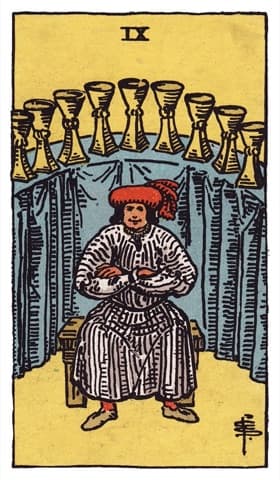
If you pulled the Nine of Cups, you pulled the card everyone secretly hopes for — the famous wish card of the tarot. A comfortable man sits on a wooden bench, arms crossed, a distinctly pleased expression on his face, while behind him nine golden cups stand arranged on a high curved shelf like trophies on display. He looks like a person whose ship came in. According to several centuries of fortune-telling tradition, that's exactly what the card means: your wish is granted.
Cups are the suit of emotion — love, feeling, connection, the heart's whole economy. And the Nine is the suit nearly complete: not the perfect family happiness of the Ten of Cups, but its more personal predecessor — individual satisfaction, the moment you sit back, look at what you wanted, and find it actually here. It's one of the most purely pleasant cards in the deck. The only thing it asks is whether you wished well.
What the picture is showing
The Nine of Cups shows a well-fed, well-dressed man seated on a plain wooden bench, arms folded across his chest, wearing an expression that's half smile, half satisfaction — the look of someone who has eaten well and knows there's more. Behind and above him, on a curved shelf draped in blue cloth, stand nine golden cups in a neat arc, displayed like the winnings they are. The arrangement is theatrical, almost a tavern's trophy wall; he sits beneath his abundance like a host presiding over a feast that hasn't started yet.
Three details carry the meaning. The crossed arms and contented face: satisfaction owned and enjoyed — this is what enough, and a little more feels like in the body. The nine cups on display: emotional wealth accumulated and arranged; wishes not pending but fulfilled, lined up where everyone can see them. And the small detail readers love: the bench is plain wood while the shelf is draped in finery — the pleasure is real, but notice it's been staged a little, set up for viewing. Satisfaction and the display of satisfaction sit very close together in this image, and the card knows it.
That's the whole card. The Nine of Cups is the wish fulfilled — genuine satisfaction, earned pleasure, the heart's harvest enjoyed — with one sly question tucked under the bench: is this happiness, or the picture of it?
What the Nine of Cups actually means
When this card appears, it's usually pointing at one of three things. All of them concern desire and its fulfillment.
The wish granted
The card's headline, and the reason for its fame. In traditional readings, the Nine of Cups appearing meant the querent's wish — the specific, held-in-mind wish — would come true. Modern readers keep a humbler version: when this card shows up, what you want is close, conditions favor you, and the emotional outcome you're hoping for is genuinely available. For yes-or-no questions it's among the deck's clearest yeses (our yes-or-no guide ranks it near the top). When the Nine of Cups lands in a spread about something you're longing for, take it at face value first: the deck is saying yes, this can be yours.
Satisfaction — the real thing
Beneath the fortune-telling glitter, the card describes a state worth more than any granted wish: actual contentment. The Nine of Cups is the feeling of enough — the project completed and enjoyed, the body comfortable, the heart genuinely pleased with its life. It often appears to mark or promise such a season, and sometimes to issue an instruction the driven personality needs: stop achieving for one evening and enjoy something. Sit on the bench. Look at your cups. This, the card says, was the point of all that effort — and skipping the enjoyment step is a stranger habit than it sounds.
Pleasure, and its fine print
The Nine of Cups is also the tarot's card of sensual pleasure — good food, good wine, comfort, indulgence, the body's honest delights. It blesses them without embarrassment; this is not a card that thinks enjoyment needs justifying. But it carries the classic fine print in its sleeve: be careful what you wish for. Pleasure mistaken for fulfillment, indulgence sliding into excess, the wish that came true and changed nothing — these are the card's reversed faces. The man has nine cups and a slightly smug smile; the card lets you decide, every time it appears, whether he's deeply happy or just well-stocked.
How to read the Nine of Cups in love
In a love reading, the Nine of Cups is close to the happiest single card you can pull. For couples, it describes a relationship in a genuinely good season — emotionally satisfying, affectionate, fun, the kind of stretch where you catch yourself thinking this is what I wanted. For singles, it's the wish card doing its classic work: the romantic hope you're carrying is favored, the connection you're wondering about has real promise, the season ahead holds pleasure rather than struggle. Questions asked in longing tend to get this card as a warm yes.
Its caution, gentle but worth hearing, is the gap between satisfaction and depth. A relationship can be thoroughly pleasant — comfortable, well-fed, enjoyable — while its deeper intimacy quietly idles; contentment can become the very thing that stops two people from ever going further. And the card's staged-display quality has a love-reading echo too: the couple that looks happy, posts happy, performs happy, while the real feeling thins underneath. Reversed, the Nine of Cups names that hollowness — having the relationship you said you wanted and feeling strangely unfilled by it. The remedy is the card's own deeper teaching: wish better. Not for the picture of love, but for the thing itself — and when you have the thing itself, sit down and actually enjoy it, which is the one part of love no one can perform.
How to read the Nine of Cups in career
At work, the Nine of Cups marks the satisfaction milestones — the goal reached, the launch that landed, the recognition arriving, the season where work actually feels good. It often appears when a professional wish is within reach: the role you've been angling for, the project you've been pitching, the number you've been chasing. As in love, take the encouragement at face value first: conditions favor you, and the outcome you want is achievable. It's also the card of enjoying success — the dinner after the deal, the bonus actually spent on something delightful — and it appears, pointedly, for people who hit every target and never celebrate any of them.
Its career caution is complacency. The man on the bench isn't building anything; nine cups can become a reason to stop at nine, and a comfortable role can hold someone years past the point it stopped growing them. The smug version of this card is the colleague coasting on past wins, the company admiring its own trophy shelf while the market moves. And the wish-fulfillment theme cuts sharply in career readings: people are exceptionally good at wishing for the wrong professional things — the title that impresses, the salary that signals — and the reversed Nine of Cups is what getting those feels like. The card's standing advice: before you chase the wish, check it's yours and not the audience's. Then chase it, win it, and take the evening off when you do.
Reading this for a card you pulled?
Pull three cards free →The Nine of Cups in combination
Nine of Cups + Ten of Cups
Personal satisfaction opening into shared joy. The Nine is my wish granted — the individual contentment of the man on his bench; the Ten of Cups is happiness that includes everyone under the rainbow. Together they trace the heart's best trajectory: getting what you wanted, then discovering it's better shared. One of the warmest pairings in the deck for love and family questions — fulfillment now, and deepening from here.
Nine of Cups + Three of Cups
The wish granted and the party thrown. The Three of Cups is celebration, friendship, the raised glasses; the Nine is the satisfaction worth raising them to. Together they're pure festivity — good news arriving and being properly enjoyed, a season of pleasure shared with the people who were rooting for you. If your question was whether the good thing is coming: it is, and apparently so is the toast.
Nine of Cups + Ace of Cups
Fulfillment and fresh feeling at once. The Ace of Cups is the new emotional beginning — love, joy, the heart refilling; the Nine is desire already satisfied. Together they often mean a wish about the heart specifically is being granted: new love arriving for the single, renewal arriving for the settled, or a creative and emotional season where what begins now goes well. The pairing reads almost like permission: want it, begin it, enjoy it.
Nine of Cups + The Devil
Pleasure's two faces, side by side. The Nine blesses enjoyment; The Devil is what enjoyment becomes when it owns you — indulgence hardened into chain. Together they sharpen the Nine's fine print into a real question: is this satisfaction or appetite, celebration or habit? The pairing often appears around overindulgence, or wishes whose granting would cost more than they give. It doesn't forbid the pleasure. It asks who's holding the cup — you, or it.
How to read the Nine of Cups by position
| Position | What the Nine of Cups usually means |
|---|---|
| Past | A wish already granted that shaped the present — success enjoyed, a satisfying season behind you, or comfort that became your baseline (and perhaps your blind spot). |
| Present | Satisfaction is here or within reach — enjoy it deliberately. If something's being wished for right now, conditions favor it. Sit on the bench; you've earned the view. |
| Future | The classic placement: the wish moves toward fulfillment. What you're hoping for is favored. The card's only ask — make sure it's the real wish before it arrives. |
| Hopes / Fears | The most literal corner for this card: the wish itself, named. You want the satisfaction, the pleasure, the granted hope — or you fear that getting it still won't be enough. |
When the Nine of Cups is genuinely hard
A few honest notes, because even the wish card has its weather:
- When the wish comes true and nothing happens. The card's deepest sting is reserved for accurate wishes, inaccurately chosen — the achievement that was supposed to change how life felt and didn't, the granted hope that left the same hollow it was meant to fill. This is the reversed Nine's signature experience, and it's genuinely disorienting: you did everything right and won. The work it points to isn't harder wanting. It's better wanting — desires chosen by the self that has to live in them, not the self that imagined the applause.
- When contentment closes the door. Satisfaction is lovely and slightly sedative. Nine cups can quietly become the argument against the tenth — the comfortable life that stops reaching, the pleasant relationship that stops deepening, the good-enough that politely strangles the better. If this card keeps appearing while something in you stays restless, read the restlessness too. The bench is a fine place to rest. It's a poor place to live.
- When the display replaces the feeling. The cups are on a shelf, arranged for viewing — and some satisfaction is exactly that: arranged for viewing. The performed happiness, the trophy life, the smile crossed-armed against any closer inspection. The card turns hard when you realize the audience believes the display and you don't. The way back is unglamorous and real: one genuine pleasure, enjoyed privately, with nobody watching. That's the cup that counts.
The bigger reframe
The Nine of Cups is a man sitting in front of everything he wished for, and the card's centuries-old promise — your wish will be granted — turns out to be its opening line, not its conclusion. Because the image keeps asking a question long after the fortune is told: granted, and then what? The man has his cups. The deck never shows him drinking from them.
That's the teaching, and it's kinder than it first sounds. The Nine of Cups isn't warning you off wanting — it's the most pro-pleasure card in the tarot, and when it appears, the honest first reading is the happy one: what you want is close; enjoy your life, you're allowed. But it adds the one instruction that makes granted wishes worth having: be present for the satisfaction. Drink from the cups instead of arranging them. Want things your actual heart wants, not things your imagined audience admires. And when the wish lands — this card says it will — don't immediately replace it with the next one. Sit down. Cross your arms. Smile like the man on the bench, for one whole evening, at the specific life you asked for and got.
If you've pulled the Nine of Cups and you're holding a wish — or holding a satisfaction you're not sure is the real thing — the free three-card draw on this site can help you read it. Pull two more cards around your Nine of Cups: what the wish is really for, what fulfilling it asks of you, and what to enjoy right now while it's on its way.
Nine golden cups on a shelf, a bench, a satisfied smile. The card is the deck's granted wish — and its gentle reminder to be there when it arrives.
Pull three cards on your wish → What it's really for. What it asks of you. What to enjoy while it's on its way.