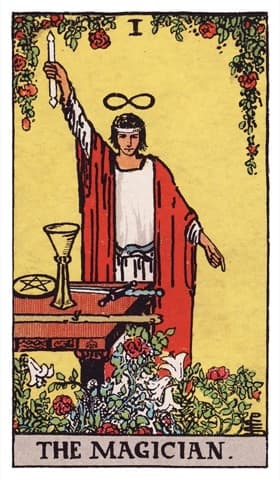
The Magician reversed is widely read as "manipulation," which is one real version and not the most common. The more useful question is whether the tools are idle, or pointed at the wrong surface.
This is a different card from the High Priestess reversed. She is unused knowing. He is unused doing. Fog versus idle hands. If you already know and will not act, that is her page. If you could act and are not, this is his.
Upright first: the kit is already on the table
The Magician stands with one hand up and one down, the four suit emblems in front of him — wand, cup, sword, pentacle. The image is not a miracle. It is a workbench. Upright says: the next thing you need is not another resource. It is use.
That is why the card is more demanding than the manifestation slogan. "You have everything you need" is not comfort. It removes the alibi.
Reversed, the workbench is still there. The current is not.
Reading one: the tools stay on the table
The most common version, and the one people recognise once it is named.
You can do the thing. You have done a smaller version of it before. The email is drafted. The skill is not theoretical. And the week ends with the same objects still sitting there.
This is not confusion. It is unused capacity. Four of Cups nearby usually confirms the refusal dressed as apathy. Two of Wands nearby confirms the plan that never leaves the window.
The Fool reversed is the neighbour when the problem is still the first step. The Magician reversed assumes the first step already happened — you have the kit — and the work after it has stalled.
Reading two: the tools are being used on someone else
The search-result version. Charm, framing, a story that is slightly ahead of the facts.
A colleague who is excellent in meetings and thin in the work. A partner who is articulate about the relationship and unreliable inside it. You, putting more craft into how a thing looks than into the thing.
The tell is audience. The upright Magician's audience is the result. Reversed, the audience is a person. Seven of Swords nearby is almost a confirmation. the Devil nearby means the performance has become the attachment.
This reading is uncomfortable when it is about you. It is also the one that gets over-applied to other people, because it is more dramatic than "you have not opened the file." Check the idle-tools reading first.
Reading three: all four emblems, none finished
The scattered version. You pick everything up. You put everything down. The table looks busy. Nothing crosses the line into done.
A week of six half-starts. A creative life that is all ignition. A job search that is research, not applications.
This still is the Magician. The function — focused will through one channel — is missing. Seven of Cups is the haze version. Eight of Wands reversed nearby can mean speed without a single destination.
The Emperor reversed sits next to this when the missing piece is a constraint: one deadline, one project, one no. The Magician without a wall becomes a demonstration.
Reading this for a card you pulled?
Pull three cards free →The test
Are the tools unused, aimed at an audience, or aimed at too many things?
| What it feels like | Reading | The move |
|---|---|---|
| You can name the next action and have not done it | Idle | Do that one action. Not a plan for it. The action. |
| More craft is going into the story than into the work | Aimed at someone | Stop explaining. Produce the thing that would make the explanation unnecessary. |
| Five things are open and none would survive a Friday | Scattered | Close four. Finish one ugly version of the fifth. |
These need different responses. Adding more ideas to an idle bench produces theatre. Adding more discipline to a manipulation problem without changing the audience produces a more polished performance. If you cannot tell which you are in, ask who the work is for. If the honest answer is "so they can see," you are in reading two.
The Magician reversed in love
Usually not "they are a narcissist." More often: competence is being used as atmosphere.
Someone who knows how to start a conversation and does not know how to stay in one. Mixed signals that are not mysterious — they are unmanaged. Or you, who already know how to send the message, and are workshopping the wording into the ground instead.
If the question is whether to trust the surface, should I trust him is the decision page. If the question is whether they want anything specific, what does he want from me is closer. This card is the diagnostic: is there unused capacity in the connection, or is the capacity being spent on the impression?
The Magician reversed at work
The unused-skill version is the most expensive, because it looks like humility. You stay in a role below what you can already do, and call it not being ready. Ready is the Magician's least interesting metric. Use is the metric.
The performance version is the meeting that goes well and the document that never ships. If the question is whether to leave, should I quit my job and will I be successful are the larger frames. This reversal asks whether the problem is talent or current.
The honest part
No card knows whether you are idle, performing, or scattered. Reversals are a convention. Plenty of readers never use them.
What this one is good for: it refuses the lazy story that you need more resources, or that someone else is simply "fake." The upright claim is still in force — the kit is there. The useful question is what the kit is pointed at. If it is pointed at nothing, pick it up. If it is pointed at an audience, turn it toward the result. If it is pointed at everything, close four loops.
Read it as reflection, and pick a use before you pick a new tool.
Where to go next
- The Magician (upright) → — the full card meaning.
- The Fool reversed → — when the problem is still the first step, not the tools.
- The High Priestess reversed → — when the unused thing is knowing, not doing.
- All 78 reversed meanings → — the full reference.
Pulled the Magician reversed? Pull a free 3-card spread → and ask what the tools are actually pointed at.