If you pulled the Hierophant and looked it up, you probably found the least exciting card descriptions in the whole deck: religion, tradition, conformity, institutions. It's the card people quietly hope they didn't draw, because it sounds like being told to follow the rules.
That reading isn't wrong, but it's shallow — and it misses what makes the Hierophant genuinely interesting. This is the card of your relationship to established systems: tradition, mentorship, shared belief, the accumulated wisdom of people who came before you. And your relationship to those things is rarely simple. The Hierophant isn't just "obey." It's "what do you do with what you've been handed?"
What the picture is showing
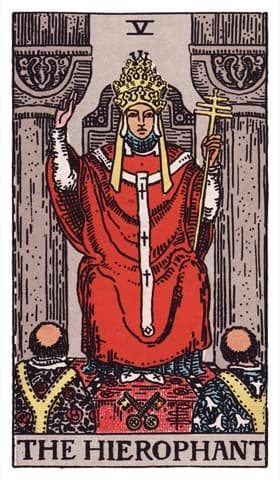
The Hierophant shows a religious figure seated between two pillars, wearing a triple crown, one hand raised in blessing, the other holding a staff. Two followers kneel before him. At his feet are two crossed keys.
Look at the details. The two pillars echo the High Priestess's — but where she sits between them guarding a hidden mystery, the Hierophant sits between them to teach openly. The followers receive knowledge through him — tradition passed down, person to person. The crossed keys are the giveaway: keys unlock things. The Hierophant holds access to knowledge — and a key can open a door or keep it locked, depending on who's holding it.
That's the whole card. The Hierophant is the keeper and transmitter of established wisdom — the bridge between the individual and the tradition.
What the Hierophant actually means
When this card appears, it's usually pointing at one of three things. Notice none of them are simply "do what you're told."
Learning through an established path
The most common Hierophant reading. There's a tradition, a system, a body of knowledge — and the card suggests working within it rather than reinventing the wheel. A mentor, a teacher, an institution, a proven method. Sometimes the wise move genuinely is to learn the rules before you break them. The Hierophant is the card of apprenticeship.
Tradition, ritual, and belonging
The Hierophant often draws around shared structures — marriage, religious practice, formal commitments, cultural traditions, the institutions people organize their lives around. It can mark a moment of joining something larger than yourself: a community, a belief system, a formal bond.
The question of conformity
The Hierophant's sharpest edge. It asks: what's your relationship to the rules? Sometimes the card endorses the established way. But just as often it's holding up a mirror — are you following this tradition because you believe in it, or because it's easier than questioning it? The keys can lock as well as open.
How to read the Hierophant in love
In a relationship reading, the Hierophant often points at commitment in a traditional or formal sense — marriage, long-term partnership, the conventional milestones. It can signal a relationship built on shared values and stable structure, or a relationship moving toward a formal commitment. It tends to favor the conventional, the lasting, the institutionally recognized.
The other reading: a relationship operating by inherited rules — expectations about how things "should" be done, roles handed down rather than chosen. Poorly aspected, the Hierophant in love can ask whether you're following a script (what a relationship is "supposed" to look like) rather than building what actually fits the two of you.
How to read the Hierophant in career
At work, the Hierophant often relates to institutions, established structures, mentorship, and conventional paths. It can mean learning from someone more experienced, working within a traditional organization, pursuing formal credentials, or following an established route to your goal. It generally favors the proven path over the maverick one — gaining mastery within a system before striking out.
The cautionary version: an environment heavy on hierarchy and "the way it's always been done," where the question becomes whether the structure serves you or just contains you. The Hierophant doesn't always say conform — sometimes it's naming the system so you can decide your relationship to it consciously.
Reading this for a card you pulled?
Pull three cards free →The Hierophant in combination
The Hierophant + The Lovers
A classic and meaningful pairing. The Hierophant is tradition and formal commitment; the Lovers is conscious choice and authentic connection. Together they often describe the tension or union between what's expected and what you actually choose — a commitment that's both traditional and genuinely chosen, or a moment of deciding whether to follow the conventional path or your own heart. One of the richest pairings for relationship readings.
The Hierophant + The High Priestess
Two cards of knowledge, pointing opposite ways. The Hierophant is outer, institutional, taught-aloud wisdom; the High Priestess is inner, intuitive, hidden knowing. Together they ask where your real guidance should come from right now — the established teaching or your own quiet intuition. Often the answer is that you've been over-relying on one and need the other.
The Hierophant + Justice
Tradition meeting fairness. The Hierophant is established rules; Justice is the honest weighing of cause and effect. Together they often describe a situation governed by formal systems — legal, institutional, contractual — where the established structure and a fair accounting both apply. Working within the rules, and being held to them.
The Hierophant + Strength
Established authority meeting inner mastery. The Hierophant is power that comes from position and tradition; Strength is power that comes from within. Together they can describe learning to trust your own quiet authority alongside (or instead of) external validation — the move from needing the institution's approval to carrying your own.
How to read the Hierophant by position
| Position | What the Hierophant usually means |
|---|---|
| Past | A tradition, teacher, or institution that shaped you — values or structures you inherited and built on. |
| Present | A question of how you relate to an established system right now — whether to work within it, learn from it, or consciously question it. |
| Future | An established path, formal commitment, or mentorship is coming. The card suggests the conventional route has something to offer here. |
| Hopes / Fears | You hope for belonging, structure, or guidance from something larger, OR you fear being boxed in by conformity and other people's rules. |
When the Hierophant is genuinely hard
A few honest cases where this card asks more than the simple "follow tradition" reading:
- When the tradition doesn't fit you. The Hierophant favors established paths, but not every established path is right for every person. Drawn by someone the system has failed or excluded, the card isn't saying "conform anyway." It's naming the system clearly so you can decide your relationship to it with open eyes — including the choice to leave it.
- When following is avoidance. The Hierophant's shadow is using "this is how it's done" to avoid the harder work of figuring out what you actually believe. Read alongside cards of individuality or choice, it can be a gentle challenge: are you following because you've examined this and agree, or because examining it is uncomfortable?
- When you're the Hierophant. Sometimes the card is pointing at you as the holder of the keys — the mentor, the one transmitting tradition, the keeper of how things are done. The honest question then: are you using the keys to open doors for people, or to keep them where you are?
The bigger reframe
The Hierophant looks like the most conservative card in the deck, and people read it as a flat instruction to conform. But the crossed keys at his feet tell a subtler story. Tradition is a set of keys — accumulated wisdom that can unlock real doors. But a key can also lock. The Hierophant isn't asking you to blindly obey or blindly rebel. It's asking you to hold the keys consciously.
The wise relationship to tradition isn't worship or rejection. It's the apprentice's path: learn the system deeply enough to understand why it exists, and then decide — with real knowledge rather than reflex — what to keep, what to question, and what to pass on. That's a far more demanding card than "follow the rules."
If you've pulled the Hierophant and there's a system, tradition, or expectation you're wrestling with, the free three-card draw on this site is built for exactly that. Pull two more cards around your Hierophant: what the tradition offers, what it costs, and what your conscious relationship to it should be.
The keys open and the keys lock. The card just asks whose hand is on them.
Pull three cards on the tradition you're weighing → What the established path offers. What it asks you to give up. The conscious choice underneath.